I know that Wales has some of the best biking roads in the UK. I therefore think that a tour around the country is well worth my time and energy. Wales not only has some of the best biking roads, but it also rains regardless of the season. Spring and summer should in theory bring decent weather. If you decide that wet weather is not for you, then the window of opportunity for a decent tour gets shorter. Two bikers from the far West of Cornwall, somewhere else that is no stranger to rain, decide that November is just fine. As long as there is no hail, ice, snow, or a howling gale, then heading up for a three-day tour would be perfect. This story is our story of that trip. Indeed rain and mist showed up, but that is all part of the experience. We had a fantastic time and will definitely not let weather or time of year be a natural barrier to biking. I love riding in dry sunny conditions, but this trip taught me that rain is more than just ok, it doesn’t stop the enjoyment one bit. Cymru am byth!
“When the rain comes…”.
For many motorcyclists, there is a season. In practice, the motorcycling season starts when the weather improves and ends when it doesn’t. In Britain, that means no one knows exactly when it starts or how long the season is, beyond knowing that the three winter months might be very cold, extremely wet or mildly dangerous. If we limit our riding to when the conditions are dry and sunny, then we can look forward to long periods of inactivity. This will result in drinking more beer than we should and sitting in an armchair watching Strictly Come Dancing while simultaneously weeping for the lost years of youthful recklessness.
I was watching the raindrops dribble down the kitchen window like a race of pearlescent snails leaving a trail of water behind them, and realised that rain is just a fact of life. I resolved there and then to go riding despite inclement weather conditions. The calendar on the kitchen wall said it was October. The sun had got his hat on, packed his bags and was on a flight to Tenerife and would not be seen again until about April. I know this because he has packed a few Jilly Cooper novels, indicating his absence will be lengthy.
There was only one choice to make now, and that was to take advantage of ice and snow-free roads in November and head up to Wales before hell broke loose. It will rain, but I will not care. I will test my wet weather gear to the limit. I know it will rain because…it will be Wales; a country renowned for its ‘green green grass of home’ and we all know that green grass requires water. Lots of it. We also know Wales is wet because its geography of hills, valleys and mountains were carved out by water over millennia. No amount of wishful thinking or close harmony singing alters these basic facts.
What follows is a personal reflection on a few days away with Marcus – my sister’s eldest son now in his latter decades but a good 15 years or so younger than me. To say he is a ‘nephew’ sounds a bit inappropriate as that word brings to mind a tousled-haired schoolboy with an ice cream cone instead of a potty-mouthed hairy-arsed biker intent on shenanigans and beer.
The Plan
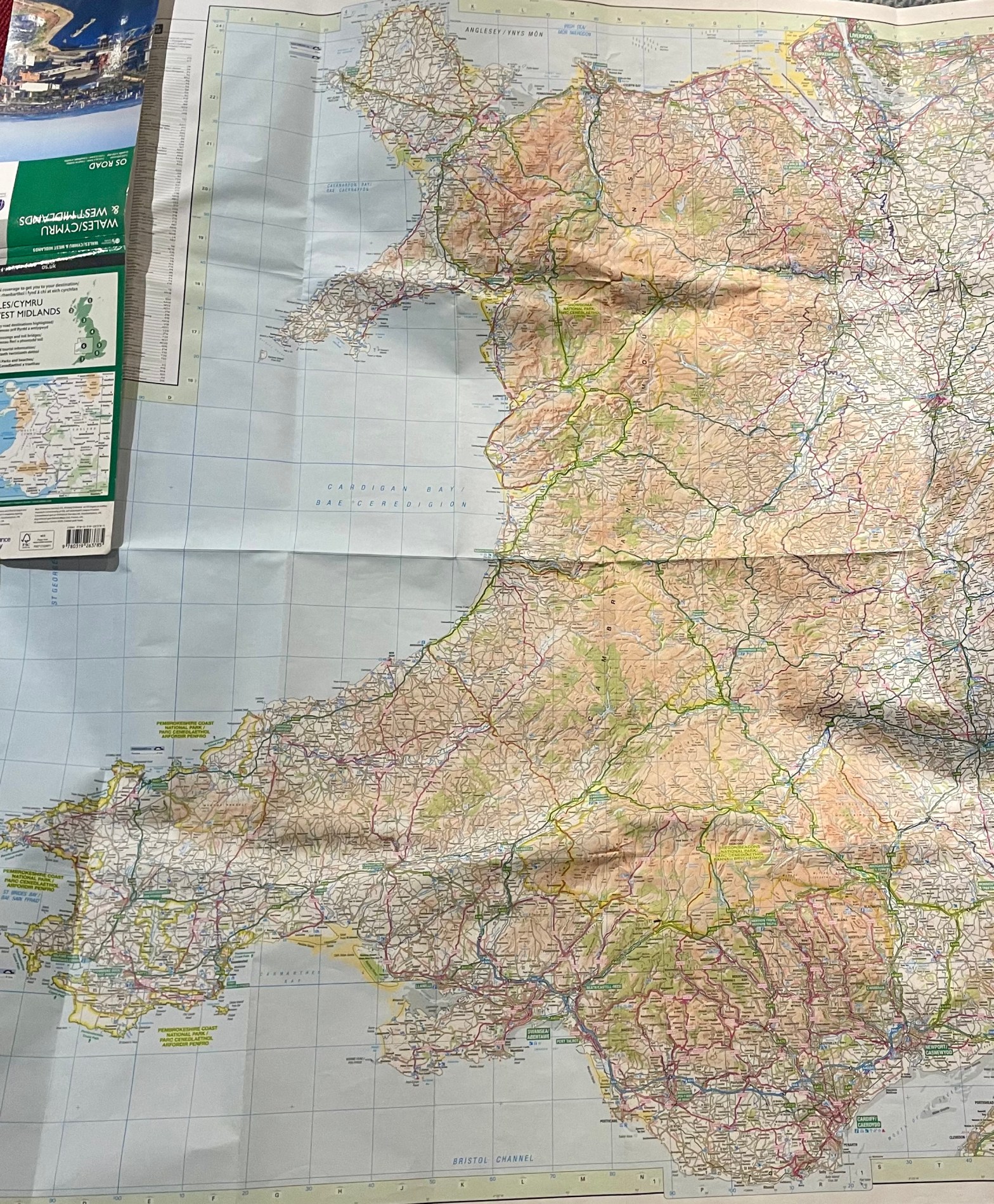
The plan was pretty simple…ride to Abergavenny for Day 1 from West Cornwall, then up north to Betys y Coed in the Eryri National Park for Day 2 and back south to Cowbridge (west of Cardiff) on Day 3. The last day would be for the return leg back down to home. In all that would be the best part of 800 miles, regardless of weather conditions.
The bikes? Marcus has a BMW R1200 GSA – while I have its little sister a BMW F750 GST. For most non-bikers, those letters and numbers will make as much sense as the recipe for a Victoria Sponge written in Egyptian Hieroglyphics. The most important thing about them is that they were designed to be out in the open in any weather. Some call them ‘adventure’ bikes which sounds a bit grand. Given the road conditions and the often poor quality of other road users’ driving, the term ‘adventure’ might not be misplaced.
We pre-booked accommodation to prevent arriving in an unknown town in the dark, searching for accommodation while cold, wet, thirsty and irritable. The criteria, apart from a warm bed, were ease of access to beer, dinner, secure parking and bonhomie. A log fire would be an additional bonus. We would not welcome Hen or Stag parties turning up in our cosy pubs and bars. The likelihood, in November in rural Wales, of a crowd of young enthusiasts wearing inflatable penises or fake boobs singing songs about the size of the groom’s balls or the bride’s propensity for prosecco-induced vomiting, is very small. Abergavenny is not Dublin, Newquay or Newcastle.
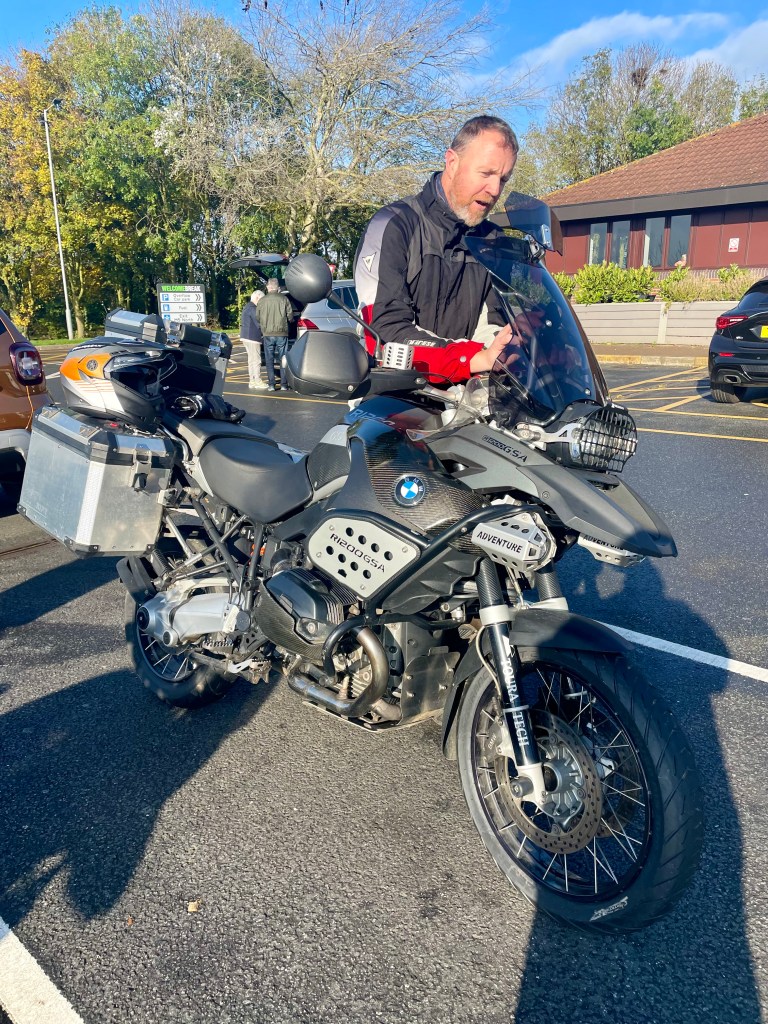
Marcus checks his bank account, after filling his tank with petrol.
The Trip Day 1
Smokey Joe’s to Abergavenny.
The sun had hardly edged over the horizon at six thirty in the morning, and in any case, I would not have seen it due to the veil of grey cloud stretching from the mid-Atlantic towards Norway. We had planned an early start to ensure we did not arrive in darkness in Wales and so I crawled out of bed, made a cup of tea, washed the sleep from out of my eyes, and farted. So far, so usual. I had thirty minutes or so to get fully kitted up for the bike in cold weather, then to head off from St Ives up the A30 for 20 miles for breakfast.
Smokey Joe’s at Scorrier has been around for as long as I can remember. It is a cafe and truck stop focusing on providing all-day ‘trucker’ breakfasts and heart disease. It should be bought by the National Trust and saved for the nation. The bungalow-style single-story building is now painted purple. The decor and furniture are probably the original from 1970, so it is just perfect. The road outside many years ago would have been the main A30 to London and has served hungry drivers for as long as there have been cars, vans, trucks and hedgehogs for them to run over. I arrive shortly after seven, the tyres on the bike crackling on the gravel car park surface. Marcus is already inside.
Breakfast
It is illegal to begin any trip from Cornwall on a motorcycle and miss out on the big breakfast served here. The full English comes in three sizes: standard, large and the hungryman’s. I’d actually like to meet the hungry man who can eat this two thousand calorie heart stopper. According to the staff, some chaps eat two of these on one plate and have a pudding, for breakfast. Unless you are a scaffolder, a builders labourer or a midwife, there is no way you are going to use enough calories to burn this baby off.
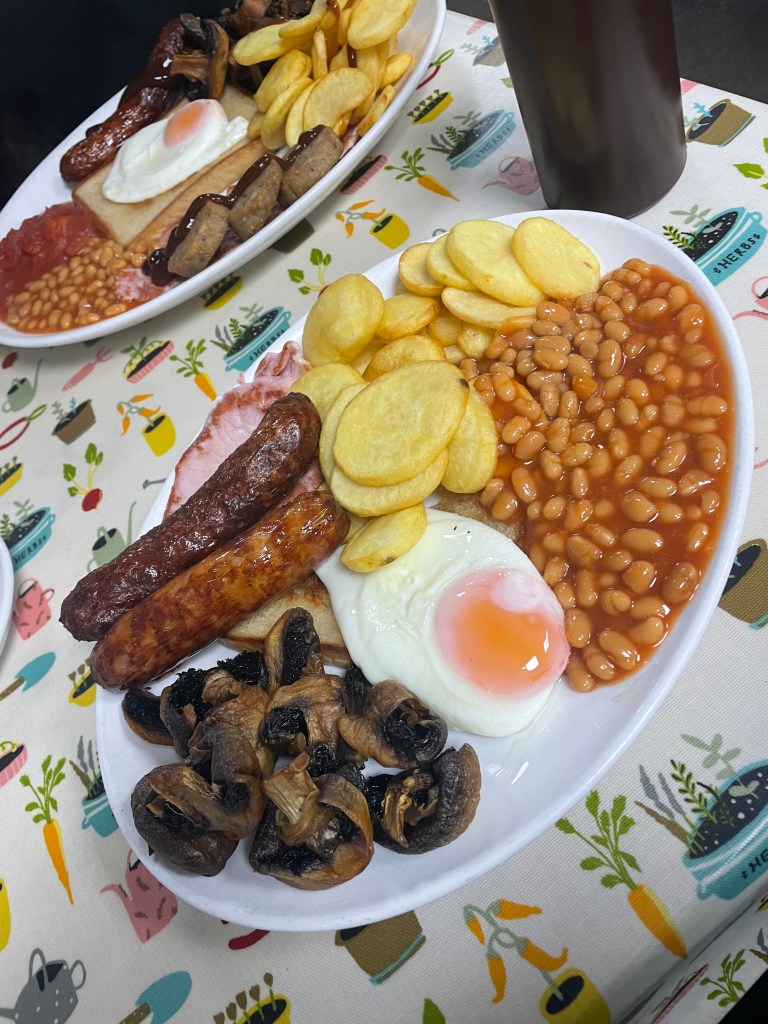
This is the ‘standard’ breakfast at Smokey Joe’s – the smallest offering.
I foolishly asked for an extra sausage, which of course is overkill, akin to building the Forth Bridge across a village duck pond. I like a sausage, they are God’s gift to humanity. And yet, on this occasion, I might have let Ambition triumph over Reason.
On the sixth day after creating light and other bits, God saw that it was good and created a sausage for his breakfast for the seventh day. This is why the Jews were told not to eat pigs, not because they were ‘unclean’ but because God was the original ‘hungry man’ and wanted to keep the sausages for himself. But after the flood, God (because he was also an Englishman) must have relented and given the recipe for full English with sausage to all, except Muslims and the French.
Crisp bacon, two sausages and sliced fried potato languished beside the milky white and yellow yoked fried egg and toast. Beans mingled alongside as a counterpoint to the fried mushrooms, the steam gently rising to disappear into the room. I am not sure my body is totally ready for this onslaught. And so it proved, as after two sausages and half a slice of bacon, I was pretty much done. The only thing I could manage was to suck on a few beans and lick the egg dry. This is just as well because the only energy I’m about to expend is staying upright on a motorcycle for 5 hours or more.
As we pay up at the till, I notice the cake offering.
Cake? This is the point at which I discover that there are hungry men out there who would laugh in my face at my paltry attempt at breakfast. These men, now abed, will feel themselves accursed they were not here and will hold their manhood cheap while I speak of sausage. If I outlive this day and come home safe, I will stand upright at the name of Smokey Joe’s and remember that we few, we happy few, we band of brothers survived the ‘standard’. Whether we will survive the journey without a brisk six-minute run to the loo when we get our five-minute warnings is yet to be seen.
Bike Comfort
I have realised that my old age is ‘raging against the dying of the light’ in subtle as well as noticeable ways. Time was that a big breakfast was no obstacle, but now it feels like my stomach has shrunk to the size of a wrinkled walnut, which incidentally is what my testicles will look like by five pm this evening. I have put in as much preparation for motorcycling comfort as I would have done in planning the D-Day landings. The bike came equipped with heated grips and hand guards. I thought this was an affection on behalf of BMW. Who needs heated grips? I have also bought an orthopaedic grade gel seat pad. Previous experience on my first ride on the Bike down from Exeter last summer taught me the wisdom of an old adage I picked up while trekking in the mountains in Nepal.
“If you look after your ring, your ring will look after you”.
There are fewer curses to endure that can match the severity of a sore arse after hours on a bike. Well, perhaps a newly erupted syphilitic wart on the perineum or a Guinness and Vindaloo-induced rapid and loose bowel movement on a slow bumpy bus crowded with goats, chickens and pungent body odours in India. Our first day will test the gel pad to destruction. You may laugh or scorn at such attention to detail but until you’ve experienced the utter misery of botty rash, you simply cannot understand the degree of Purgatory suffered.
Biking Communication.
We set off in the dry, and relatively warm, the temperature is coming up to around 11 degrees, and our journey is about 230 miles. Marcus and I have invested in a bike-to-bike intercom so that we can communicate without having to stop or flash headlights. This comes in really handy when warning each other, for example, about a fast car trying to muscle past in the fast lane. There is a term for this phenomenon, of a driver safe in his metal cage while not giving a devil’s toss about other road users. We use it often in the next few days. Normal folk may say to the lead biker: ‘Take care, a car coming up fast in lane 2/3‘. That is a perfectly good phrase and conveys the meaning clearly and concisely.
We are not normal folk.
We have our own special term which means exactly the same thing, the acronym for which is “watch out for the ‘CUYA“. You work it out. I think the private nature of the intercom allows us to inhabit a bubble of profanity. Safe in the knowledge that no one else can hear us we can relax, eat up the miles and use what the Readers’s Digest used to call ‘picturesque speech’. We adopt the vernacular of the gutter, in which troopers, sailors, and Prince Philip, have dipped their toes.
Having turned on the heated grips, I remark to Marcus up ahead, that the heating on a bike actually is a great addition in colder weather. The term for this experience, I learn from Marcus, is that “it’s like having a hot cock in each hand”. From that point, we refer to the heated grip switch as the ‘HC switch’. BMW should be told. I have to imagine what having two hot cocks feels like, after all, I’ve only ever held one. The female readers of this piece are free to leave a comment regarding the number of male members they have held at any one time, as indeed any gender, sex, them/they/it can also do. I don’t want to sound exclusive as I know that holding a cock is not the preserve of women.
After about three hours and 173 miles of carefree biking, apart from a few ‘CUYAs’ we need a stop at Sedgemoor Services. The gel pad is doing its job of keeping me comfortable. Usually, 2 hours or less is the limit on a bike before one needs a leg stretcher. Yet these bikes have a fantastic range in the tanks so fuelling up is not an issue. It’s almost as if someone designed these bikes for just such adventures?
Sedgemoor Services to Tintern Abbey
At some point, the sun begins to shine. There is a blue sky overhead and a dry road leading onwards. Most road users are behaving themselves. The second Severn Bridge is now toll-free, and today is wind-free. We glide high above the river with glimpses of the nuclear power station on the north somerset coast to our right. I’m told that at night there is a sub-radioactive orange glow emanating from the site and that the construction workers are losing their hair, their sperm count and their hope. The men are not doing too well either. Observers from Chernobyl have arrived and have been employed as consultants to ensure that the Chinese-owned company using migrant workers don’t cut corners. We can rest in peace knowing that the nuclear risk to human health is negligible. As long as we supervise the site for the next 100,000 years, everything will be fine.
Sex, Money and Power
Once you cross the Severn, the opportunity beckons to follow the Wye Valley up from Chepstow and on through Tintern towards Monmouth. From Sedgemoor, it is only about 50 miles to the ruins of the Abbey at Tintern. The valley road, especially at this time of year, is one of the most scenic. The leaves are flame-red, blood orange, chestnut brown and yellow ochre while the road weaves beneath the canopy and the open sky below them. There is very little traffic. In many places, we are ‘the traffic’.
The ruins of the Abbey soon come into view to our left, and as the sky is being kind, we stop for a coffee and a piece of cake. The visitor car park is pretty empty allowing peace to descend. The Abbey is undergoing major structural work – ironic, as it is a ruin – and has a wall of scaffolding. It now looks like they are repairing the roof. The Abbey was ‘dissolved’ in 1536 as part of King Fat Henry The Bastard’s quest to pursue Ann Boleyn. The Church of Rome didn’t approve of Fat Henry 8th’s shenanigans as he was already married. Henry was not a King to be trifled with, and so because of his inability to keep his trousers on, he initiated one of the most momentous events in English history, the consequences of which can’t be underestimated. He told the Pope that his position as head of the church was no longer viable and instead, he, Henry, would become head of the church.
Money was involved and so the Catholic monasteries were the next target as part of the break with the Pope. This tactic was to suppress Catholic opposition, steal the wealth of the monasteries and allow Henry legitimate access to the knickers of Ann Boleyn.
Sex. Money. Power.
Henry was an early disrupter and ‘pussy grabber’ (and not the only one) and possibly a role model for the likes of Donald Trump and Boris Johnson? According to some accounts, Henry was found wanting in the trouser department, and according to one of his wives, having sex was like being slobbered over by a Mastiff. I can’t help but think all the power posturing was compensation for a small willy he couldn’t control or know how to use.
On September 3, 1536, Abbot Wych surrendered the abbey to the King’s ‘visitors’. He had little choice really. It was either surrender or death. The valuables from the abbey were then sent to the Royal Treasury, where else? Give to the poor as Jesus might’ve done? The lead from the roof was sold via Henry’s ‘del boy’ ‘Ye Old Lead Solutions Trading’. The buildings then began to decay. The TV series ‘Game of Thrones’ is all about sex, money and power…I wonder where they got the ideas? Today you can enjoy a slice of Victoria sponge cake under the shadow of this bloody history and wonder what it was all about, safe in the knowledge that sex, money and power no longer are the driving forces of politics.
Perhaps.
In any case, Sex, Money and Power are three things Marcus and I will not be indulging in on this trip. Unless asked.
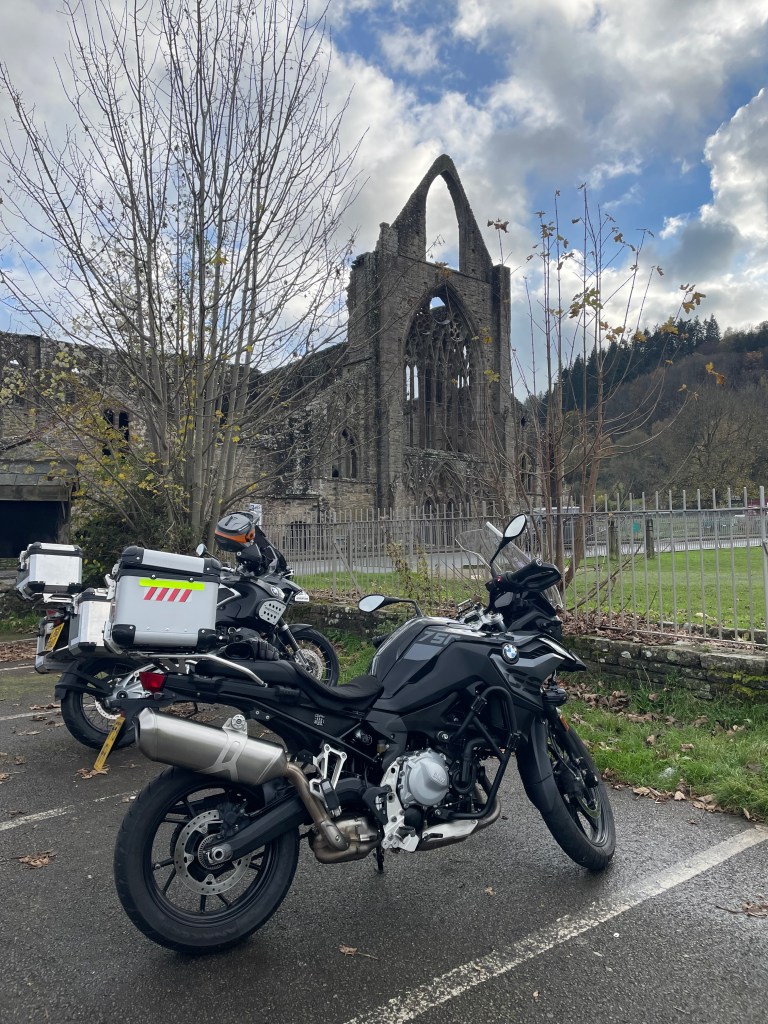
Tintern Abbey – needs a new roof?
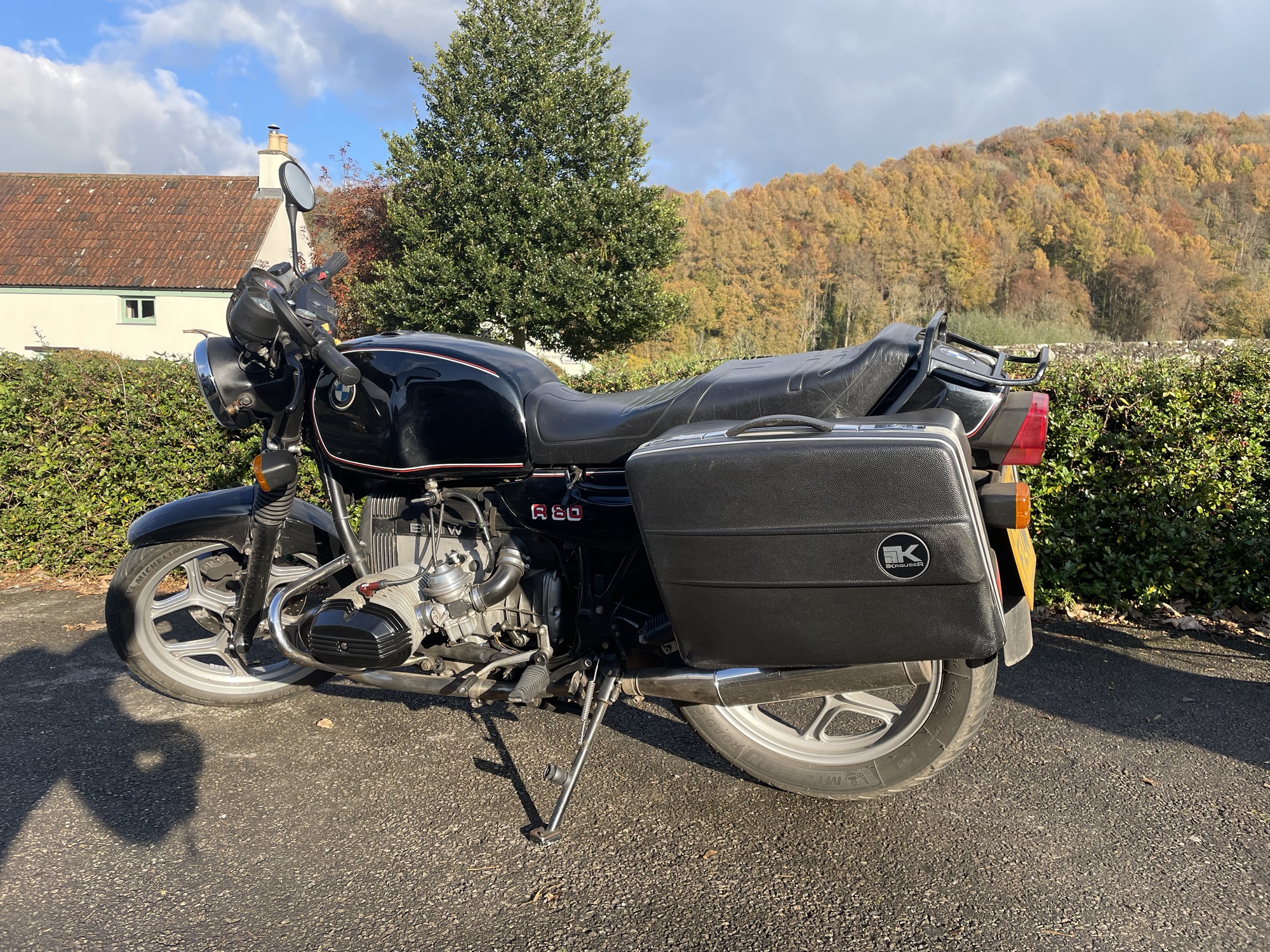
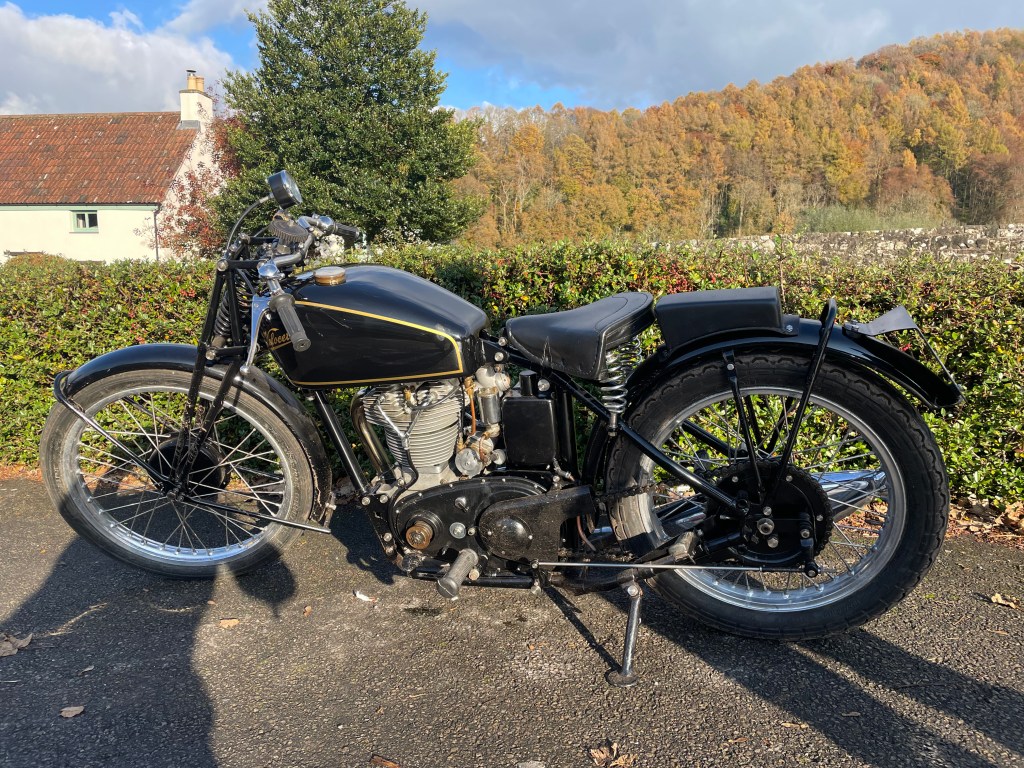
We are not the only bikers at Tintern – a BMW R80 and an old Velocette.
Slap your back
Our last leg is about 35 miles via Monmouth and a small village called Grosmont. The scenery is just beautiful – classic rolling hills, green and lush farmland. The traffic is non-existent. The weather is fine.
The Lamb and Flag is located just on the western edge of Abergavenny. It overlooks the hills and woodlands on the A40 to Brecon. Upon arrival, we are greeted by a group of workmen painting up the place. It has just started a refurbishment, nothing too radical. It is not Wetherspoons. We arrived at about 15:30 as the sun was beginning to drop below the hills opposite. The routine soon establishes itself – unload, secure the bikes, shower and beer before dinner.
The pub serves Reverend James, a classic Welsh bitter but it’s a Moretti for Marcus. So, we settled in and waited for dinner. James Martin is not in charge of the menu, but that is fine because they are not charging James Martin prices. It is thirsty work, perusing a menu, and we feel the need for a second pint to help us navigate the list. The menu was the usual list of pub classics, which means that we don’t actually need a menu. We should know what will be on it: chips. Lobster, Oysters and a filet mignon with a bearnaise sauce will be absent. I suspect it is the refreshment beforehand that leads us to order a ‘mega-mixed grill’. Mind, the waitress also suggested that it is a good option. I should’ve remembered the breakfast at Smokey Joe’s and my inability to get beyond sniffing one sausage.
When it arrives, ‘mega’ is about right. I instantly regret the decision and resign myself to the fact that most of it will be uneaten. I should’ve ordered a pickled egg and a packet of crisps. Although we have not eaten much all day, this is a plate too far. It is so big, it could kill. And it nearly does.
I cut a piece of steak and it sticks in my throat. I cough once, then again, but it is still there. So I try some beer which bounces off the meat and comes back up my nose and in a light spray across the plate and table. Marcus looks quizzical. I cough a bit more. Nope. It isn’t shifting. The couple on the table opposite look up and enquire about my condition. I can’t talk so I hold up my hand as if to say “I’m fine” which obviously I am not. As an ex-nurse, my brain goes to the resuscitation guidelines for choking, which is fine but I am the choker. I can’t relay this information.
Choking is a peculiar feeling. You take a breath and then wheeze. While you are conscious, the mind wanders before it begins to panic. Then Marcus just stands up and does exactly the right thing…he slaps hard between my shoulder blades and a huge piece of gristly grey steak bounces across the plate, and instantly I can breathe again. Funnily enough, my appetite has completely vanished.
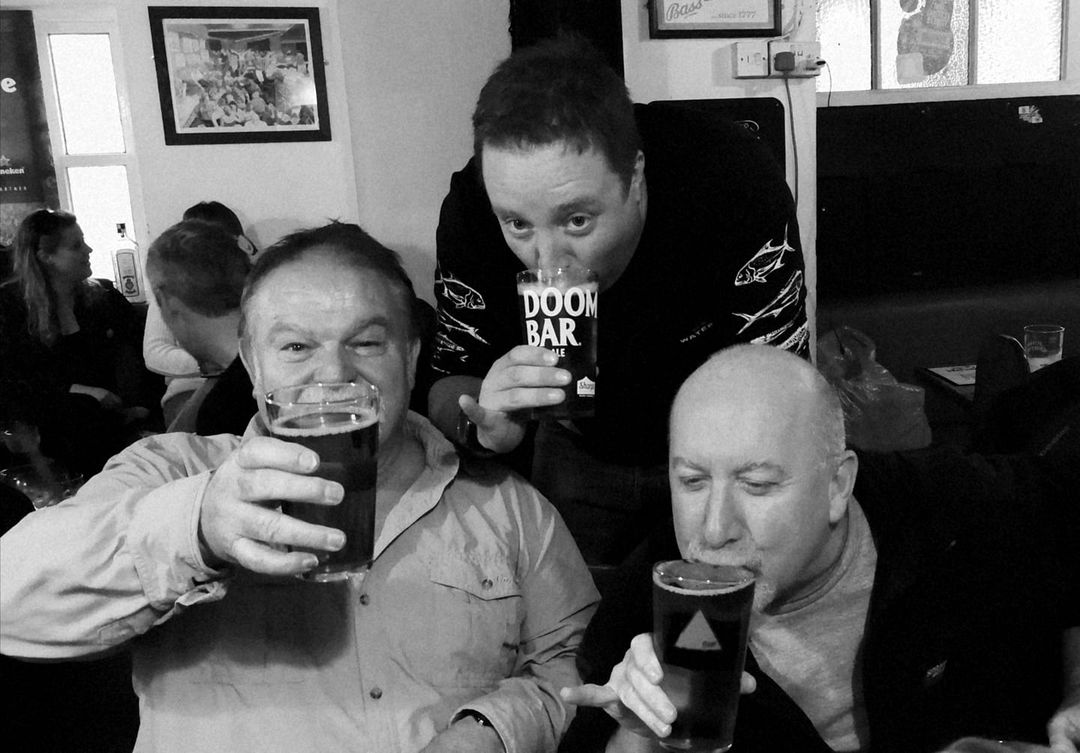
I think I need a beer. There is a pub quiz later and so we retire to comfy chairs and make right twats of ourselves trying to answer the simplest questions. I eagerly wait for a question about the Tudor Kings and the dissolution of monasteries, but instead, we get questions about subjects that only young people know about. I’m tempted to answer ‘sex, money and power’ to the question “What three things link Mother Theresa, The Archbishop of Canterbury and the Pope? ”
A whisky might have been taken before bed. Tomorrow is North Wales!
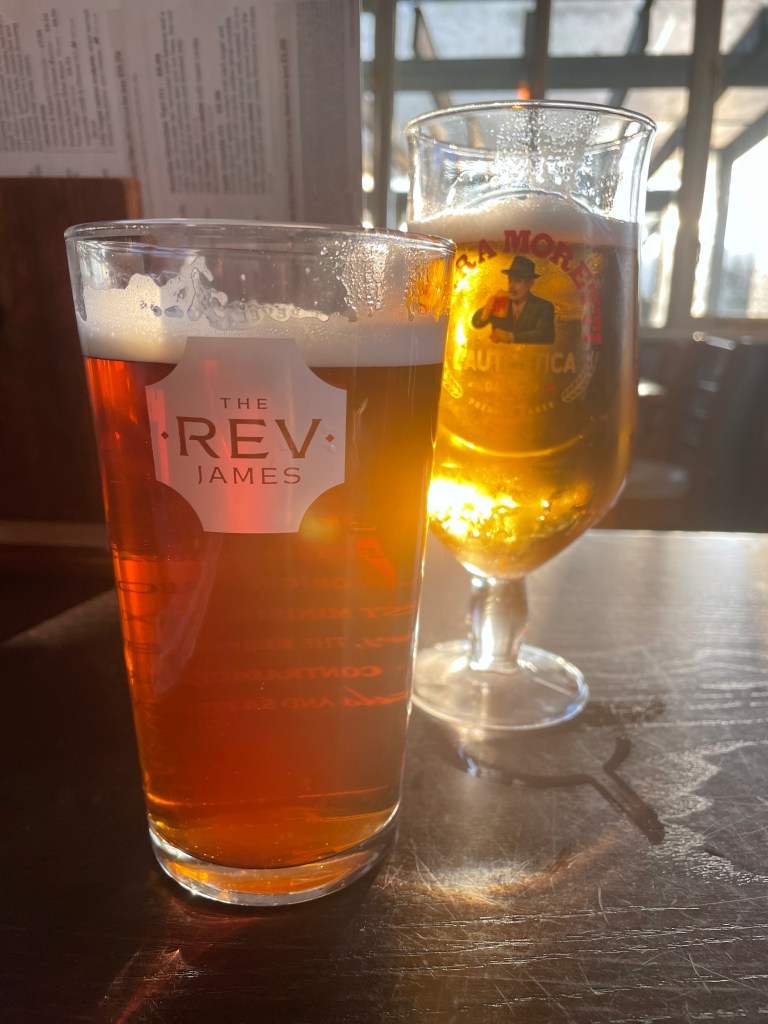
The first beer of the day.
Day 2 Abergavenny to Betws-Y-Coed
For those bikers who do not know this 144 mile route, the main direction is – go north. Leave Abergavenny on the A40 towards Brecon. Find the A 470 and just keep going. When you get to Trawsfynyyd north of Dolgellau turn right at the A 4212 (there is a petrol station on your right) towards the small village of Fron-goch. Turn left onto the B 4501 and then follow the A5 into Betws. Curb your enthusiasm because the road will tempt you into twisting the throttle more than perhaps you should? There is nothing on these roads except speed cameras, police and glorious scenery. We saw lots of the latter, but not much of the former.
Motorcycling and Speed
This is a contentious topic among bikers because, undoubtedly, speed is one of the reasons bikers ride. The power and acceleration of motorcycles have been the pull for most of us even before we could spell ‘Bonneville’. Most of us have had near misses and crashes, some very serious, in which excessive speed was a major contributory factor.
In public health jargon, we can talk about proximal causes of death and injury. These are the immediate causes that lead directly from A to B, for example speeding around a blind bend on a bike (A), having ignored the warning sign, leading to hitting a car pulling out of a side road out of sight (B). Bikers will also say the cause was the car pulling out – known as a SMIDSY “sorry mate I didn’t see you” – and while there is a good deal of truth to that, our own excessive speed meant we couldn’t stop in the distance we could see to be safe.
In 1977, on a Triumph Bonneville with a mate as pillion, that’s exactly what I did. My reaction time upon rounding the bend was just enough to mutter ‘shit’. Did I take note of the warning sign? What warning sign? Did I take note of the speed limit? What speed limit?
The distal (C,D,E….) causes are those multiple factors that lead us towards the proximal cause (A), and when they come together, they make the proximal cause more likely.
In my case, aged 18, one of the distal causes was ‘fuckwittery’ and another was ‘teenage brain’. My waking hours when not at work…well even when at work…were filled with thoughts on a single track. That track led to reckless hedonism and a disregard for personal safety. My teenage brain, like all young men’s brains, could not adequately assess risk. Instead, my brain was filled with thoughts about titties and beer. And bikes. So ‘ignoring the warning sign’ was one cause of many.
It is a truth, which should be universally acknowledged, that a teenager in possession of a full scrotum, brimming with testosterone, over-confidence, lack of training and a ‘won’t be told’ ego is a simmering cauldron of distal causes just waiting for the coming together of a proximal cause (speed) with a road hazard.
From Abergavenny to Rhayadar is about 45 miles of joyful empty twisty and often quick roads. Mind, there are now speed restrictions encouraging us to curb our enthusiasm. The introduction of 20mph limits in villages and towns has not been met with universal joy and it matters not what the science and data say regarding reductions in ‘death and serious injury’ statistics, many of us want to take the decision ourselves whether to keep the throttle open.
I’ve noted a type of biker who really gets upset at the implementation of speed limits, whether it be 20, 30 or 60. After coffee at Rhayader we were about to set off but got talking to a chap who clearly knew the Welsh roads.
“So, at Trawsfynydd, turn right at the petrol station and take the road to Fron-Goch” he said “its an empty scenic road and you can go as fast as you like, just watch in the distance for police.”
He was right, it was gorgeous, but Marcus and I both felt that 100 + mph was not for us.
Some bikers start with the ‘individual freedom’ perspective and just hate any government intervention in their lives. Some then add arguments based on ‘years on the road’ and their ‘perceived superior skill’. They could be on the wrong side of fifty, but still exhibit characteristics of the teenage brain. For them 20 mph is not just an irritant, it is an assault on their personal liberty. Advanced motorcycling training is often sneered at by this group, and they will say something about taking the car instead of the bike if one doesn’t want to race around the countryside.
And to a point, I get it. On the empty, hedge-free, Fron-Goch road (A4212) I can see why a biker would want to pitch their skill against the road conditions, and with the visibility as it is, no doubt going faster than 60 is relatively safe. I have been known to breach to 70 mph limit at times, and in certain conditions, it feels necessary!
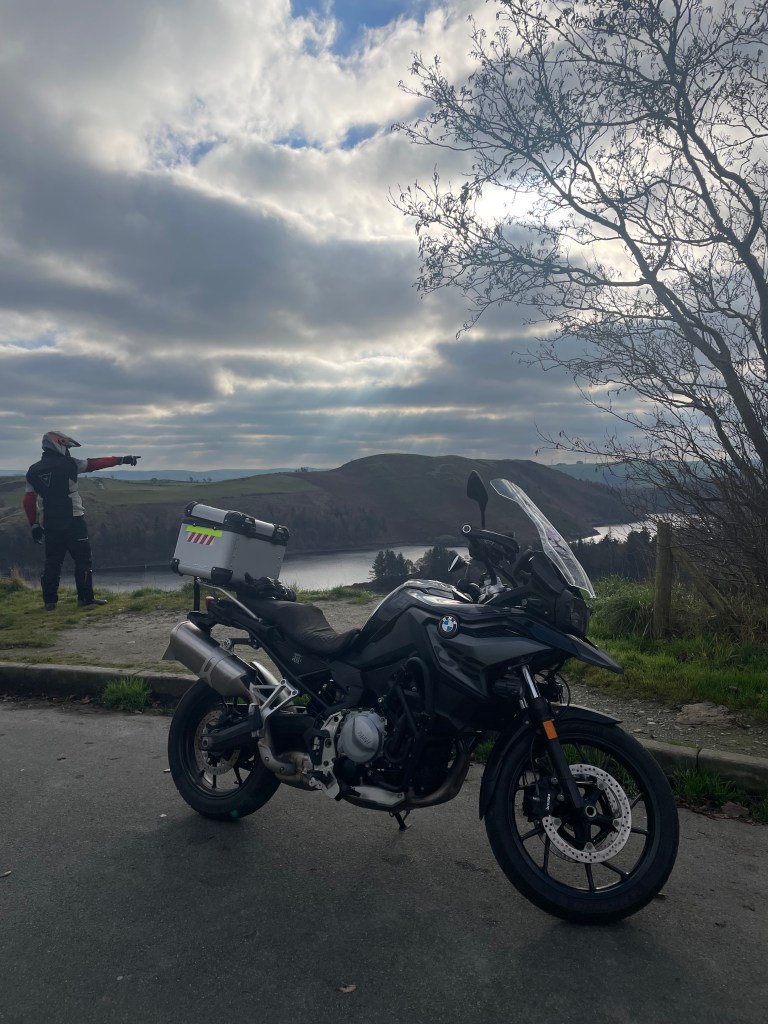
“Look, I can see my house from up here”
Rhayader Cafe
Upon leaving Abergavenny the weather was a right old mixture of mist and breakthrough sunshine. The River Usk led us onwards for the first stretch and later by the River Wye. The mist lay damply in the valleys but troubled us not. The blue skies and sunshine lit up the roadside trees and woodland in a magical show of colour. The Wye accompanies the road right on to Builth Wells and then on to Rhayadar. The road is magnificently empty.
There is a sort of crooked crossroads in the middle of Rhayader where the A470 is met by the A40, in the middle of which stands a clock tower. On the corner is a tea room given away by its name – The Old Swan Tea Rooms. We both quickly realise that we might get a nice cup of tea. I open the door to the quietude inside, punctuated only by the low murmur of the local radio informing us of the weather, traffic and the price of mint sauce. The place was empty save for two tables on opposite sides of the cafe, occupied by the leisured class of old-age pensioners.
Marcus and I sat and enjoyed tea and a light refreshment. Every now and then the tea in our cups rippled as a result of huge trucks lumbering past. All of them had to stop to negotiate the tricky narrow crossroad to avoid taking out the clock tower, cyclists, babies in prams, pensioners, hedgehogs and the Old Swan cafe.
” Has anyone of those trucks ever hit this place…and do you see many near misses?” I asked the girl behind the counter. She pointed to the corner of the building closest to the road. It clearly had evidence of a collision.
“We have to have measurements taken in the basement to check on the vibrations caused by the trucks to ensure the foundations are safe”.
At a nearby table which was draped in a yellow checked tablecloth, an older grey-haired woman sits quietly sipping her pea and ham soup. She is completely oblivious to the risk of ending her morning by lying face down in the bowl as her table gets shifted 10 yards forward through the cafe window and out into the street. This would be the result of a trucker, while twiddling with his mobile phone or fast asleep after driving all the way from Dover and underestimating the narrowness of the road, drives into the cafe rather than around it.
I note from a snatch of conversation between her and an older gentleman and his wife who were both were sitting at the window table opposite, that she is a regular here, so I guess she has tweaked the nipples of risk and decided that death by truck is preferable to death by dementia – both are messy but only one is prolonged.
This is as exciting as life gets in Rhayader, in the Old Swan Tea Rooms, even the bikers on their way to the Elan Valley have to slow right down at this disjointed, crooked crossroad. The old pendulum clock on the cafe’s wall ticks to a different rhythm. Einstein taught us that time is relative…well, here it is proven in front of your eyes. You might think it is 2024, but here in a Rhayader tea room, it is more like 1964 and all the better for it.
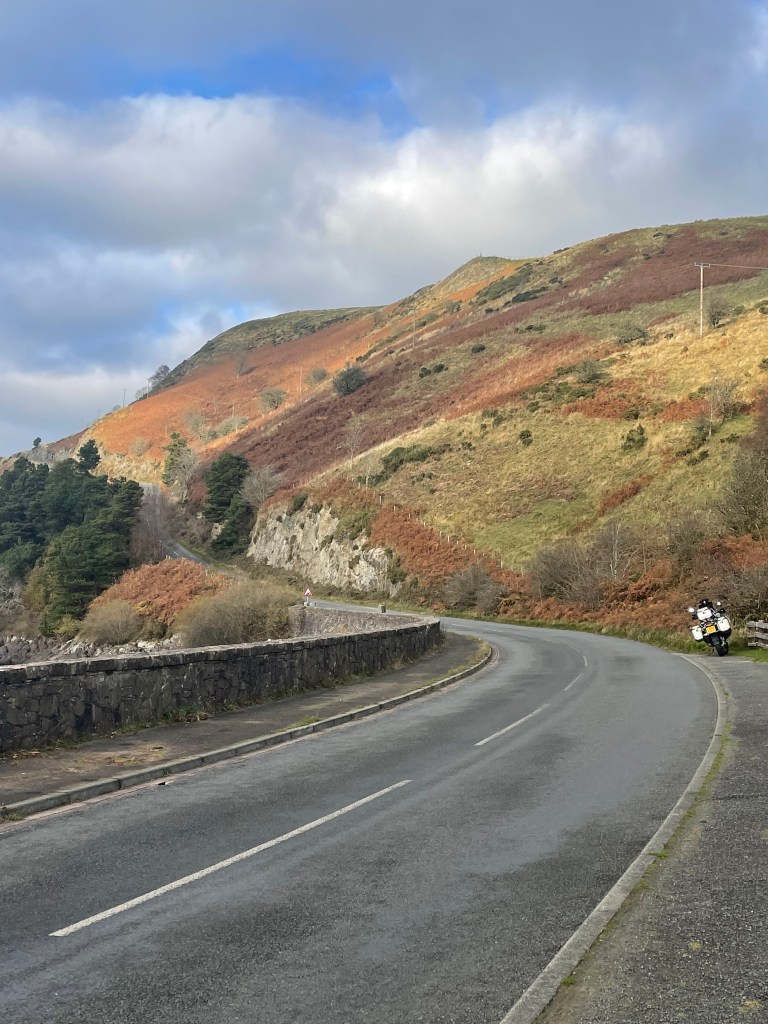
The B 4518 at Lyn Clywedog between Llandiloes and Machynlleth
If you are interested, click this link for the route to Betws-Y-Coed from Abergavenny.
It is another 97 miles to Betws – glorious biking miles. No holidaymakers are goofing at the scenery while towing caravans, there are very very few (if any) large Trucks, and as for this being farming country, we see no tractors at all. Sheep there are aplenty of course littering the hillsides and fields. The road surface is remarkably free from skiddable wet leaves, moistened admixtures of dung and mud or fallen rocks. I remember seeing one pothole. I don’t have the highway maintenance figures to compare between Wales and England so I don’t know if the lack of potholes is real or imagined. I just remember that scanning the surface for potential hazards was made much easier than back in Cornwall.
We only need to concentrate on vanishing points, braking, corner lines, hazard perception and acceleration. Very few CUYAs are noted by either of us.
A note on Welsh pronunciation
I always think it is respectful to try and learn how to say a town’s name, especially when in that town. The Welsh are generally a temperate lot when not infused with alcohol and rugby, but it doesn’t do to mangle place names with abandon, gay or otherwise. The Cornish have a giggle, some get upset, at the same thing during the summer when the emmets descend in droves and absolutely smash the ‘Tre, Pol and Pens’ into obfuscation via their manifest cultural and linguistic illiteracy. The Scots will burn you at the stake for this crime against Celtic humanity. Welsh place names can be particularly tricky, except for places like Swansea (emphasis on the first syllable), Tenby (the same) or St David’s (if you can’t pronounce that, perhaps you should go back to infant school).
So…Betws-Y-Coed is I believe not Betwis yuh Co -ed but Bettus eh Coyd. The coy is like boy. The ‘eh’ is a very short eh, not a long drawn out one. I admit I’m no linguist, but I try my best.
And remember accents – I bet the Cardiff Welsh say Betws slightly differently to the North. That is because Cardiff is a bastardised London but with leeks, colonised by bastards from London who have so diluted the language and accent as to render them unrecognisable to true-born Taffies in the North. This I read from the 1971 version of Lady Bird book of Welsh History.
Machynlleth: Not Macky en leth, but Muh Khunth leth but with a bit more spit in the back of your throat in the middle of it. Dolgellau – not Dol Gell ow but Dol Geth Lai (as in Thai). Oh, and there is so much more to trip you up and make a fool of yourself, beware the double L and the double F! Get this wrong and you’ll sound just like the invading interloper you are. They’ll think you are after a community destroying second home and be imposing a foreign colonial future in which rugby will be replaced by Golf and hymn singing by Radio 1. Get plenty of phlegm ready when you are about to ask for directions and spit the name at the right syllable or face opprobrium at best or at worse being tossed off the Devil’s Bridge at Pontarfynach (Pont Fa Nark?) into the watery abyss below. Being tossed off is not necessarily a bad thing, but not from the Devil’s Bridge.
Ty Gwyn and Kiwis.
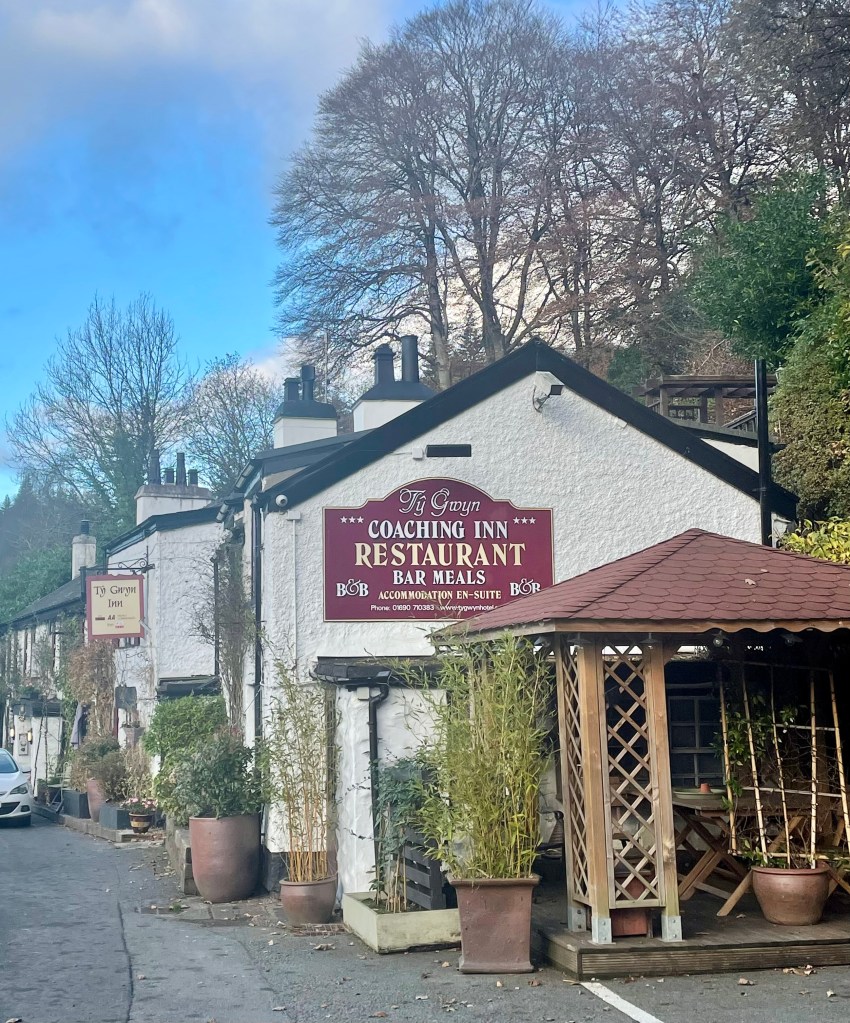
The A5 to Betwys meets the River Conwy in a wonderful descent into to tree-lined gorge and valley. The road seems to follow the line of the river as it snakes and twists towards the sea far away to the north.
Our destination tonight is the Ty Gwyn Coaching Inn and well worth the trip. The building is what it says, dating back to the 16th century, a fact attested to by its construction and architecture. It creaks and groans as its wooden beams and stairs bear the weight of guests. Its thick stone walls would repel cannon balls from invading armies and its low beams are of a height that only dwarves find agreeable. While Goblins and Orcs may prowl at night, deep in the cold wooded river valley outside, we can – hobbit-like – relax in the warmth of an atmosphere redolent of log fires, candle-lit glows, beer, and steaming platefuls of lamb shank, mash potato and rich thick unctuous gravy. Thighs can be slapped and ribald stories told, safe from the vagaries of late autumnal weather. At this time of year, the sun sets at about four thirty so it is not a time to still be out trying to find your way and mispronouncing Welsh town names when asking for guidance from hairy-handed locals drunk on illicit hooch and the Bible.
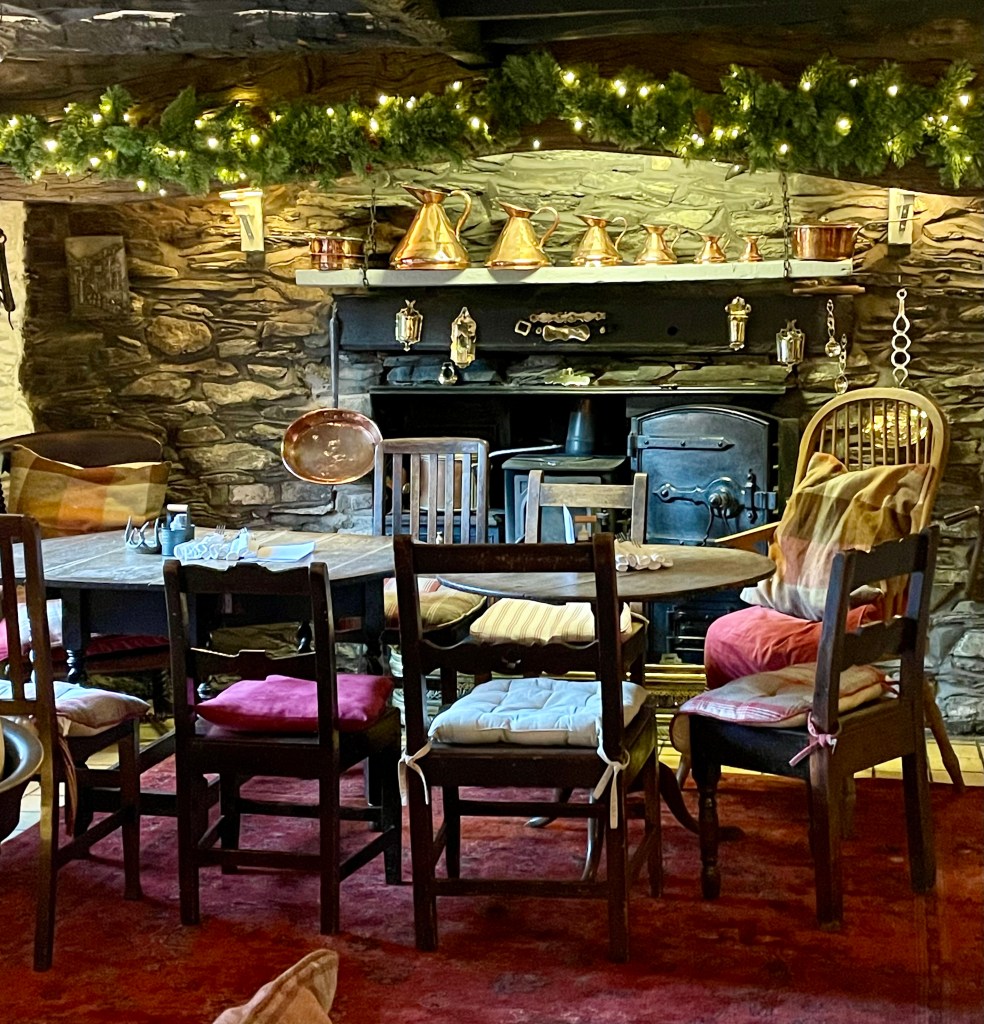
Just one of the cosy rooms in the TY Gywn
We park our bikes, shower and set off into Betws for a pre-dinner beer before it gets dark. The walk takes us over the Conwy crossed by the Waterloo Bridge. It is a single-span iron bridge commemorating the famous battle. Why the Welsh celebrated the battle fought by the English, Irish and Scots regiments alongside Belgians, the Dutch and Germans against the French, is because of the involvement of the Royal Welch Fusiliers (note the ‘c’) which lost 100 men and its commander fatally wounded. Either that or a bribe was involved.
The routine was establishing itself again. Park and secure bikes, shower, beer then dinner. After a decent couple of pints in ‘town’ – bear in mind ‘town’ is possibly not the right description for a very small collection of pubs, hotels, and outdoor pursuit stores – we walk back to the Ty Gwyn with loins girded and ambition.
We are guided to a table in a cosy side room in which only two other tables could fit. During the perusing of the menu, a young couple sat at the next table. He was a bearded and curly-headed chap who reminded me of a very young Rolf Harris but without the glasses and the look of a kiddy fiddler. His partner looked Italian, all dark-eyed and raven-haired fiesty.
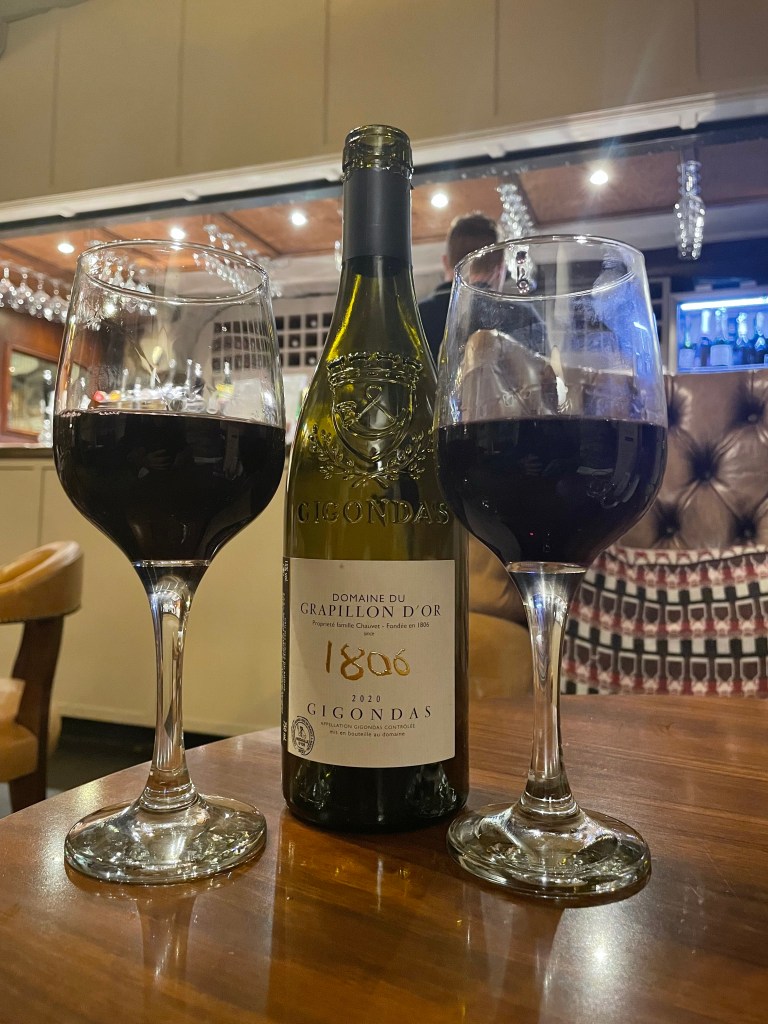
Marcus and I had ordered, and in short order a bottle of red wine turned up for our table. We talked about the roads, the scenery, the bikes and the lack of CUYAs we had encountered during the day. I could see and hear the couple debating what to order, and so I couldn’t help but suggest that the lamb shank was particularly good. At this, the young chap turned in his chair as if very happy to have someone else to talk to.
They were both working in London, but so loved Wales they took the opportunity for a few days away. Ruby, for twas her name, was originally from New Zealand (Auckland) and her chap, also a Kiwi, but originally from South Africa. I think he was an accountant but that’s a trivial fact. What started as a ‘helpful’ suggestion about dinner choice, turned into a cracking couple of hours telling stories about New Zealand, rugby, racism, Wales, Aussies (“they are racist bastards”) and Wine. We laughed and drank and laughed well into the night, and probably way after the time when we should have gone to bed. I am not sure how loud we got, but we were in a side room so the conversation might have been sucked into the stone walls.
This is just as well because, and I do not know why, we got into a discussion about the use of the C word. Ruby loved it and explained that in New Zealand it is often used, and often as a term of endearment. I pointed out the lack of emphasis on the last ‘T’ of the word as used by Americans and others, and we spent another 10 minutes describing when and how that ‘T’ should be used. Ruby used the soft T which to my ears just doesn’t sound right. Perhaps the Welsh say it differently like they say ‘dd’ or something? Cunff?
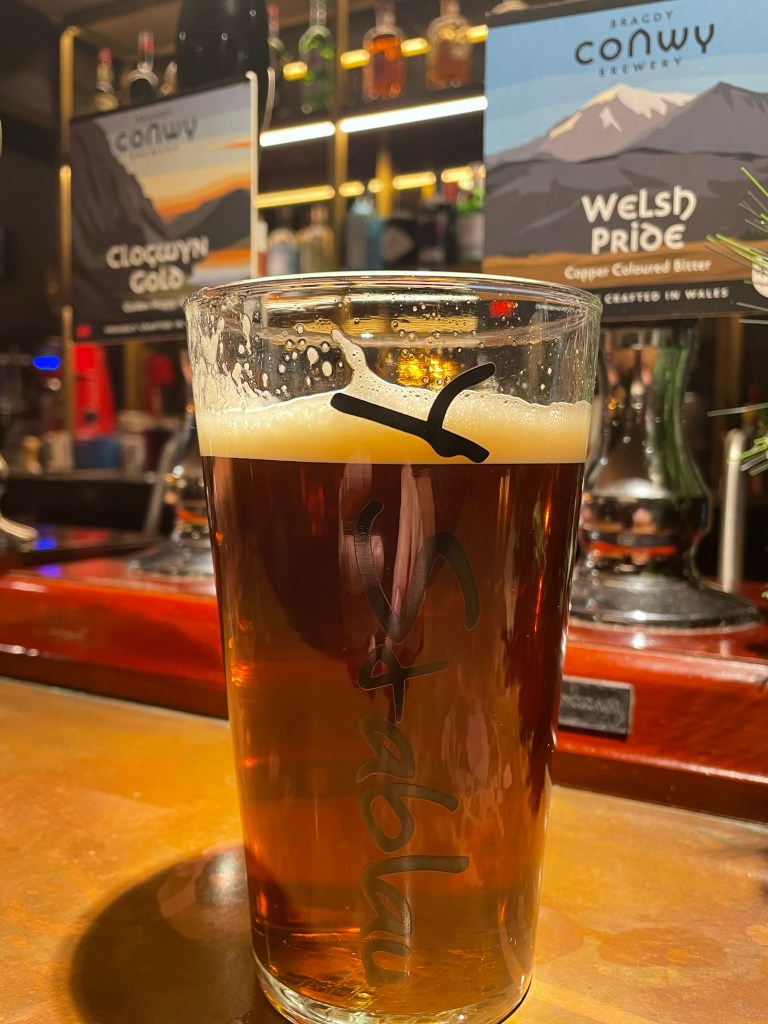
A beer before dinner in Betws-Y-Coed
Day 3 – Betws-y-Coed to Cowbridge
The return leg to the south is a 195 mile run and you can find the route here.
Cowbridge is pronounced ‘Cow-bridge’ – just like in English.
Average Speeds?
Looking outside the bedroom window, I could see a damp road but it was not raining. There was a bit of mist above the hills but ice, snow and hail has stayed away. The run down south will be a bit longer than previous days perhaps, but the last miles will be on dual carriageway and so any time lost will easily be made up.
I read somewhere that the average speed on a local A road in the UK is about 23 mph. This sounds quite slow especially when you are banging along at 60. The same source states that the average delay is 45 seconds per vehicle per mile. If that is true 195 miles of local A road miles would take 8 and half hours! We have left each day about 9- 9:30 and arrived about 15:30 to 16:00. By that logic it will be Christmas before see Cowbridge.
I guess I can understand delays when there are traffic lights, roadworks, roundabouts, tractors, junctions, blind bends, cyclists, horses, dickheads and morons. There is a lesson here for the CUYAs who like to tailgate and pressure us to move on faster. The lesson is quite obvious but the reality is there are folk who just like to drive like a twat and enjoy speedy and dangerous driving. Some of them still have ‘teenage brains’ even when older. Marcus and I are well practiced and prepared to sound the hard ‘T’ to each other as we look out for the dickheads and morons.
On the Road
From Betws we cross the Waterloo bridge and head towards Capel Curig and the Pen y Pass towards Beddgelert. This skirts the lower reaches of Yr Wyddfa (Snowdon) and past the Pen Y Gwryd Hotel made famous by Hillary and Tenzing who were training for the first ascent of Everest. Many climbers trained in the region and wrote their names on one of the ceilings in the hotel. The last time I visited, I didn’t bother signing and instead had a pint.
The ‘GORDAC’ ascended Yr Wyddfa in a blizzard a good few years ago, beginning the day in darkness. Why have you not heard of this? There is not even a blue plaque on the wall at the Pen Y Gwryd commemorating the event. That’s because the ‘Gentleman Of the Rum Doodle Appreciation Club’ only had 4 members. All were dedicated curmudgeons, boozers, and insane. They came leaving only footprints, and a bowel movement, high in the deep snow on the side of the mountain. Fame and fortune were not important, they risked all for that all important 10% of effort required to get 100% more reward in their outdoor pursuits. When I say ‘risked all’, that might be a slight exaggeration, a bit like claiming crystals bought in a street market can cure cancer.
I’m going to give up describing the majesty of the landscape – google it.
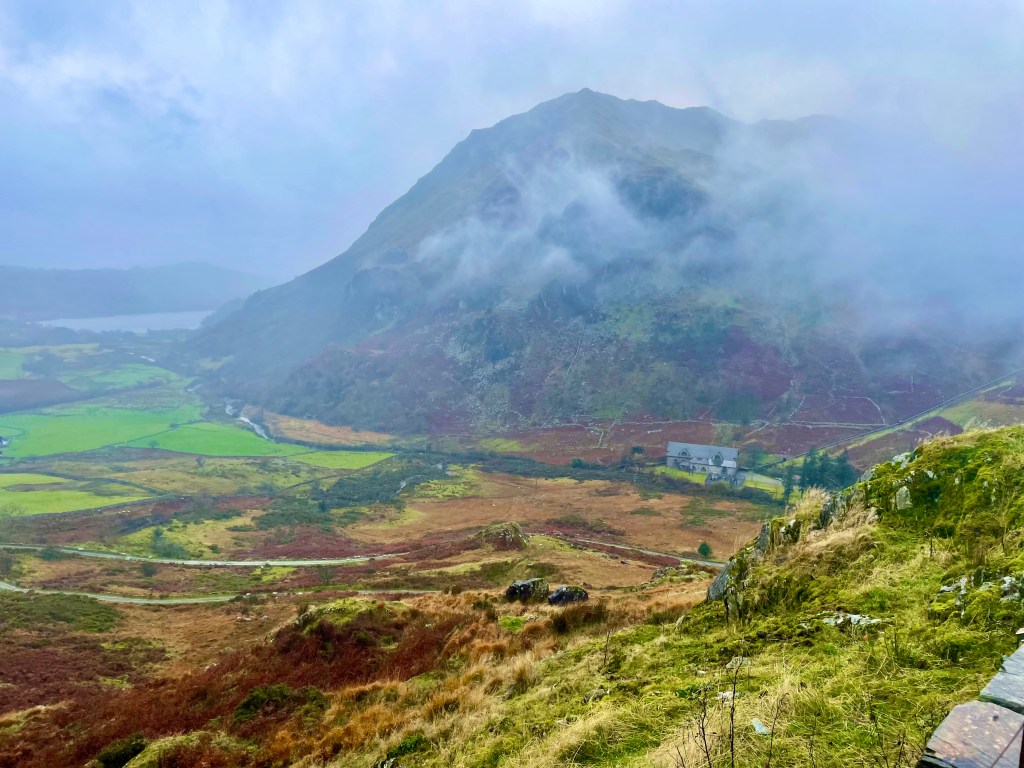
Penygader just north of Beddgelert
Our first stop for tea was Machynlleth, the Ty Medi cafe.
Machynlleth was the seat of Owain Glyndŵr‘s Welsh Parliament in 1404, and as such claims to be the “ancient capital of Wales”. However, it has never held any official recognition that this was so. If you go there you will see why. It is a sleepy market town selling tea and sausage sandwiches. And coffee. And cake if you ask for it. No one cares about its history as a capital except some beardy nerd, with biscuit crumbs in his beard, in the library poring over ancient books and hoping for Owain’s return. However, Owain is in the same club as Jesus, King Arthur and the Terminator who all promised to be back but all left followers with a crushing disappointment while the rest of us developed cynicism, science and a distrust of myth.
We were soon back onto the A470, and going south towards Brecon. The bikes are really good on fuel but they do need topping up. And so we found ourselves in a small village called Llyswen. I know this because a woman at the garage told us it was called ‘Clisswhen‘ which a phlegmy sounding C at the front. This really fooled me when checking up later on the map where exactly we had been.
We both topped up the tanks on an otherwise empty forecourt. The road was devoid of traffic. The village bathed in the lowering light of a greying sky. We parked the bikes away from the pumps and then went in to pay. I finished first and then stood outside the shop on the forecourt to wait for Marcus. As I stood by idly without my helmet on, a small car pulled up at the pump, fuelled up and the driver got out to go inside to pay.
I noticed the passenger of the car pointing at the bikes, and putting his tongue out and giving the thumbs up. I saw the thumbs up and without thinking did the same, but for some unknown reason I also mimicked his sticking his tongue out, and instantly realised he had Downs Syndrome.
I stood there grinning like a monkey, thumbs up and copying his ‘sticky out tongue’, thinking to myself “what the f*ck are you doing?” ‘Window licking’ has never been my strength and I avoid it when possible but here I am in small village in Wales doing just that. Marcus walked out of the shop and stopped dead still when he saw what was happening. Then he laughed, breaking the spell so that I too could put my tongue back in my mouth and then I cried so hard with laughter, I had to walk away. Luckily the driver (his carer?) was still in the shop.
Finally he came out and drove off and I last saw the passenger smiling, tongue out doing the wanker sign, or so I thought until I realised he was mimicking a throttle. The next few miles of biking were hard work because we both broke out into spontaneous laughter.
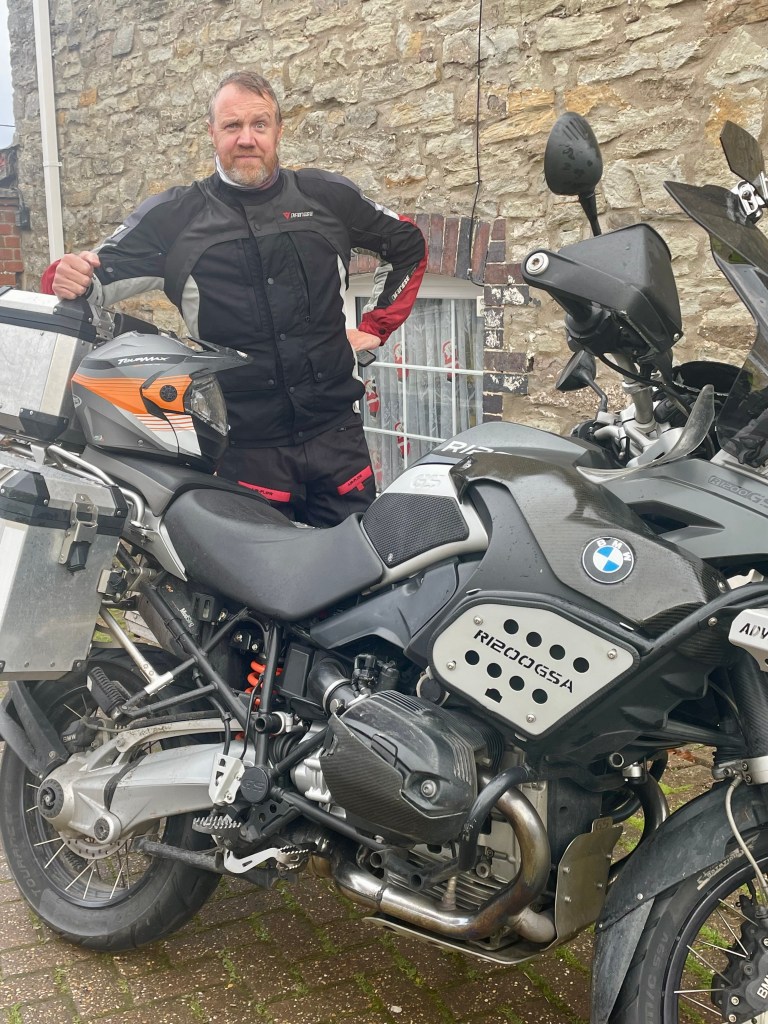
Marcus trying to compose himself after the ‘tongue incident’.
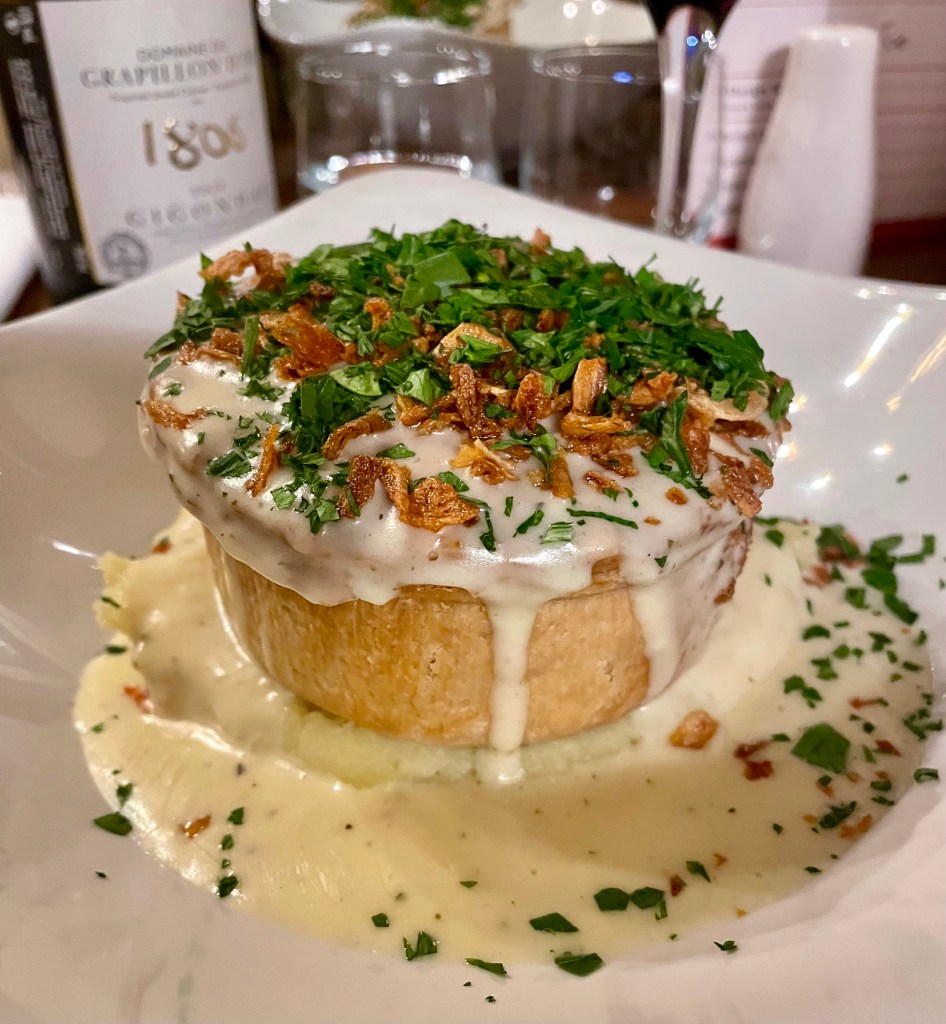
The final run was a thoroughly enjoyable run down to Cowbridge – without incident involving folk with Learning Disabilities. Our last destination for the night was The Bear Hotel. The usual routine completed, we both stood at the hotel bar with a Guinness (or two) and watched as a glamorous crowd of a wedding party turned up. We left them to their party and enjoyed an excellent dinner with wine before a small snifter and bed.
The next day would be a run of 230 miles back down to Cornwall – the bikes ate up the miles comfortably. I had forgotten about the gel pad and the HCs in each hand, that’s how good they are.
Final Thoughts
Wales is country of contrasts that is reflected in its language, landscape and roads. Welsh is spoken everywhere but is more dominant in the North. The mountains of the North contrast with the old coal valleys and Cities of the South. Its roads are both mundane transport links but also beckon as a bikers playground. Reconciliation of these dualities require care and understanding. Anyone who lives here or who visits here will be met with these contrasting contradictions and instead of fighting them, should accept that this how things are without imposing one upon the other.
For bikers, we are privileged to ride here. The locals have to live here. If we are to come back again and again to enjoy what this beautiful country can offer, we have to bring respect, and work with speed limitations and choose with utmost care when and where we are going to play.
Rain? As Billy Connolly once said, there is no such thing as bad weather, just bad clothes. And yet, we had great weather, with most of the trip being sunny and/or dry.
 Looking After Your Ring.