The Race for ‘Collective Agency’
TLDR: The political future depends less on the existence of grievance than on who succeeds in converting it into collective agency.
There seems to be no shortage of anger. We see it on social media, on the telly, on the roads. Many people are angry about housing, immigration, wages and public services. They are angry about tax. Angry about inequality. Angry that their children cannot afford what they could afford. Angry that governments seem increasingly incapable of doing very much about any of it. Then add climate change, water and energy security, war, migration and the uncomfortable suspicion that the next twenty years may be rather more difficult than the last twenty. Intergenerational blame is rife, ‘ok boomer’ and ‘avocado on toast’.
On the other hand, we have cruises to the Caribbean and the Mediterranean, Waitrose offers on wines from Bordeaux and SUVs. Attendance at Wimbledon’s centre court, West End Theatres and Henley Regatta may be middle class stereotypes but they are real. As is the Private School-Oxbridge-Professional and city jobs links. Some people are isolated and protected from many social and economic ills. Chelsea and Clacton? Belgravia and Blackpool? We have second homes and homelessness connecting these two worlds.
We have grievance coming out of our ears but grievance isn’t power. It seeks power or descends into apathy and fatalism.
For much of the twentieth century, millions of people had institutions that helped turn private problems into collective ones. Trade unions were an obvious example. You could walk into work believing that your lousy pay was your problem and walk out of a union meeting understanding it as a bargaining problem. The rent, the wage, the shift pattern, the unsafe machine, the redundancy notice stopped being something happening to me and became something happening to us. And once there is an us, something becomes possible.
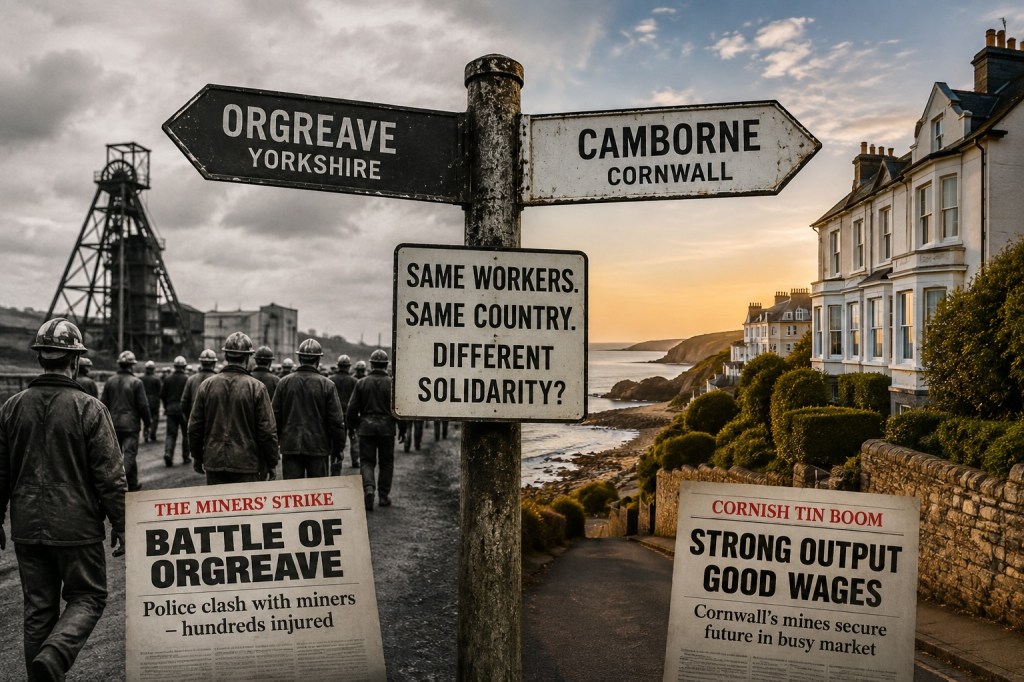
Today, that experience of a collective interest, of action has weakened. I saw it most starting clearly in 1984 – the miner’s strike. Local tin miners in Cornwall did not see any solidarity with Coal miners in the North. Many did not see that severe weakening of Union power means that what happened in Orgreave can happen in Camborne. They were all miners, but that occupational resemblance did not automatically create a common political identity. What happened at Orgreave was about more than coal. The defeat of one of Britain’s most powerful unions altered the balance of power between organised labour, employers and the state. A tin miner in Camborne did not need to believe that his mine was about to become another Cortonwood to have an interest in that outcome.
The connection was there. The difficult political task was getting people to see it.
Across the developed world, trade-union membership and collective bargaining have fallen substantially. Political parties have changed too. The old assumption that working-class people voted left and affluent people voted right now looks decidedly creaky.
But this doesn’t mean collective action has disappeared. We may simply have been looking in the wrong place.
What has changed is who is successfully turning grievance into an ‘us’.
I think the process looks something like this:
condition → grievance → explanation → identity → organisation → mobilisation → power
Or, in ordinary English:
1) Something is happening to you, you face high rent or completion for decent housing.
2) You decide it is wrong.
3) Someone explains why it is happening. “Immigrants”
4) You discover other people who accept the same explanation on GB News, Facebook and X or at the pub.
5) You begin thinking of yourselves as a group: ‘Raise the Flag’ patriots.
6) You organise.
7) You act. You paint roundabouts and climb lampposts, you gather around hotels.
8) And, sometimes, you acquire enough power to change things, by voting in an MP who aligns with your views.
I’ve called this the Collective Agency Conversion Chain.
The name isn’t as particularly important as the mechanism. Because the same miserable economic circumstances can produce completely different politics.
Imagine somebody in their fifties. Their wages haven’t moved much. Their children cannot buy a house. The GP is difficult to see. The town centre looks knackered. They don’t trust politicians and think the country is going backwards. What follows? Nothing necessarily.
One person concludes that wealth and power have become too concentrated and that stronger unions, better public services and redistribution are needed. Another concludes that mass immigration and a remote political elite have destroyed the country. A third concludes that all politicians are crooks and there is no point voting. We all live in the same country and possibly the same street, but we end up in a very different destination.
Our shared political future may depend less upon how much grievance exists than upon who gets to explain it.
Karl Marx understood part of this a long time ago. He wrote that having common economic interest does not magically turn a collection of people into a political force. Antonio Gramsci then suggested that politics is also a battle over what becomes ‘common sense’. Who gets to tell the convincing story about why your life looks like this? Common Sense? What does even mean?
If you have a grievance you might think can anything actually be done?
Researchers call this ‘collective efficacy’. Self efficacy is the belief that you possess the resources and attunes than bales you to achieve your personal goals. Collective efficacy is the belief that ‘we as a group’ can do so. You can believe that you are being shafted and you can know exactly who you think is responsible. You can even find thousands of people who agree with you.
But if everybody thinks, “What’s the bloody point?”, nothing much follows. So, then we have three end points:
1) One is solidarity: We’re in this together. We can organise. We can change it.
2) Another is exclusion. We’re in this together. They did this to us. We need to take back control.
3) And the third is fatalism. Yes, we’re being shafted. No, nothing will change.
That third one interests me particularly because it is easy to mistake political anger for political agency. Someone sitting at home furiously scrolling through Facebook may be extremely angry and almost completely powerless.
Which brings us to the internet. Social media has changed the speed of all this.
You no longer need a union branch, church hall, political meeting or pub to discover that 20,000 other people think the same thing you do. The phone in your pocket can do it before breakfast. It can give you the grievance, the explanation, the enemy and the group simultaneously. That is politically extraordinary.
But we should be careful. There is now decent evidence that some algorithms amplify some kinds of political material more than others and that, under some circumstances, changing what people see can change political attitudes. There is also good evidence from other experiments showing surprisingly little effect. So “social media is brainwashing everyone” won’t do.
What we can say is that the machinery through which political identities are constructed has changed radically, and much of that machinery is now owned by private companies whose algorithms decide what millions of people see.
There is another trap. Something can look enormous online without being enormous in the country. A small number of extremely committed people can generate a colossal amount of noise.
But here’s the twist. Looking enormous can help you become enormous. Visibility creates attention. Attention creates legitimacy. Politicians start talking about the issue. Journalists cover it. More people encounter it. Something previously regarded as fringe begins to feel normal. So social media can make a movement look bigger than it is while simultaneously helping it become bigger than it was.
And at the moment the radical right seems rather good at this whole conversion business. That doesn’t mean people vote for Farage simply because they are poor, insecure or angry. The evidence is much messier than that. Immigration, national identity, cultural change, distrust, economic insecurity and the belief that established politicians don’t listen can all matter.
The clever political move is to connect your GP appointment, rent, tax bill, your daughter’s inability to buy a house, the asylum hotel, the bloke arriving in a small boat with a politician in Westminster or the bureaucrat in Brussels.
Take a collection of largely separate things and provide one story that connects them.
Then provide an us. ‘The People vs the Establishment’
That’s collective agency.
The story can be wrong and still be politically effective. It can also contain truths mixed with nonsense. What matters initially is whether enough people find it convincing enough to organise around. The left once possessed exceptionally powerful machinery for doing this, the idea of social class did a lot of work. The miner and the railwayman didn’t have identical interests, but institutions helped construct a political identity capable of containing those differences. That infrastructure is much weaker now. It is why it is arguable that we lack institutions to protect such things as the NHS.
Meanwhile our actual interests have become wonderfully contradictory. We want our houses to increase in value and our children to be able to afford houses. We want good pensions and companies to pay workers more. We want cheap energy and rapid decarbonisation. We want excellent public services and low taxes. We want cheap goods and well-paid workers producing them. There is no obvious political ‘we’ sitting there waiting to be discovered.
And while we’re arguing about all this, something else is happening. The physical world doesn’t care. The climate doesn’t negotiate with Nigel Farage, Keir Starmer, Donald Trump, Greta Thunberg or me. Seven of the nine planetary boundaries identified by Earth-system scientists are now assessed as having been crossed. That means the environmental conditions within which politics takes place are becoming less forgiving. Flooding, food prices, insurance, migration, energy, heat and water don’t arrive as “environmental issues”. They arrive as bills, shortages, taxes, planning disputes and arguments about who should pay.
And once again the questions become:
1) Who explains what is happening? David Attenborough or Reform UK?
2) Who constructs the we? The Daily Mail, The BBC, GB News, Facebook?
3) Who persuades people that collective action can work? Nigel Farage, Tommy Robinson, the Intergovernmental Panel on Climate Change, and Climate Scientists?
4) And who turns that belief into institutions capable of doing something? Elon Musk? Mark Zuckerberg?
Selling the story is not enough, nor marching in the streets or getting ‘likes’. Power to change things has eventually to become institutional.
That means: Law, Budgets, Bargaining arrangements, Planning decisions, Ownership, Regulation, Public institutions. All the boring stuff of politics that few want to listen to or deal with. Who wants to watch Newsnight when you have Strictly, and who wants to analyse legal policy rather than the Arsenal back four?
And here’s the bit I had initially underestimated. Institutions as well as exercising power they can store it. A union agreement, cooperative, local institution or bargaining structure can leave behind organisation, knowledge, relationships and the experience of having successfully acted together. Success teaches people something rather important:
‘We did that and We could do it again’.
So the political race is to convert grievance into collective agency.
The finishing line of that race could be something approaching Charles Eisenstein’s ‘More Beautiful World’. It could be Nigel Farage. Green technology or runaway climate change. Working Class solidarity or Pogroms. Under sufficiently ugly circumstances, history tells us it can become considerably worse than Farage.
Another destination is that nothing happens at all because enough people decide that everyone is lying and nothing they do makes any difference. However, the laws of physics, of meteorology, of ocean warming, don’t stop. They will continue regardless.
This is possibly the bigger picture current ‘stop the boats’ politics misses. The political contest is not about whether people are angry because we know they are. Nor is it about the coming decades producing difficult choices, as they already are.
The question is who succeeds in explaining those difficulties, who gets included in the resulting we, and whether that group acquires the confidence and organisation necessary to act.
 Lance Goodman
Can’t read it all, but in short, lots of people can be unhappy about the same things without agreeing about why they’re happening, who is responsible, or what should be done about them. The political group that does the best job of turning that unhappiness into a convincing story, a sense of “us”, organised action and eventually political power is likely to shape what happens next.
Grant Goodman Elite Coach | BaseCamp Endurance Coaching World-class cycling coaching. Motivating community. Proven performance. http://www.joinbasecamp.com Explore BaseCamp CoachingOn 29 Aug 2026,
LikeLike