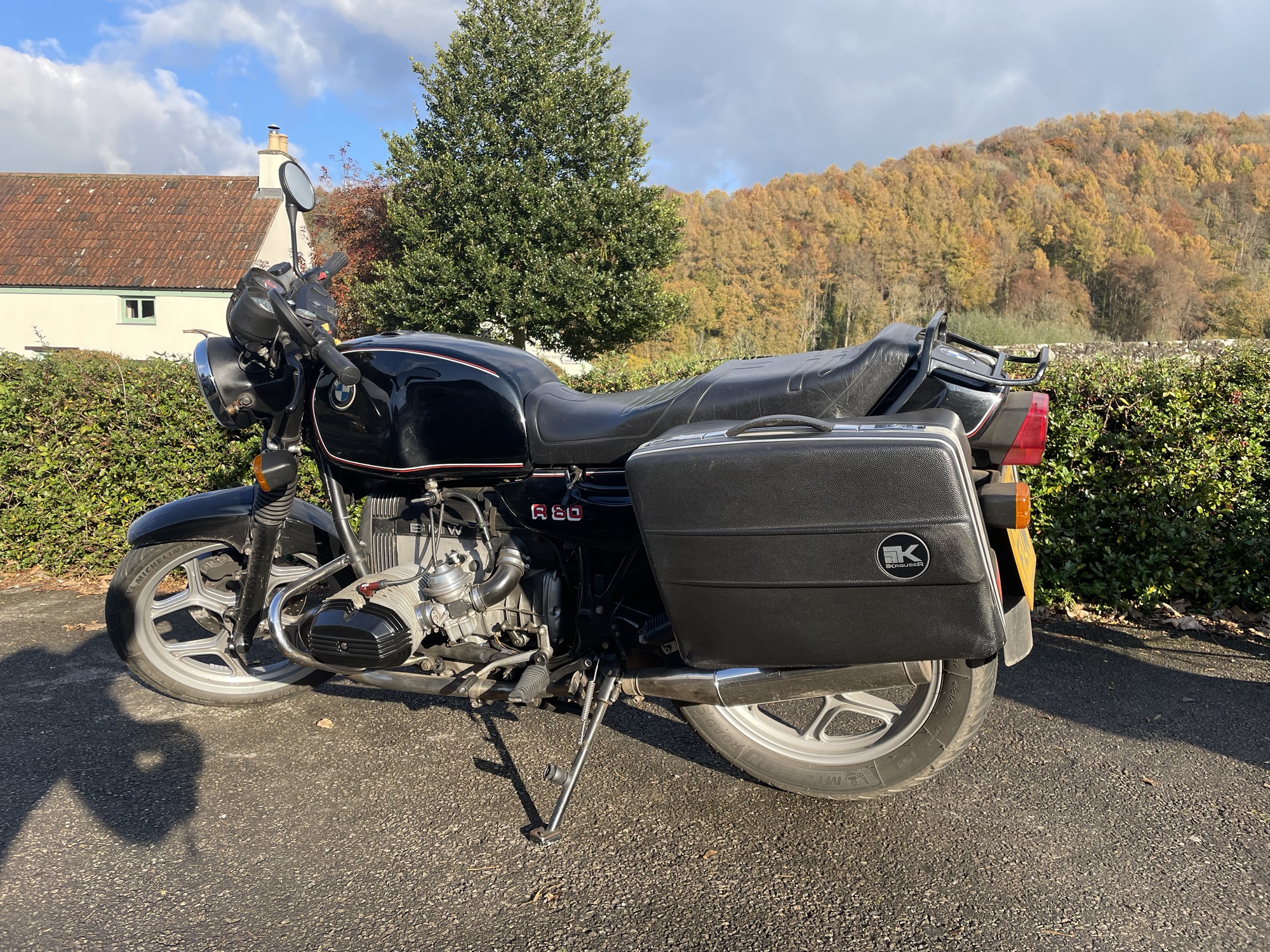
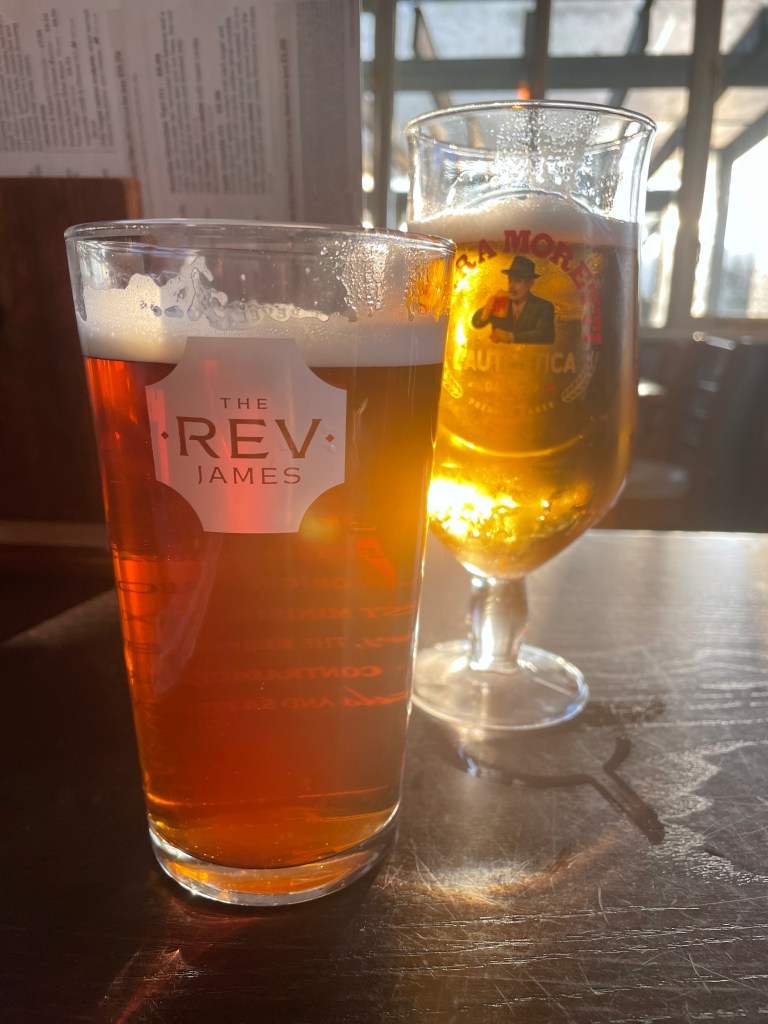
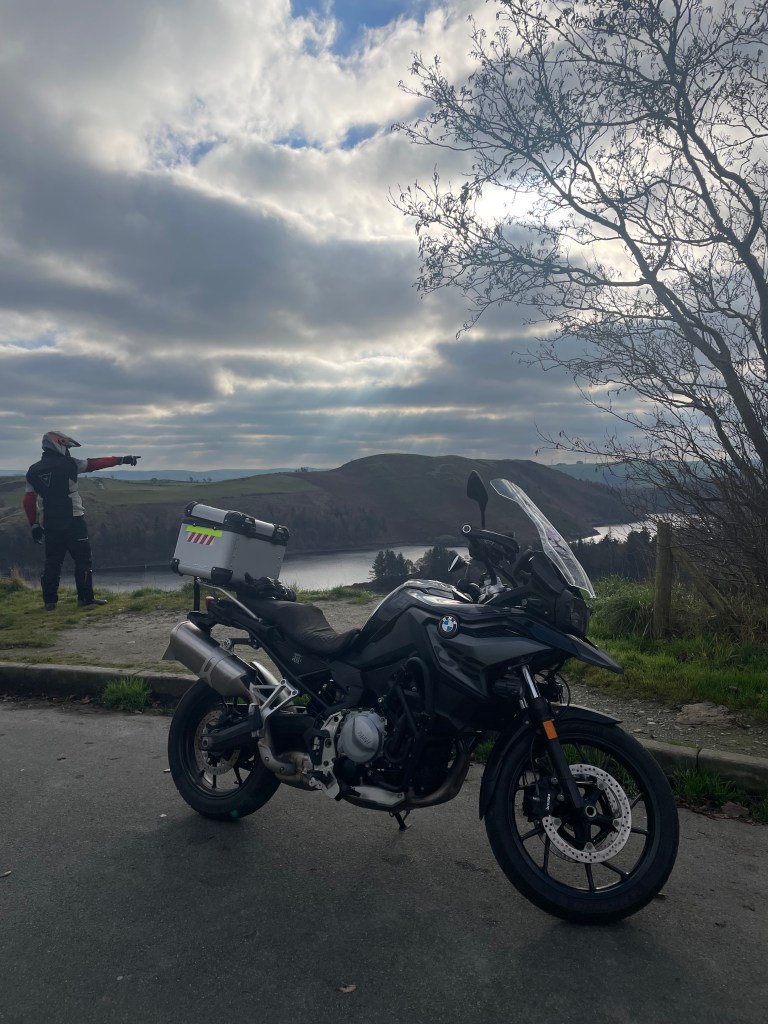
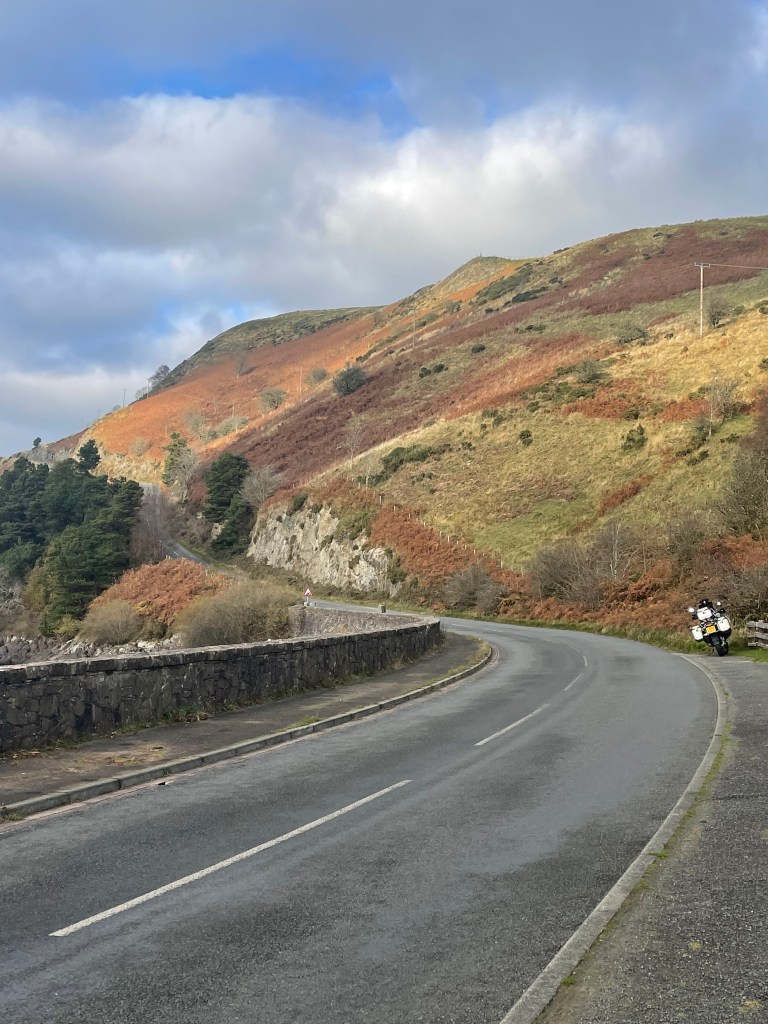
You know the kind of day that kicks off as classic damp, cold, and grey. Of course you do, because that’s just the standard weather in Britain, and we all love to make a big show of complaining about it. Endlessly. We’re such experts at grumbling that it’s practically a form of greeting for us – we’ll even start whining to total strangers who are also stuck in a soggy-necked limbo until the sun decides to show up on a random Wednesday in May.
Such gloomy, drizzly days tend to inspire feelings of melancholy, boredom, and an insatiable craving for chocolate in even the most resilient of British hearts, prompting us to embark on a quest for sun-drenched and wine-soaked solace in the likes of Benidorm, Torremolinos, or Magaluf. In days of yore, the British would set sail for distant lands, promptly annex them, and then succumb to sunburn, scurvy, and syphilis on mosquito-infested Caribbean islands long before resorts like Sandals transformed them into luxury destinations – albeit now with the added bonus of a gin and tonic at sunset.
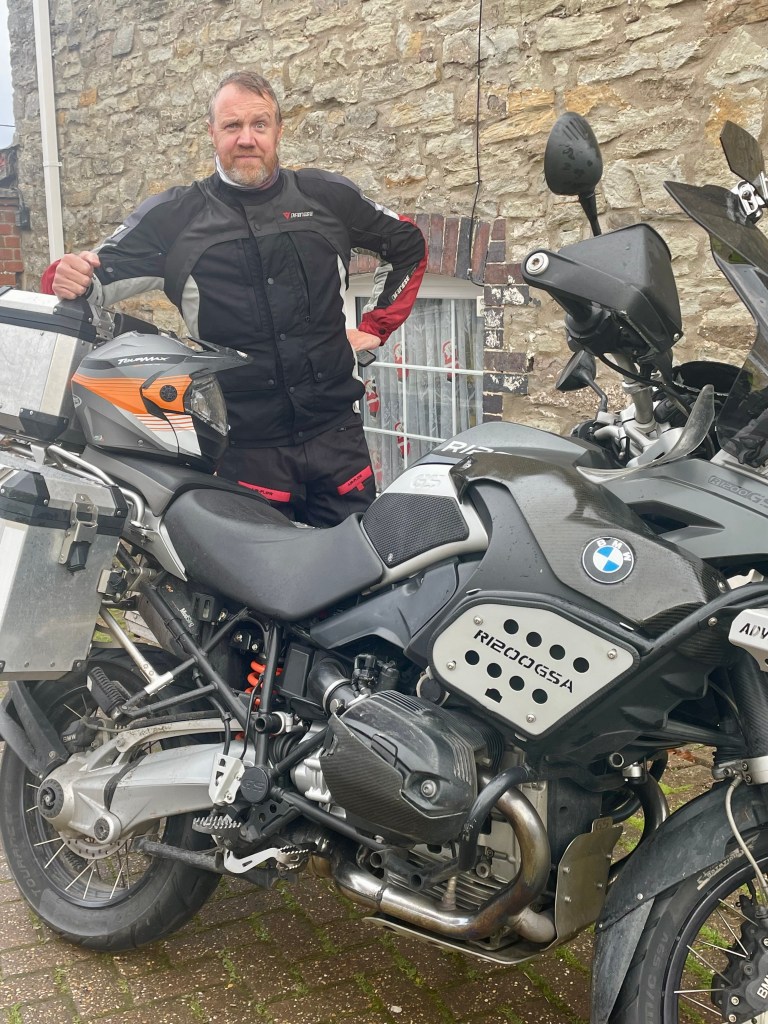
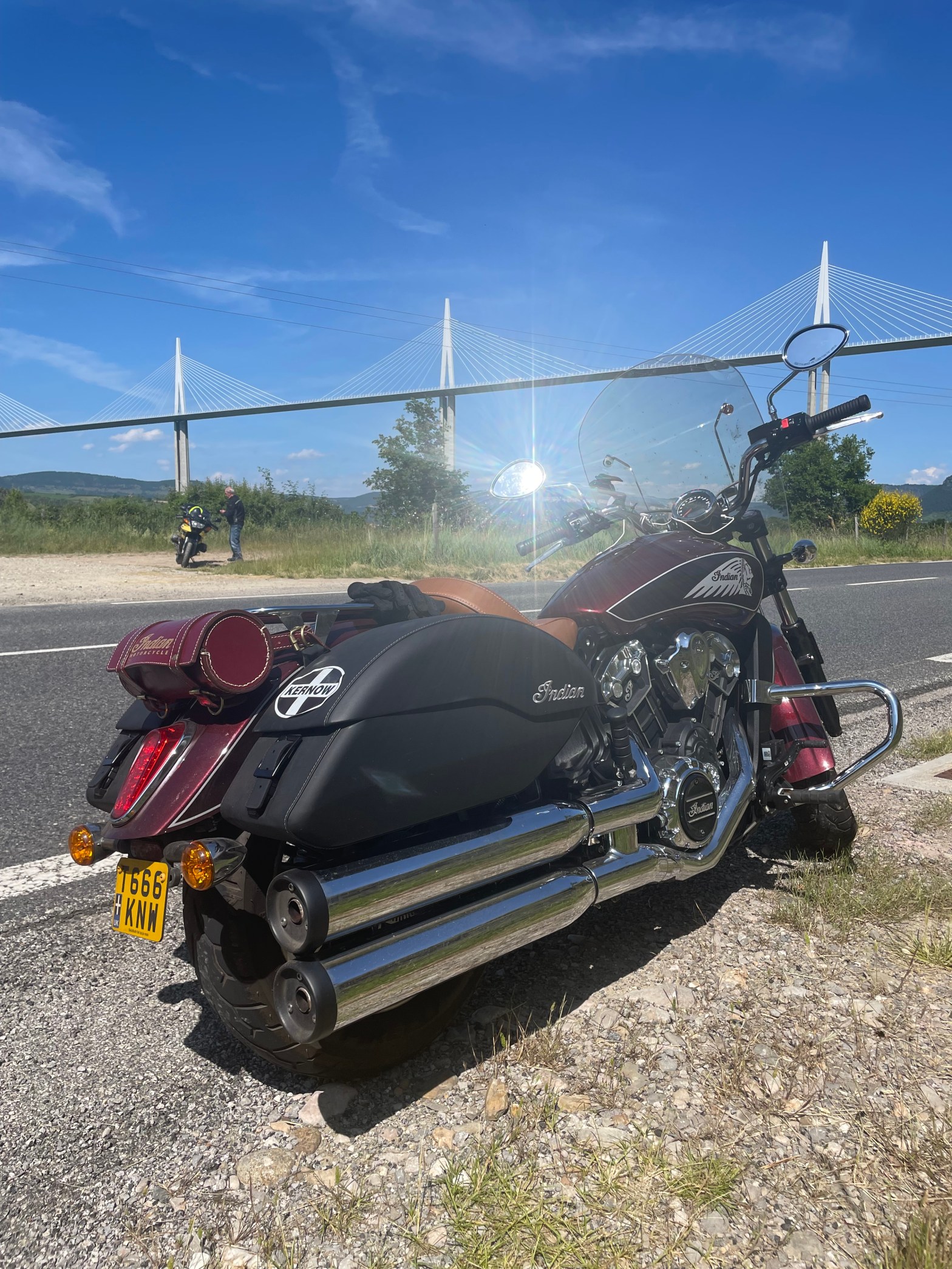
On just such a miserable wet day, I found myself standing in my garage with a cup of hot tea in hand, staring wistfully out of the open door as the cold rain drops kept falling nearly upon my head. I stood next to my Triumph Bonneville and my Indian Scout, both now as silent as an England football crowd after yet another loss at a penalty shoot out. I was reminded of Hamlet’s thoughts on just how depressing life can be:
“I have of late—but wherefore I know not–lost all my mirth, forgone all custom of exercises; and indeed it goes so heavily with my disposition that this goodly frame, the earth, seems to me a sterile promontory. This most excellent canopy, the air, look you, this brave o’erhanging firmament, this majestical roof fretted with golden fire, why, it appears no other thing to me than a foul and pestilent congregation of vapours”.
I stared up at the sky and saw exactly what he meant…a ‘foul and pestilent congregation of vapours’ indeed.
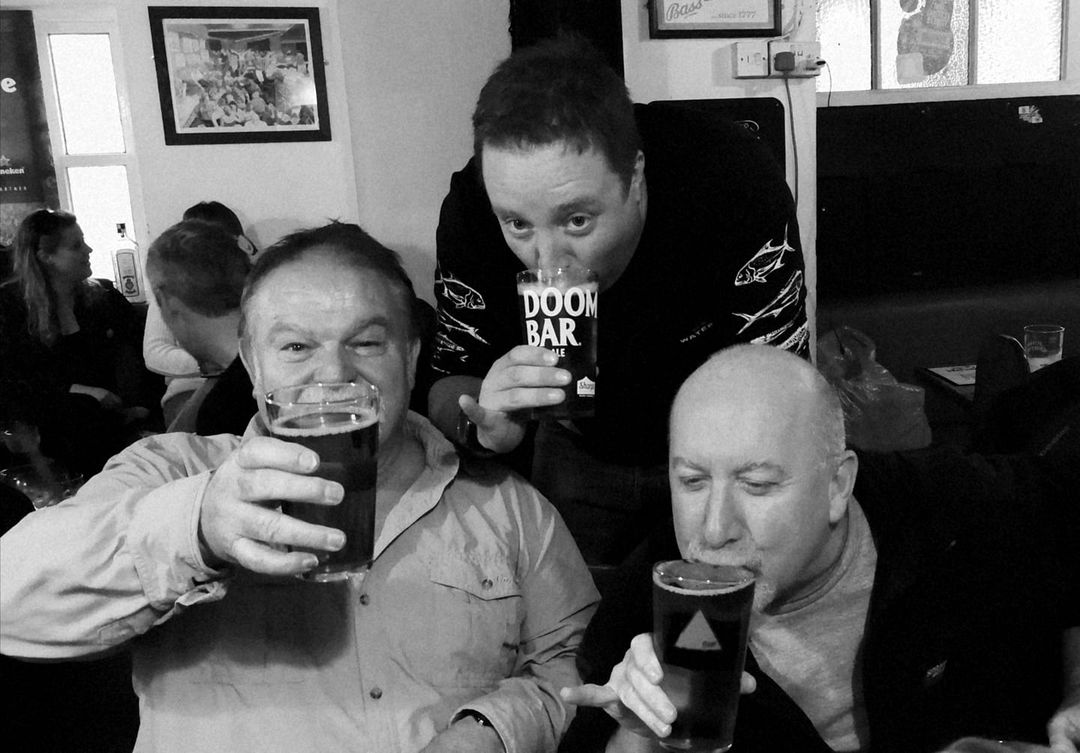
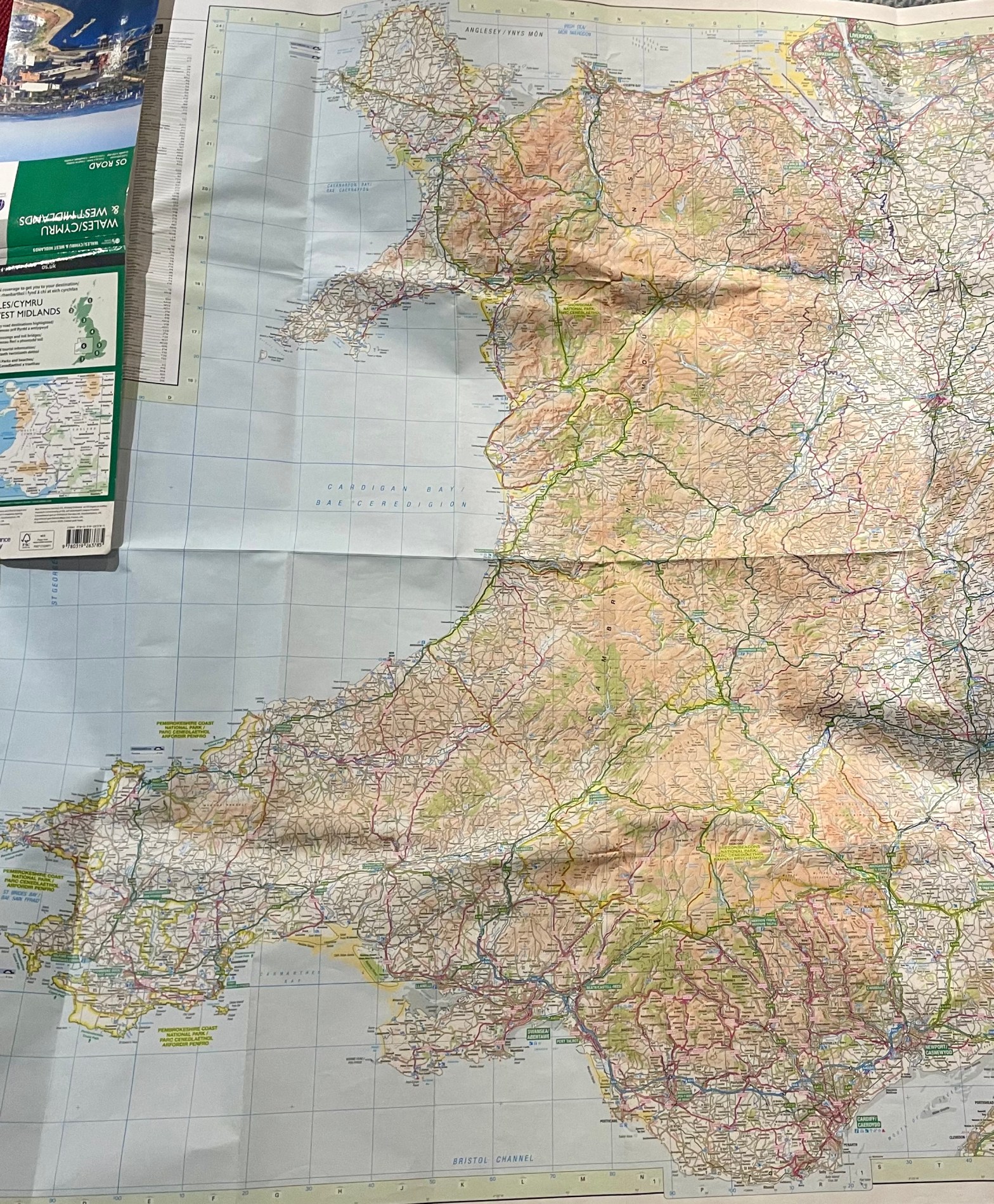
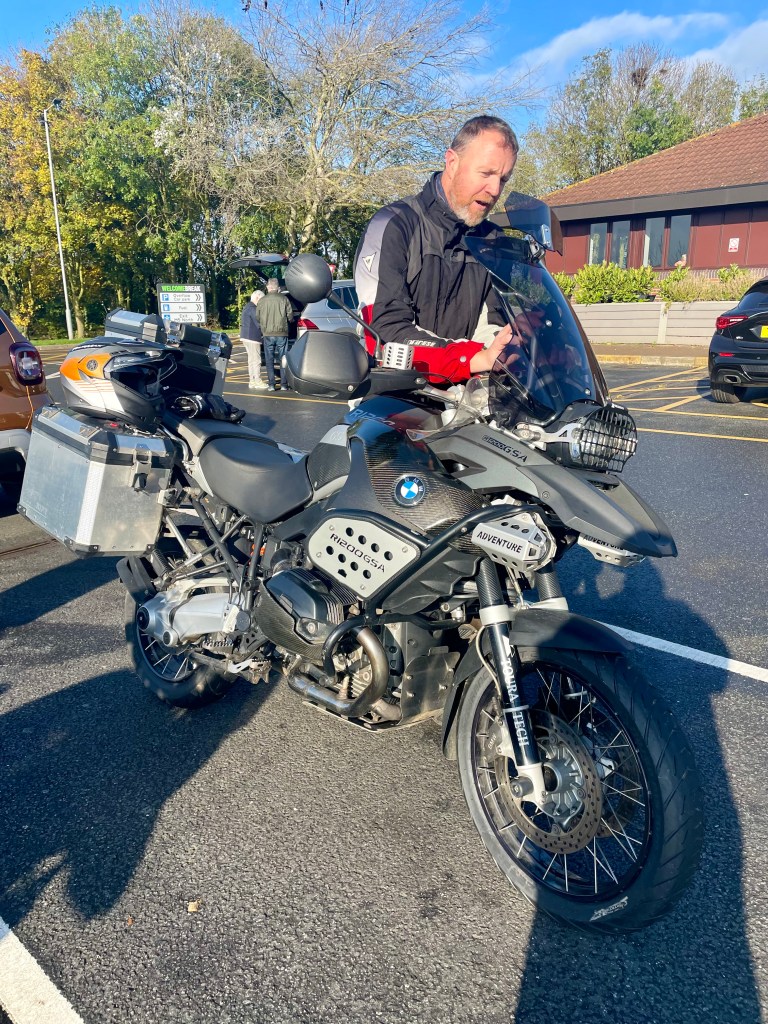
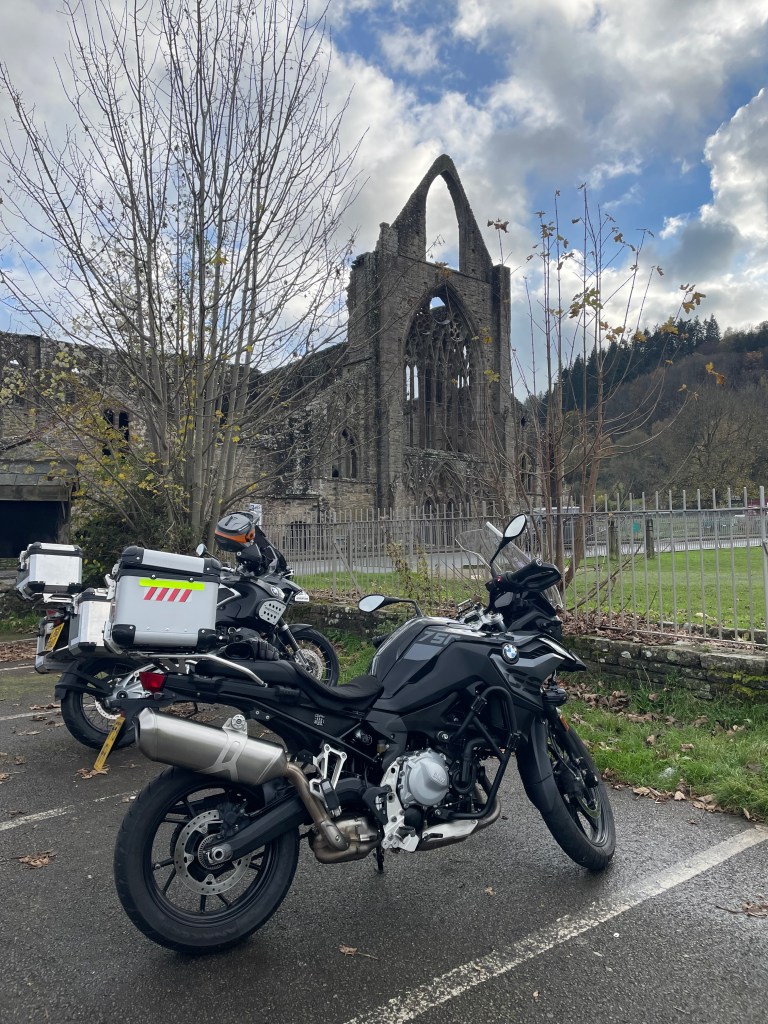
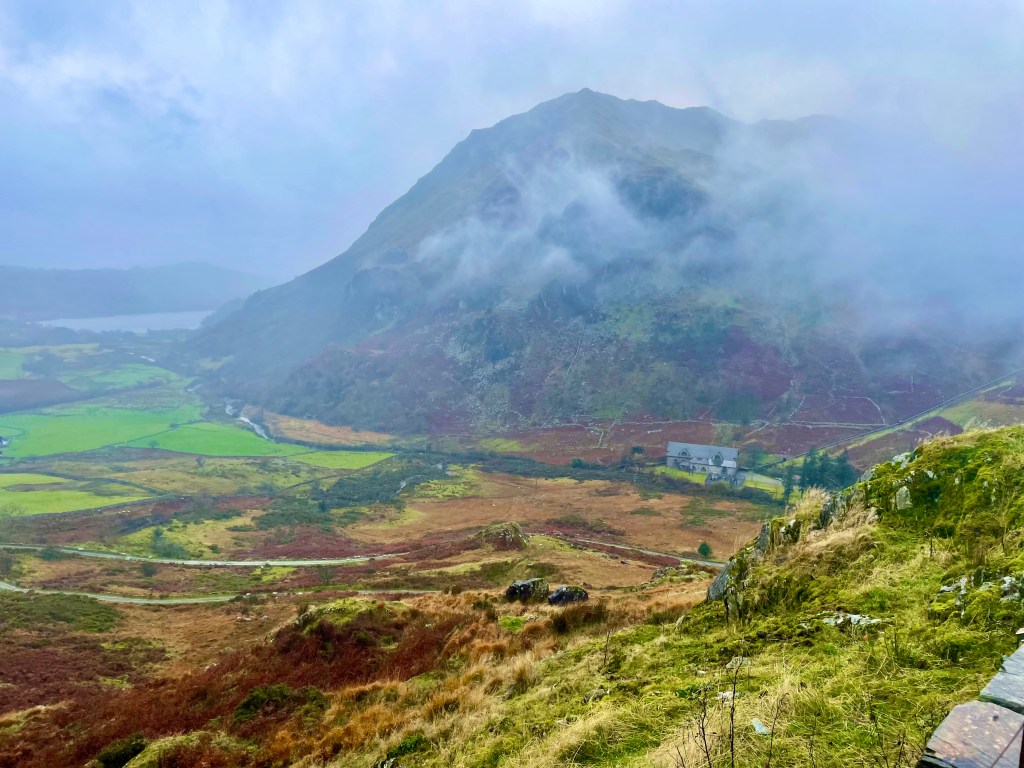
And yet only a few months before, two weeks of glorious sunshine allowed three old gits on motorcycles to tour the sunny hills and valleys of central and western Wales. Adrian, Steve and I were somehow blessed in not having to ride through gales and heavy showers as we left West Cornwall bound for Brecon, Abergavenny and Aberystwyth. Wales is not known for sunshine but we struck gold and I guess this experience set the tone for more two wheeled adventures as the clock ticks down.
God is a cantankerous, capricious bastard. The Reaper can be sent at any moment to do his bidding; which is to sever one’s neck with a quick flick of the scythe wielding wrist. Riding a motorcycle is a two fingered signal to God that we just don’t give a toss for his plans for our petty miserable lives. Cut us down if you will, you desert dwelling commandment giving, self congratulatory, narcissistic sociopath, but not before we ride like bats out of hell into the sunshine.
In France!
That’s the answer. We must go to France.
I’m currently pondering the fact that after defying the odds and basking in the Welsh sunshine, our grand plans for France might hit a few road bumps. The only uncontrollable elements? Early morning grumpiness, touchy stomachs, and Atlantic weather fronts that, even in June, have a knack for crashing our party.
And so, with hearts full of hope, Adrian, Steve, David and I are taking four motorcycles down to south east France. We are joined by Trevor, a Camborne boy, over from Australia. Trevor is hiring a small white Berlingo van as he doesn’t have a motorcycle license. He doesn’t have a British driving licence either, being an Australian resident. But he is the de facto support vehicle, able to pop into the ‘boulangeries, fromageries and charcuteries’ to keep our baguettes, cheese and meaty victualling supplies nice and fresh. Trevor might even get the beers ready for when we arrive on our bikes at the end of each riding day.
Or he might get lost in the French countryside, out of signal, tired and lonely with only a poorly scaled map and regret for company. But we have plans, we have destination locations printed off just in case of technological failures. I know that we can’t rely on simple things such as road signs in the deepest of rural France to help us. We will have to rely on wit, ingenuity and the friendliness of the locals after we leave Nantes. I have Michelin maps that do have the correct scale, but I also note that even these do not show the ‘chemins’ that lead us to our accommodation in both Peyrilhac (day 2) or Marmanhac (day three and our base).
Think of standing in a country lane, as the sun begins its descent and the early gold and orange glow becomes alive, listening to the birds singing (larks, blackbirds, swallows) and the slight rustling of wind in the leaves in the trees as all around is fields and woodland. Perhaps a tractor is working five miles away. French Country folk are popping corks safe in their country kitchens, looking forward to a decent meal of coq au vin and fresh baguette to mop up the sweetly reduced jus infused with garlic and chicken stock. While we hope we can find the house set back off the road, hidden by a hedge, with no signal and only a poorly written address that makes as much sense as a pissed up Parisian on Bastille Day. Someone will have to phone the host and embarrassingly ask in bastardised French, for directions for the final 500 metres.
Or not.
And so the plan is to leave Cornwall on Friday evening and get on board the late night ferry from Plymouth to Roscoff in Brittany. The ship departs at about 2200 hours and arrives in Roscoff at about 0800. The first day’s destination is Nantes, about 190 miles away. If we can get on board early, the beer drinkers among us can get to the bar and start quaffing ale accompanied by loud ribaldry and bawdiness as we sit among the holiday making French and British families with their small children mewling and puking over their hand held screens they refuse to let go off and their parents daren’t take away.
I promise not to fart or snore in the four berth cabin we have booked for the crossing.
We all have to get around the place. In our early years that means using our legs as the primary means of transport before being promoted to a bicycle. When that happens, we are introduced to a largely pain free, and exciting, medium of getting from A to B via all points wherever.
The bicycle.
For some of us that meant getting to school, for others it included wild carefree excursions to the coast with a packet of crisps and a bottle of pop.
All too soon there comes a time when even a bicycle is not enough and a bus is just not cool. Testosterone flushes through one’s very core, rinsing out any lasting vestige of sensible and replacing it with insanity, speed, tumescence and often the spilling of a little blood and snapping of bone. If you managed to skip the motorcycling stage and went straight instead to four wheels, then the blood letting may have been evaded.
As a young man in the 1970s, one was short of money and so the choice of car was extremely limited to old Dagenham dustbins kept together with rust, string and hope. It was the time when filler was a must to keep the rusty panels together in some form of harmony. Flash German made cars were verboten, Italian style was the abode of scooters and the French were comedy vehicles fit only for the transport of eggs across a ploughed field in Brittany rather than a serious option for the ambitious young man with an urge to impress the ladies. And so good old British design was the back stop.
We must bear in mind that Britain had designed Dreadnought Battleships, the record breaking steam engine Mallard, the Spitfire and the mini skirt. There has been a wealth of talent in this country to design things of beauty, of form and function that the world could only envy. Even the French.
Then at some point we took our eye off the ball when it came to cars. Yes, Alec Issigonis had designed the mini. But, Alec was an Englishman born in Turkey, of Greek origin and through his mother’s kinships, was a first cousin once removed to BMW and Volkswagen director Bernd Pischetsrieder. Perhaps that explains the mini exception in car design in the 1970s. For the ‘hoi polloi’, apart from this masterpiece, we were offered cars designed by some blokes down the pub after several rounds of mild and porter whose only association with any form of style was of the type of field entrance covered in cow shit.
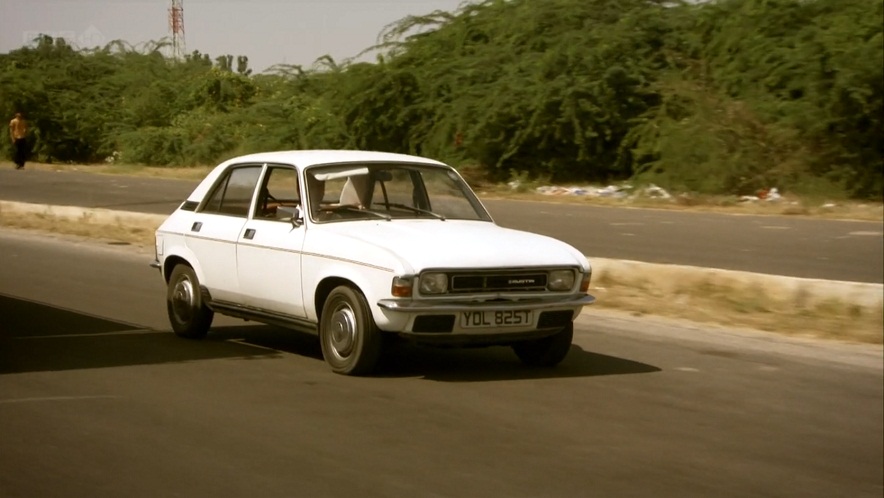
Ladies and Gentlemen, I present to you a car, which if you have not owned, seriously challenges your credentials to be a member of the beige cardigan wearing community.
I need not tell you the make or model, nor the year in which it made its first appearance. Those of you who have had the ‘joy’ of owning, repairing, riding, or dare I suggest ‘canoodling in the back seat of’ this or similar motors, will still bear the memories and the scars of that mental trauma.
Mine was white.
It was about as thrilling to drive as filling out a tax return, except less challenging. It must have been designed by burned out engineers at the end of their careers who otherwise dreamed of turning their allotments into mini Edens (but without the nudity and snakes). They were given the project on a Friday afternoon by the CEO with the remit: “Nothing fancy, mind, and don’t work late, just make it go”. They would have gnawed at the end of their HB pencils, then scribbled furiously for 10 minutes before remembering that their local pub had a happy hour which, for 2s and 6d, would provide the opportunity for a three pints of mild and a packet of salt and vinegar crisps to discuss serious matters such as the correct methods for cheese-paring.
The name of the car is a farce. And a lie.
As you know it means “at brisk speed”.
You will only find bigger fibs, and misdirection, in the Old Testament, Estate Agents’ blurb and in the vocal prelude to the performance of fellatio by over enthusiastic and inebriated youths to their gullible girlfriends.
I had the ‘joy’ of driving to work one day, and just as the car turned into the hospital’s main entrance the nearside wheel fell off causing a sudden lurch to the left and a grinding halt mid turn. Upon inspection the wheel was at 90 degrees to the body of the car. Something had completely snapped. Needless to say the car was now immovable stuck in the gateway. With the assistance of a few onlookers, who must have seen my pain, the car was pushed, scraping and grinding to one side leaving a slick of oil that a Gulf bound Tanker grounded off the rocks of the Manacles would have been proud of.
I must have paid £300 quid for what was now just a useless pile of rust infested metal, good only perhaps to be a modern art installation or a warning to the unwary car buyer. The most valuable thing about it now was the full tank of petrol and the packet of fags in the glove compartment. Thus it was necessary, before calling the scrap dealer to lift it away on a flatbed truck, to empty the tank, and to clear the interior of detritus such as crisp packets, chewing gum and a year old packet of rusty condoms kept in the glove box for ‘just in case’. This was the 1980’s when hope was still alive for such matters.
When the scrap dealer turned up to tow it away, it was with mixed emotions. On the one hand, a little sorrow as I was now without transport. On the other hand, I was as relieved to see the back of it as a man on death row seeing his sentence commuted to a life organised around wine, cherries and an endless supply of willing female entertainers bent on using an ostrich feather in an amusing fashion.
A car is a car. It is merely an means to an end. Some have a frisson of excitement about them, some are reliable, some are cheap to run. Many are destined to be assigned to the sluice of history removing all traces of their existence in one’s consciousness lest wellbeing, dignity and sanity is flushed down Satan’s u bend.
TLDR: The political future depends less on the existence of grievance than on who succeeds in converting it into collective agency, and what kind of ‘we’ they construct?
This paper examines how shared economic, social and ecological pressures acquire political form in contemporary democracies. Its starting proposition is that structural conditions do not generate collective political responses automatically. Grievances must be interpreted, incorporated into collective identities, organised, mobilised and ultimately converted into institutional power. Drawing on Marx’s account of class formation, Polanyi’s analysis of market society, Gramsci’s theory of hegemony, Olson’s analysis of collective action and Scambler’s concept of the fractured society, and integrating these with research on framing, collective identity, political opportunity, organisational resources and collective efficacy, the paper develops a heuristic Collective Agency Conversion Chain:
structural condition→grievance→interpretation→collective identification→organisation→mobilisation→institutional power
The argument does not assume a general decline in collective agency. Evidence instead indicates the weakening of some historically important forms of institutionally embedded collective agency, particularly trade unionism and collective bargaining, alongside a broader recomposition of political cleavages and collective identities (Gethin, Martínez-Toledano and Piketty, 2022; OECD, 2025; Department for Business and Trade, 2026). Radical-right and ethnonationalist movements form one important part of this recomposition. Comparative European evidence suggests that their mobilisation cannot be reduced to economic grievance and depends upon combinations of cultural grievance, political opportunity, media visibility and organisational resources (Castelli Gattinara, Froio and Pirro, 2022).
Perceived collective efficacy is treated as an important conditioning mechanism. People may recognise a grievance and identify with a collectivity while remaining inactive if they doubt that collective action can alter outcomes (van Zomeren, Postmes and Spears, 2008). Recent European evidence linking inequality with lower external political efficacy and political trust provides one possible route from structural inequality towards political fatalism (Bienstman, Hense and Gangl, 2024).
Digital platforms further modify the conversion process by reducing some organisational costs and altering the structure of political communication. Evidence that recommendation systems produce political effects is significant but heterogeneous and platform-specific. These transformations are occurring during measurable deterioration across several Earth-system processes and increasing climate-related risks (IPCC, 2022; Sakschewski et al., 2025).
The paper proposes Collective Agency Conversion Efficiency as a comparative hypothesis concerning the ability of competing political formations to translate grievances into durable institutional power. Three broad outcomes are considered: solidaristic collective agency, exclusionary collective agency and political fatalism. The central empirical question is which conditions determine movement along these different pathways as ecological and socioeconomic pressures intensify.
Introduction
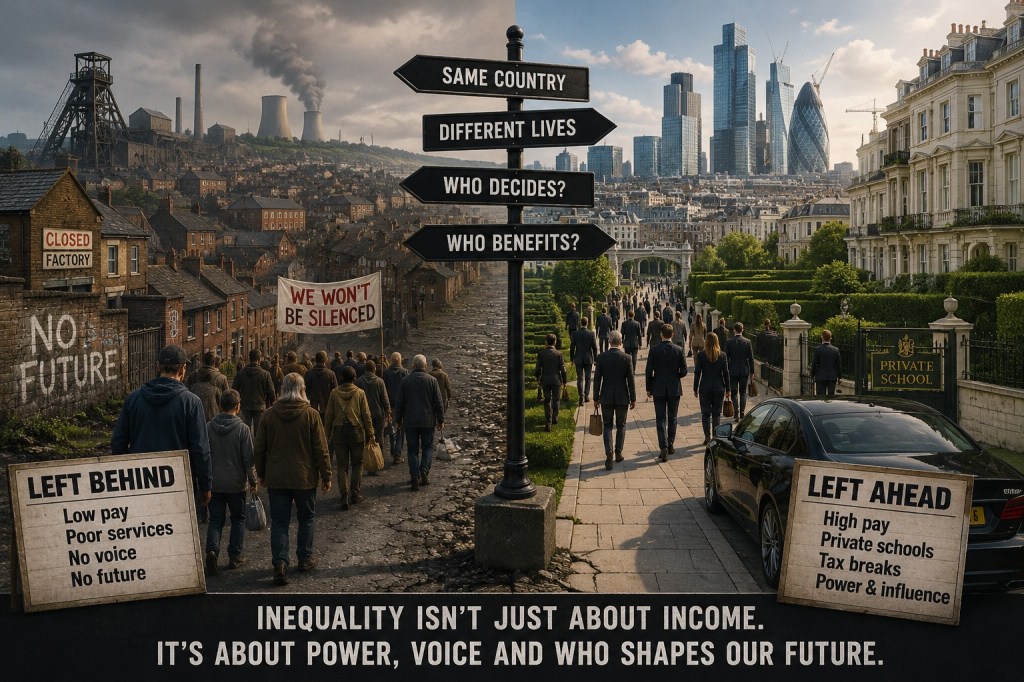
Contemporary democratic societies combine considerable aggregate wealth and scientific capacity with persistent economic inequality, institutional distrust, housing insecurity, pressure upon public services and increasing ecological constraints. Governments retain substantial formal powers to tax, regulate, redistribute, provide services and determine many of the institutional conditions within which markets operate. Possessing those powers does not establish the political conditions under which governments can use them, nor the direction in which they will be used.
That distinction directs attention towards an older sociological problem: how shared social conditions become organised political forces.
Marx identified an early form of this problem. Common economic circumstances could create shared material interests without producing a politically organised class. Political organisation had to be formed through struggle (Marx, 1847/1976). Polanyi (1944/2001) later demonstrated how the extension of market relations could generate pressures for social protection, while offering no guarantee about the political form those responses would take. Olson (1965) showed why the existence of shared interests provides no assurance of collective action. Gramsci (1971) placed political interpretation and the construction of common sense at the centre of struggles for social power.
Contemporary social-movement research gives these processes a more explicit empirical vocabulary. Collective-action frames diagnose problems, attribute responsibility, propose responses and supply reasons for action. Collective identities help explain how people come to understand themselves as participants in common projects. Political opportunities and organisational resources affect whether mobilisation becomes possible and sustainable (Benford and Snow, 2000; Polletta and Jasper, 2001; McAdam, Tarrow and Tilly, 2001).
Social-psychological research adds another mechanism. Van Zomeren, Postmes and Spears’ (2008) meta-analytic synthesis found that perceived injustice, social identity and efficacy each predict collective action. People may share a diagnosis and recognise a common identity while remaining inactive if they believe collective action cannot influence institutions or outcomes.
These literatures suggest that the central problem is one of conversion: how structural conditions become grievances, how grievances acquire shared interpretations, how interpretations contribute to collective identities, and how those identities acquire organisational and institutional force.
This problem has acquired renewed significance because the institutional and electoral structures through which collective interests were organised during much of the twentieth century have changed substantially. Trade-union density and collective-bargaining coverage have declined across many advanced economies (OECD, 2025). Comparative electoral research demonstrates a long-term restructuring of the relationship between education, income and party support (Gethin, Martínez-Toledano and Piketty, 2022). Collective agency has therefore been recomposed as well as weakened in particular institutional forms. Nationalist and radical-right movements show that substantial mobilisation remains possible, while environmental and other social movements provide further evidence against a simple thesis of generalised political atomisation.
Digital platforms have simultaneously altered the communicative environment through which grievances are interpreted and political identities constructed. These developments are occurring while climate change and other Earth-system pressures increasingly require sustained forms of coordination extending across electoral cycles and national boundaries (IPCC, 2022; Sakschewski et al., 2025).
The present paper does not attempt to provide a general account of inequalities organised around race, gender or other ascriptive social divisions. These constitute substantial and developed fields of inquiry in their own right. The analytical scope here is narrower: the institutional, interpretive and organisational mechanisms through which structural pressures are converted into collective political agency. Collective identification is therefore central to the argument, while the paper does not attempt a substantive sociology of particular identity categories.
The paper asks why shared vulnerability may be converted into solidaristic political organisation in some circumstances, exclusionary or authoritarian mobilisation in others, and fatalism or withdrawal elsewhere. The argument is deliberately provisional. Ecological deterioration and the decline of particular forms of organised labour can be measured with relative confidence. The comparative capacity of competing political formations to convert grievances into durable institutional power is harder to establish. That difference in evidential strength is central to the analysis.
Markets, protection and countervailing institutions
Polanyi’s The Great Transformation provides a useful starting point because it challenges the treatment of markets as naturally occurring arrangements that emerge whenever states withdraw. Markets require institutions. Property has to be defined, contracts enforced, currencies maintained and decisions made about which resources, activities and relationships may legitimately be organised through exchange. Market societies are therefore political constructions as well as economic systems (Polanyi, 1944/2001).
Polanyi’s description of labour, land and money as ‘fictitious commodities’ is especially relevant. Labour involves human beings and their capacity to work; land encompasses the natural environment upon which social life depends; money is an institutional creation. Organising these entirely according to market signals has consequences extending beyond individual transactions. Labour markets affect family life, health and community security. Land use affects ecosystems and access to resources. Financial systems affect investment, housing and macroeconomic stability.
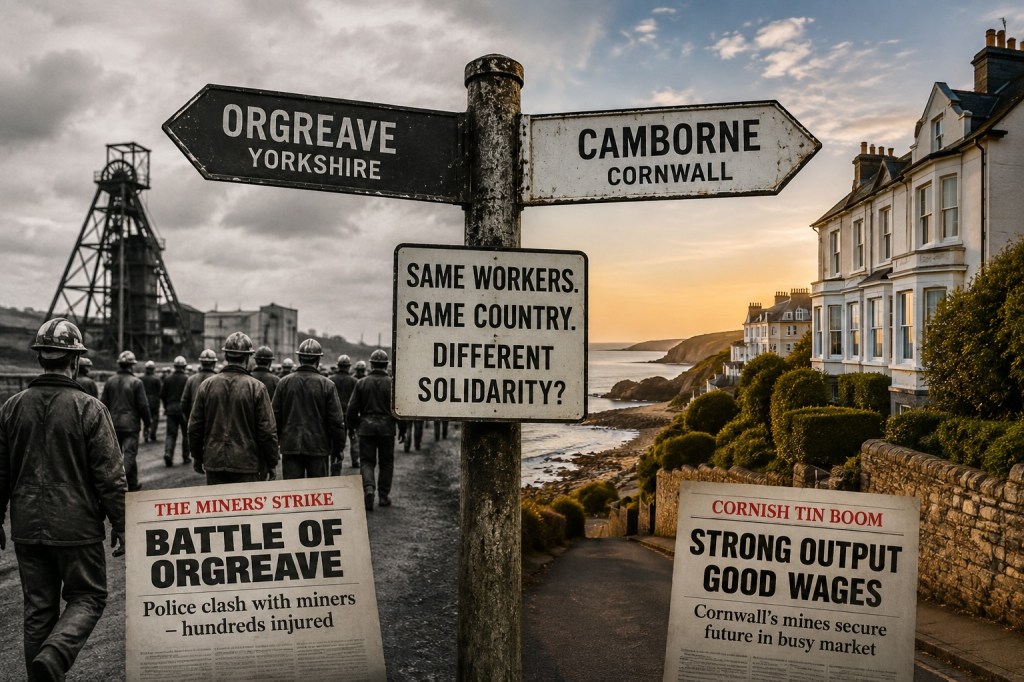
Polanyi’s double movement describes the historical tendency for market expansion to generate pressures for social protection. Trade unions, factory legislation, social insurance, public provision and economic regulation represented different institutional responses to the disruptive consequences of marketisation. The post-war European settlement provided an unusually extensive expression of this tendency. Organised labour, collective bargaining, welfare provision, public services, progressive taxation and macroeconomic management constrained important aspects of market power without eliminating markets.
Galbraith’s concept of countervailing power captures one institutional mechanism within this settlement. Concentrated economic power could be checked by other organised centres of power, including trade unions, regulators and governments (Galbraith, 1952). The relevant unit was organisation. Individual workers and consumers generally possessed fewer resources than large corporations. Collective institutions altered the balance.
This matters because political accounts focused upon individual preferences can obscure the institutional distribution of resources. A large corporation enters a policy dispute with capital, legal and technical expertise, established access to government and the capacity to alter investment decisions. An individual employee or consumer normally possesses none of these at comparable scale. Organisation changes the relationship.
From the late 1970s, the institutional balance shifted across many advanced economies through varying combinations of privatisation, financial liberalisation, tax reform, restrictions upon trade-union activity and the extension of market mechanisms into domains previously organised more extensively through public provision or collective regulation. The extent and timing differed markedly between countries. The category ‘neoliberalism’ can conceal that variation if used carelessly. One measurable consequence, however, has been a substantial decline in organised labour.
Across the OECD, average union density fell from approximately 30 per cent in 1985 to 15 per cent in 2023–24. Collective-bargaining coverage fell from 47 per cent to 33.6 per cent. Employer organisation remained considerably more stable, with around 55 per cent of private-sector employees working in firms affiliated to an employer organisation in 2023–24 (OECD, 2025). The asymmetry matters because employers enter bargaining and political processes through organisations that already aggregate resources and interests.
Britain demonstrates the longer trajectory clearly. Trade-union membership reported by unions peaked at 13.2 million in 1979. Labour Force Survey estimates indicate that 6.6 million UK employees were union members in 2025, giving an employee union density of 22.4 per cent. Density had fallen from 32.4 per cent in 1995. The 2025 estimate represented a small increase from 22.0 per cent in 2024, and the official bulletin advises caution in interpreting short-term movements because the Labour Force Survey series is currently classified as official statistics in development (Department for Business and Trade, 2026).
The long-run pattern remains clear, but it should not be represented as an uninterrupted annual decline.
These data establish the weakening of one historically important infrastructure of collective agency. They do not establish a general decline in collective agency itself.
Trade unions historically performed functions extending beyond wage negotiation. Branches, shop stewards, workplace meetings, ballots, political education and industrial disputes created settings in which private experiences could acquire collective interpretations. A dispute about an individual wage could become a question about bargaining power. Redundancy could become a discussion about investment and ownership. Unsafe work could become a collective issue rather than a private misfortune.
The decline of this infrastructure therefore raises a question about what has replaced it. It does not permit the assumption that people have ceased to organise collectively.
From structural position to collective agency
Marx provides an early formulation of the conversion problem. In The Poverty of Philosophy, economic conditions produce a mass of people sharing interests in relation to capital, but political struggle is required before that population constitutes itself as an organised class (Marx, 1847/1976). The later textbook distinction between a ‘class in itself’ and a ‘class for itself’ tidies Marx’s language, but the underlying analytical problem remains valuable.
Shared circumstances do not contain their own political interpretation.
A nurse, warehouse worker, pensioner, self-employed tradesman and delivery driver may all experience high housing costs, deteriorating public services or economic insecurity. They may explain those experiences through entirely different causal accounts. Capitalism, immigration, taxation, globalisation, government incompetence, wealthy elites, environmental regulation and personal failure can all be invoked as explanations for overlapping experiences.
The existence of a shared condition therefore tells us relatively little about the politics that will follow.
Thompson’s historical account of class formation reinforces this point. Class is formed through relationships and historical experience rather than simply assigned through occupational categories or income distributions (Thompson, 1963). Political collectivities are constructed within structural circumstances. They do not simply emerge from them.
For present purposes, collective agency refers to the socially organised capacity of people who recognise some significant common condition or interest to develop shared interpretations of that condition, coordinate resources and action, sustain collective organisation and influence social or political institutions.
The definition is intentionally politically neutral. Trade unions possess collective agency. So can environmental movements, nationalist movements, religious organisations, civil-rights movements and fascist movements. The existence of collective agency tells us nothing by itself about the moral quality of the project being pursued.
This allows a more precise diagnosis of contemporary change. Some forms of collective agency have weakened, particularly those rooted in organised labour and some traditional mass political organisations. Other forms have developed or expanded. The problem concerns recomposition, distribution and political direction.
The Collective Agency Conversion Chain
The processes through which shared conditions acquire political force can be represented heuristically as:
structural condition→grievance→interpretation→collective identification→organisation→mobilisation→institutional power
I refer to this sequence as the Collective Agency Conversion Chain.
Its components are not novel discoveries. The contribution lies in bringing together mechanisms already established across class analysis, collective-action theory, social-movement research and political psychology and using them as a common framework for comparing competing forms of political agency.
Olson (1965) demonstrated why shared interests need not generate collective action. Individuals may benefit from successful collective action regardless of whether they bear the costs of participation, creating familiar free-rider problems. Concentrated interests also possess organisational advantages over large populations receiving diffuse benefits. A small number of firms facing large regulatory costs have a stronger incentive to organise than millions of citizens each receiving a modest dispersed benefit. Corporations also arrive already organised, with budgets, professional staff and institutional memory.
Social-movement research adds processes that a purely material account cannot adequately explain. Benford and Snow (2000) show how collective-action frames identify problems, attribute causes, propose responses and provide motivations for participation. Framing is part of the mechanism through which grievance acquires political meaning.
Polletta and Jasper (2001) identify collective identity as another important component. People mobilise partly through understandings of who ‘we’ are, the boundaries surrounding that category and the relationship between individual identity and collective projects. Collective identity cannot simply be inferred from structurally given interests.
Political-process and contentious-politics approaches further demonstrate that mobilisation depends upon political opportunities, organisational networks and interactions with institutions and opponents (McAdam, Tarrow and Tilly, 2001). Political movements consequently emerge through combinations of grievance, interpretation, identity, resources and opportunity.
The Social Identity Model of Collective Action adds perceived efficacy to this account. Van Zomeren, Postmes and Spears (2008), synthesising 182 effects across three meta-analyses, found that perceived injustice, identity and efficacy each contribute to collective action. Efficacy refers here to the belief that coordinated group action can affect relevant outcomes. It therefore conditions movement through the middle stages of the Conversion Chain.
This does not require another formal stage. Perceived efficacy can affect several transitions simultaneously. It can influence whether grievance is understood as politically actionable, whether collective identification produces commitment, whether organisations recruit successfully and whether mobilisation is sustained.
The Conversion Chain should therefore be treated as recursive and conditional. Organisations generate identities. Political entrepreneurs can construct frames before widespread grievance becomes coherently articulated. Mobilisation can create organisations. Institutional reforms can generate constituencies that later organise to defend them. Successful action can increase perceptions of efficacy, while repeated political failure can reduce them.
The sequence is a heuristic for locating transitions and blockages rather than a deterministic chronology.
This distinction also prevents political visibility from being confused with political capacity. A movement attracting millions of social-media interactions may possess fewer durable organisational resources than a union with a much smaller membership, professional negotiators, legal resources, institutional recognition and the capacity to withdraw labour. Mobilisation, organisation and institutional power therefore require separate measurement.
Political Recomposition
The decline of organised labour might once have supported a relatively straightforward account of declining class politics. Comparative electoral evidence makes the contemporary picture more complicated.
Gethin, Martínez-Toledano and Piketty (2022), examining more than 300 elections across 21 Western democracies between 1948 and 2020, document a substantial long-term transformation in the social composition of left and right electorates. In the 1950s and 1960s, lower-income and lower-educated voters were more strongly associated with social-democratic, socialist and affiliated parties. Over subsequent decades, higher-educated voters increasingly moved towards parties of the left while high-income voters remained more likely to support parties of the right. The authors describe an increasing disconnection between the political effects of income and education and argue that many Western party systems have become more multidimensional. The rise of green and anti-immigration parties contributed to this development, although it explains only part of the longer transformation.
The importance of this finding lies less in the labels ‘Brahmin left’ and ‘merchant right’ than in the evidence that political cleavage cannot now be read straightforwardly from income or occupational position. Gethin, Martínez-Toledano and Piketty explicitly caution that their evidence does not provide a complete causal explanation of the realignment (2022). Their findings establish a long-run empirical pattern rather than a comprehensive theory of why it occurred.
For collective agency, the implication is substantial. The older pathway connecting occupational position, class identification, trade-union organisation and party affiliation has become less reliable. Economic position continues to matter, but it intersects with education, housing tenure, age, geography, cultural values and attitudes towards migration and national identity.
This also weakens any assumption that a coherent political constituency exists waiting to recognise its objective economic interests.
Individuals can possess materially cross-cutting interests. A homeowner may favour rising property values while worrying about their children’s inability to afford housing. A pension holder may benefit from corporate profitability while supporting higher wages. A worker may favour cheaper energy while also supporting decarbonisation. A small-business owner can experience both the autonomy of ownership and considerable economic insecurity.
Political collectivities have to be constructed across these contradictions.
That strengthens the Gramscian component of the argument.
Hegemony and the struggle over interpretation
Gramsci’s concept of hegemony concerns the capacity of particular understandings of social life to become embedded within common sense. Political power depends upon institutions and material resources, but also upon the ability to make particular interpretations appear plausible, normal and legitimate (Gramsci, 1971).
Periods in which established political explanations lose authority create opportunities for competing projects. Gramsci’s concept of an interregnum has frequently been used to describe such periods, although its application to contemporary politics should remain provisional.
An empirical account of an interregnum would require more than widespread dissatisfaction. Relevant indicators might include weakening identification with established parties, declining institutional trust, electoral volatility, the growth of challenger parties, fragmentation of political narratives and the absence of a stable successor settlement.
The important point for the present argument concerns interpretation. Societies can contain widespread agreement that conditions are deteriorating alongside profound disagreement about causes.
Housing shortages can be attributed to inadequate construction, financialisation, planning restrictions, migration, second-home ownership, population distribution or combinations of these. Stagnant wages can be attributed to weak productivity, globalisation, employer power, migration, taxation, automation or trade-union decline. Deteriorating public services can be attributed to inadequate funding, poor productivity, privatisation, demographic change, migration, managerial inefficiency or excessive demand.
These explanations have different empirical merits. Politically, they also construct different collectivities.
The causal story helps determine the ‘we’, the adversary and the plausible response.
Fracture, efficacy and fatalism
Scambler’s concept of the fractured society adds an outcome easily overlooked when political analysis concentrates upon mobilisation. Economic insecurity, inequality and cultural disorientation may produce forms of disconnected fatalism characterised by abandonment, bitterness, impotence and alienation (Scambler, 2018).
The concept becomes more empirically tractable when connected to research on political efficacy.
Political efficacy is conventionally divided into internal efficacy, concerning an individual’s sense of competence in understanding and participating in politics, and external efficacy, concerning the perceived responsiveness of political institutions to citizens. Low external efficacy therefore captures a proposition central to political fatalism: the belief that institutions are unlikely to respond regardless of what ordinary citizens do.
Bienstman, Hense and Gangl (2024), using time-series cross-sectional data from the European Social Survey, examine whether inequality contributes to political distrust through its effects on external efficacy. They find that increases in income inequality are associated with declines in external political efficacy and political trust, while mediation analysis suggests that lower efficacy accounts for part of the relationship between inequality and distrust.
The finding does not establish that inequality mechanically produces political withdrawal. It identifies a plausible pathway. Structural inequality may alter citizens’ perceptions of institutional responsiveness, which can in turn affect trust and the perceived utility of political participation.
Fatalism matters because grievance does not necessarily proceed towards organisation. People can conclude that collective political action is futile. Under those conditions, adaptation becomes increasingly private. Individuals attempt to protect their own income, property, pension, family and immediate security. Political anger can remain intense while confidence in collective solutions declines.
This suggests a possible feedback process:
inequality or insecurity→reduced external efficacy→distrust→weaker collective participation→inadequate institutional response→further distrust
The sequence remains a hypothesis. Its components require independent measurement and causal direction may run both ways.
It nevertheless sharpens the third destination for grievance alongside competing solidaristic and exclusionary projects.
Shared vulnerability may contribute to solidaristic agency where common interpretations, identification and collective efficacy develop.
It may contribute to exclusionary agency where a bounded political ‘we’ is constructed alongside a credible narrative of restoration or control.
It may contribute to fatalism where grievances are recognised but collective efficacy remains low.
Economic resources and political power
Economic inequality matters to this argument principally through the resources and opportunities it distributes.
Bourdieu’s distinction between economic, cultural, social and symbolic capital provides one account of how advantages acquired in one domain can be converted into advantages elsewhere (Bourdieu, 1986). Economic resources can purchase education, professional expertise, security and access to networks. Cultural resources affect navigation through institutions. Social connections provide access. Symbolic resources affect credibility and legitimacy.
Lindblom (1977) adds the structural position of business. Governments operating within predominantly private economies depend upon investment for employment, production and taxation. Policy-makers therefore have incentives to anticipate the responses of investors even in the absence of explicit lobbying.
This produces two distinguishable forms of business power. Instrumental power operates through lobbying, political finance, policy networks and access. Structural power operates through the anticipated economic consequences of investment decisions.
Neither should simply be assumed.
Gilens and Page’s (2014) analysis of 1,779 US policy issues found substantial independent associations between the preferences of economic elites and organised business interests and policy outcomes, while average citizens showed little or no independent influence once preferences were considered simultaneously. The study concerns the United States, operates within distinctive American institutions and has generated methodological debate. It cannot establish an equivalent distribution of influence in Britain or elsewhere.
Its relevance here is methodological. Claims about the conversion of economic resources into political influence can be tested.
Lukes’s three-dimensional conception of power provides a useful clarification of where such influence can operate (Lukes, 1974/2005). Power may be visible in observable decisions. It may operate through control over agendas, determining which questions become politically actionable. It may also operate earlier, through processes affecting preferences, assumptions and perceptions of what is possible.
These dimensions correspond to mechanisms already present in the argument. Gilens and Page concern observable policy influence. Lindblom’s structural power partly concerns agenda formation and anticipated constraints. Gramscian hegemony concerns the interpretive environment within which interests and possibilities are understood.
The third dimension raises difficult questions about the identification of ‘real interests’, and those questions are not resolved here. Lukes is therefore used as a typology of locations at which power can operate rather than as a claim that an analyst can determine people’s interests independently of their expressed preferences.
This distinction matters for the Conversion Chain. Power does not enter only at its final stage. It can affect which structural conditions become recognised as grievances, which explanations receive public visibility, which collective identities appear legitimate and which political alternatives enter institutional debate.
Ecological constraint
The ecological side of the analysis rests upon a comparatively strong empirical foundation.
The planetary-boundaries framework identifies Earth-system processes associated with maintaining relatively stable conditions for human societies. The 2025 Planetary Health Check assessed seven of nine planetary boundaries as transgressed, with ocean acidification becoming the seventh boundary assessed as outside the proposed safe operating space (Sakschewski et al., 2025).
These boundaries should not be described as seven irreversible tipping points. They represent risk thresholds and increasing departure from a proposed safe operating space. The framework itself involves scientific judgements about control variables and boundary placement and should not be treated as a literal countdown to societal collapse.
The IPCC provides a separate and much broader evidence base. Human-induced climate change has already caused widespread adverse impacts and related losses and damages to nature and people. Vulnerability differs substantially within and between regions, and some human and natural systems have already encountered adaptation limits (IPCC, 2022).
The political significance arises because ecological pressures are socially mediated.
Heat, flooding, crop losses, water scarcity, insurance costs, energy prices and migration affect populations differently according to income, housing, infrastructure, welfare provision and state capacity. Ecological pressures therefore enter existing distributions of resources and political conflict.
A plausible mechanism is:
ecological pressure→distributional consequences→grievance→competing interpretations→mobilisation or fatalism
No political outcome follows inevitably from ecological pressure. A food-price shock can encourage demands for redistribution or hostility towards outsiders. Climate-related migration can generate international cooperation or border fortification. Energy insecurity can produce accelerated investment in renewables or demands to slow decarbonisation.
The ecological crisis intensifies the conversion problem without solving it.
Radical-right collective agency
The rise of radical-right and ethnonationalist politics provides a strong reason for rejecting a simple thesis of declining collective agency. These movements demonstrate substantial capacities for political identification and mobilisation.
The empirical literature also cautions against explaining their growth primarily through economic insecurity.
Castelli Gattinara, Froio and Pirro (2022) analysed 4,845 far-right protest events across 11 East and West European countries between 2008 and 2018. Their findings show that classical social-movement explanations can be fruitfully applied to far-right mobilisation. Cultural grievances, particularly concerns surrounding immigration, political opportunities and organisational resources all matter. Media visibility, networks among nativist organisations and access to elected representatives contribute to mobilisation.
The study is particularly useful here because it treats the far right as a mobilisation problem rather than assuming that political support follows mechanically from immigration levels or economic deterioration.
This changes the causal story.
Economic insecurity may contribute to the context within which mobilisation occurs, but grievance is multidimensional. Cultural change, immigration, political distrust, national identity and perceived status loss can enter the conversion process alongside material insecurity.
Radical-right movements may be effective at connecting these grievances through accessible narratives.
National decline provides a diagnosis.
Elite betrayal attributes responsibility.
National identity constructs the collective subject.
Outgroups or institutions can provide adversaries.
Political restoration supplies a programme.
The empirical accuracy of each component requires separate investigation. The sociological mechanism concerns the capacity of the narrative to organise experiences that might otherwise remain disconnected.
National identity has a particular advantage as a basis of collective identification because it can cross economic positions. A pensioner, warehouse worker, small-business owner and professional may possess conflicting material interests while all recognising themselves as British. Political narratives that transform this broad identity into a threatened political community can therefore construct solidarities that do not depend upon shared class position.
This does not make nationalism intrinsically authoritarian or exclusionary. Civic nationalisms can construct relatively inclusive political communities. The analytical issue concerns how the boundaries of the collective ‘we’ are defined, which adversaries are identified and what political consequences follow.
The digital public sphere
Political conversion increasingly occurs within a communications environment very different from that inhabited by Marx, Polanyi or Gramsci.
Habermas’s concept of the public sphere provides a useful institutional starting point. Democratic political life requires communicative spaces through which social experiences become matters of public discussion and through which opinion can influence political institutions (Habermas, 1989).
Digital platforms have greatly expanded opportunities for participation in those processes. They reduce the cost of publication, allow movements to communicate directly with supporters and enable geographically dispersed individuals to discover one another rapidly. They are also predominantly privately governed infrastructures whose ranking and recommendation systems determine a substantial part of what users encounter.
This alters parts of the Conversion Chain.
A conventional pathway might require grievance to become interpretation and identity before organisations coordinate mobilisation. Digital networks can permit more immediate movement from interpretation and identity towards networked mobilisation. Formal organisation can sometimes be bypassed, at least temporarily.
The empirical evidence concerning political effects requires caution.
Huszár et al. (2022), analysing Twitter’s algorithmic amplification across several countries, found greater amplification of mainstream political-right content than political-left content in six of seven countries studied. They did not find evidence that extreme political groups received greater amplification than moderates.
More recent experimental evidence from X provides stronger causal evidence. Gauthier et al. (2026) randomly assigned US X users to algorithmic or chronological feeds over seven weeks. Algorithmic exposure increased engagement and exposure to conservative content and shifted some political attitudes in a conservative direction. Effects were not found across all political outcomes.
Those findings should not be generalised into a universal theory of social-media effects.
Guess et al. (2023), in a large experiment during the 2020 US election, found that replacing Facebook and Instagram algorithmic feeds with reverse-chronological feeds substantially altered users’ behaviour and information exposure but did not significantly change issue polarisation, affective polarisation, political knowledge or other key attitudes during the study period. A related deactivation experiment likewise found several political-attitude and turnout effects close to zero (Allcott et al., 2024).
A recent integrative review of 52 peer-reviewed studies of political communication on Twitter/X reinforces this conditional interpretation. Naranjo-Vinueza et al. (2025) identify interactions among actor strategy, audience behaviour, platform architecture, algorithmic mediation, trust and legitimacy. Their review is limited to Twitter/X and studies published through 2024, so it cannot provide a general theory of platform effects. Its relevance here lies in supporting a relational and platform-specific account of political communication.
The defensible conclusion is narrow. Some recommendation systems can produce politically asymmetric amplification and measurable political effects. The magnitude and direction of those effects vary across platforms, users and political contexts. Claims that ‘the algorithm’ generally radicalises users exceed the available evidence.
This creates an unusual methodological problem.
Social media is simultaneously part of the causal environment and one of the places through which observers attempt to judge political strength.
A feed is not a representative sample.
Highly motivated minorities can generate disproportionate quantities of material. Engagement-based systems can increase the visibility of contentious content. Repetition can create perceptions of prevalence whose relationship with population-level opinion is uncertain.
Yet amplification can also alter political reality.
A plausible sequence is:
existing support→disproportionate visibility→perceived prevalence→normalisation→agenda-setting→increased support
Social media can therefore make a movement appear larger than it is while helping it become larger than it was.
This is one reason why claims that the radical right is ‘winning’ cannot be established from online visibility.
From mobilisation to institutional power
The final stages of the Conversion Chain are easily neglected.
Mobilisation does not guarantee institutional power.
Digital communication can generate rapid identification and episodic mobilisation while producing organisations with little durability, expertise or governing capacity. Institutional influence requires leadership, finance, candidates, professional expertise, organisational memory, coalition-building and the ability to operate within or transform existing institutions.
This distinction applies equally to progressive movements. Large demonstrations may have limited policy effects. Smaller organisations with institutional access may produce significant regulatory or legislative change.
Collective bargaining illustrates the importance of institutionalisation. OECD evidence shows that countries with widespread sectoral or multi-employer agreements can retain high bargaining coverage even where union membership itself is comparatively modest (OECD, 2025).
England’s developing fair-pay agreement for adult social care provides a contemporary example. The Employment Rights Act 2025 created powers for a sector-wide collective-bargaining framework. The government’s July 2026 response states that the Adult Social Care Negotiating Body will be established during 2026–27, negotiations for the 2028–29 financial year are expected to begin around April 2027, and the first agreement is intended to take effect in April 2028 (Department of Health and Social Care, 2026).
The example complicates any linear account in which widespread political consciousness must precede institutional change. Institutions can create experiences of collective determination, and those experiences may subsequently strengthen collective identification, efficacy and organisation.
This is where Erik Olin Wright’s analysis adds an important final component. Wright distinguishes among ruptural, interstitial and symbiotic strategies of social transformation and examines how institutional arrangements can increase the capacity of social actors to exercise power over economic and political conditions (Wright, 2010). For the present argument, the important point concerns institutional reproduction rather than the wider socialist project within which Wright develops it.
Successful collective agency can create institutions that alter the conditions of subsequent collective action.
A cooperative, union recognition agreement, sectoral bargaining institution, community organisation or participatory political structure may produce an immediate outcome while also creating organisational resources, expectations, relationships and experience. Institutions can therefore store and reproduce collective capacity.
Wright’s concept of positive class compromise is also relevant. Under some conditions, strong organised labour may produce arrangements that improve workers’ position while solving coordination or productivity problems for employers (Wright, 2000). Countervailing power need not operate exclusively through zero-sum confrontation.
This extends the recursive character of the Conversion Chain. Institutional power is an outcome, but it can also become an input into subsequent rounds of collective agency.
The chain therefore ends analytically at institutional power without implying that the social process itself ends there.
Collective Agency Conversion Efficiency
The central comparative hypothesis can now be stated more precisely.
Collective Agency Conversion Efficiency refers to the comparative capacity of political formations to translate grievances into shared interpretations, collective identities, organisation, mobilisation and durable institutional power.
The concept is proposed as a research heuristic rather than an established measure.
Its components should not initially be collapsed into a single index.
Possible indicators include organisational membership, activist networks, financial resources, electoral support, media reach, offline mobilisation, organisational persistence, coalition formation, agenda-setting influence, effects upon established parties, institutional representation and demonstrable policy outcomes.
Perceived collective efficacy is related to, but distinct from, Conversion Efficiency. The former concerns actors’ beliefs about whether collective action can succeed. The latter concerns the observable capacity of a political formation to convert grievance into political power. The two may interact. A movement that repeatedly demonstrates effectiveness may increase perceived efficacy among potential supporters; repeated failure may reduce it.
Different movements may perform very differently across the dimensions of conversion.
A digital movement may possess enormous reach and weak organisation.
A union may possess modest public visibility and considerable institutional leverage.
A radical-right party may exercise agenda-setting power while remaining outside government.
An environmental organisation may exert regulatory influence without mass electoral support.
Conversion efficiency therefore concerns movement through the chain rather than success at any single stage.
The contemporary radical-right hypothesis can then be stated in a form capable of empirical failure.
Radical-right and ethnonationalist movements may currently possess relatively high conversion efficiency because they combine salient grievances, accessible causal narratives, broad identity categories, identifiable adversaries, organisational networks and sophisticated digital communications.
Evidence against the hypothesis would include persistent failure to translate visibility into organisation, declining electoral support, weak organisational durability, little agenda-setting effect, limited institutional penetration or superior conversion by competing political movements.
Cross-national comparison is essential. A hypothesis derived largely from Britain or the United States cannot automatically describe Sweden, Germany, Spain or the Netherlands.
The proposition should remain precisely what it is: a testable claim about comparative political capacity.
Three possible conversions
The resulting model identifies three broad political trajectories under conditions of structural pressure.
The first is solidaristic collective agency.
Shared vulnerability is interpreted through accounts emphasising common interests, accompanied by sufficient collective efficacy to sustain participation, and generates organisation directed towards cooperation, redistribution, universal provision or collective regulation.
The second is exclusionary collective agency.
Shared vulnerability is interpreted through narratives defining a threatened political community and attributing significant responsibility to outsiders, minorities or allegedly illegitimate internal groups. Mobilisation becomes more likely where actors combine this collective identity with a credible belief that political action can restore control, status or security.
The third is fatalism.
Grievance fails to become durable collective organisation. Individuals retain anger or dissatisfaction while losing confidence in the possibility that collective action will produce meaningful change.
These categories are analytical simplifications. Real movements can combine solidaristic and exclusionary elements, while individuals can move between mobilisation and withdrawal. They nevertheless provide a clearer dependent variable than a general claim about the rise or decline of collective agency.
The empirical question becomes:
Under what conditions does structural pressure convert predominantly into solidarity, exclusion or fatalism?
That question connects the literatures considered throughout the paper.
Marx directs attention to the transformation of shared circumstances into collective political identity.
Polanyi explains why market disruption can generate pressures for protection.
Olson identifies organisational obstacles.
Social-movement theory explains framing, identity, resources and opportunities.
Social-psychological research identifies perceived injustice, collective identity and efficacy as predictors of collective action.
Gramsci directs attention to competition over political meaning.
Lukes clarifies the different levels at which power can shape decisions, agendas and the interpretive environment.
Scambler identifies the possibility that fracture terminates in fatalism.
Wright shows how successful collective action can become institutionalised in ways that reproduce or expand future collective capacity.
The contribution of the Conversion Chain lies in placing these mechanisms within a common comparative problem.
What would falsify the argument?
The argument should be vulnerable to evidence.
First, if the decline of traditional labour institutions were consistently accompanied by equivalent or stronger forms of durable democratic organisation capable of exercising comparable institutional power, the claim that an important conversion infrastructure has been lost would weaken. The argument would then need to describe institutional substitution rather than loss.
Second, if changes in grievance, political opportunity, organisational resources, framing, collective identification and perceived efficacy showed little relationship with mobilisation or institutional outcomes, the Conversion Chain would have limited explanatory value.
Third, if collective identities proved largely epiphenomenal once individual material interests and institutional opportunities were controlled, the emphasis placed upon interpretation and identity would require revision.
Fourth, if external political efficacy showed little relationship with participation, mobilisation or political trust, the proposed connection between fracture, efficacy and fatalism would weaken.
Fifth, if radical-right movements consistently demonstrated high online visibility but weak electoral performance, poor organisational persistence, little agenda-setting influence and minimal policy effect, the hypothesis of comparatively high radical-right conversion efficiency would fail.
Sixth, if platform recommendation systems showed no systematic effects upon political exposure, attitudes, mobilisation or network formation across well-designed experimental and observational studies, the role assigned to digital mediation would have to be reduced. Existing evidence already cautions against universal claims because effects vary substantially between platforms.
Seventh, the ecological component should remain analytically separate from claims about political response. Evidence that societies experiencing substantial ecological stresses consistently develop stronger cooperative institutions would weaken any expectation that ecological pressure favours exclusionary politics. Conversely, systematic movement towards authoritarian or exclusionary politics following ecological shocks would strengthen that mechanism.
Finally, if institutionalised forms of collective action did not increase subsequent organisational capacity, efficacy or political leverage, the recursive role assigned to institutions would require qualification.
The argument therefore does not require the radical right to win.
It predicts political competition over the conversion of structural pressure.
The outcome remains open.
Conclusion
The starting point of this paper was a problem of political capacity. Contemporary democracies possess extensive formal powers and substantial aggregate resources while confronting persistent inequalities, institutional distrust and ecological pressures requiring sustained collective responses. Explaining this condition requires an account of how social conditions become political forces.
The evidence does not support a simple claim that collective agency has disappeared. Trade-union density and collective-bargaining coverage have declined substantially across many advanced economies, weakening one historically important infrastructure through which economic experiences were interpreted and organised collectively (OECD, 2025; Department for Business and Trade, 2026). At the same time, other forms of mobilisation have expanded. Comparative electoral research demonstrates substantial changes in the social bases of political competition, while radical-right, environmental and other contemporary movements demonstrate that modern societies remain capable of generating collective political identities (Gethin, Martínez-Toledano and Piketty, 2022).
The more useful concept is recomposition.
Structural conditions create possibilities and constraints. Their political meaning has to be produced.
Marx’s problem of class formation remains relevant because common circumstances do not automatically generate collective political subjects. Polanyi demonstrates that disruption can generate pressures for protection. Olson explains why common interests encounter organisational barriers. Social-movement theory identifies framing, identity, political opportunity and organisational resources as mechanisms through which mobilisation occurs. Van Zomeren, Postmes and Spears add collective efficacy, showing that perceived injustice and shared identity are more likely to generate collective action when participants believe coordinated action can make a difference. Gramsci explains why the interpretation of social experience is itself an arena of political struggle. Scambler identifies the possibility that insecurity and fragmentation terminate in disconnected fatalism.
The Collective Agency Conversion Chain brings these mechanisms together:
structural condition→grievance→interpretation→collective identification→organisation→mobilisation→institutional power
Its purpose is heuristic. Each transition can be investigated empirically, and movement through the chain can stop, reverse or be accelerated by existing institutions. Collective efficacy operates across several of these transitions rather than constituting a separate stage. Success can increase efficacy; repeated failure and perceived institutional unresponsiveness can reduce it.
Recent evidence on inequality and political efficacy strengthens this part of the argument. Bienstman, Hense and Gangl (2024) find that increases in income inequality are associated with lower external political efficacy and lower political trust across European democracies, with reduced efficacy mediating part of the relationship between inequality and distrust. This provides one empirically testable pathway through which structural conditions may contribute to political fatalism without assuming that inequality directly causes withdrawal or authoritarian politics.
The contemporary radical right provides an important test case because its mobilisation demonstrates the inadequacy of assuming that weakening traditional class organisations necessarily produces political passivity. European evidence indicates that far-right mobilisation draws upon combinations of grievances, opportunities and organisational resources rather than any single material cause (Castelli Gattinara, Froio and Pirro, 2022).
Digital platforms alter this environment further. They reduce some costs of communication and mobilisation while placing substantial parts of political communication within privately governed algorithmic infrastructures. Experimental evidence demonstrates that some recommendation systems can asymmetrically amplify political content and influence attitudes, while other large experiments report little change in important political attitudes after substantial changes to feed ordering or platform access (Guess et al., 2023; Allcott et al., 2024; Gauthier et al., 2026). Recent review evidence reinforces the conclusion that political effects emerge through interactions among platform architecture, actor strategy, audience behaviour and political context rather than through a uniform platform effect (Naranjo-Vinueza et al., 2025).
Reaching institutional power also does not terminate the process. Wright’s analysis of social empowerment makes clear that institutions created through collective action can themselves become resources for subsequent collective agency (Wright, 2010). Sectoral bargaining illustrates the mechanism. An institutional settlement can change immediate outcomes while also creating representation, organisational resources, expectations and experience. Institutional power can therefore become an input into the next cycle of collective action.
The resulting political competition is taking place under ecological conditions that can be measured more confidently. Climate change is already producing widespread adverse effects, and seven of nine planetary boundaries were assessed as transgressed in 2025 (IPCC, 2022; Sakschewski et al., 2025). These pressures do not contain a predetermined politics. Their social consequences are distributed through existing inequalities and institutions and interpreted through competing political narratives.
This produces three broad possibilities.
Shared vulnerability can be converted into solidaristic collective agency.
It can be converted into exclusionary collective agency.
It can dissipate into fatalism.
Which pathway dominates depends upon interpretation, identity, organisation, opportunity, perceived efficacy and institutional capacity.
Collective Agency Conversion Efficiency turns this into a comparative empirical question. Political formations can be examined according to their ability to move from grievance through interpretation and mobilisation towards durable institutional influence. Claims that the radical right currently possesses an advantage can then be tested against electoral support, organisational durability, agenda-setting, institutional penetration and policy outcomes rather than inferred from the apparent prevalence of political content online.
The ecological dimension gives the problem urgency without determining its outcome. Increasing environmental pressures will create additional demands for coordination, adaptation and distributional decisions. Those demands enter political systems in which older class alignments have weakened, new cleavages have developed and communications infrastructures have changed profoundly.
Collective agency remains abundant. The unresolved question concerns its conversion.
The political struggle ahead will concern who succeeds in explaining shared vulnerability, who is included within the resulting ‘we’, whether people believe collective action can make a difference, what institutions that collectivity constructs, and whether those institutions reproduce the capacity to act.
The race for collective agency is already underway.
References
Allcott, H., Gentzkow, M., Mason, W. et al. (2024) ‘The effects of Facebook and Instagram on the 2020 election: a deactivation experiment’, Proceedings of the National Academy of Sciences, 121(21), e2321584121. doi:10.1073/pnas.2321584121.
Benford, R.D. and Snow, D.A. (2000) ‘Framing processes and social movements: an overview and assessment’, Annual Review of Sociology, 26, pp. 611–639. doi:10.1146/annurev.soc.26.1.611.
Bienstman, S., Hense, S. and Gangl, M. (2024) ‘Explaining the “democratic malaise” in unequal societies: inequality, external efficacy and political trust’, European Journal of Political Research, 63(1), pp. 172–191. doi:10.1111/1475-6765.12611.
Bourdieu, P. (1986) ‘The forms of capital’, in Richardson, J.G. (ed.) Handbook of Theory and Research for the Sociology of Education. New York: Greenwood Press, pp. 241–258.
Castelli Gattinara, P., Froio, C. and Pirro, A.L.P. (2022) ‘Far-right protest mobilisation in Europe: grievances, opportunities and resources’, European Journal of Political Research, 61(4), pp. 1019–1041. doi:10.1111/1475-6765.12484.
Department for Business and Trade (2026) Trade Union Membership, UK, 1995 to 2025: Statistical Bulletin. London: Department for Business and Trade.
Department of Health and Social Care (2026) Fair Pay Agreement Process in Adult Social Care: Government Response. London: Department of Health and Social Care.
Galbraith, J.K. (1952) American Capitalism: The Concept of Countervailing Power. Boston, MA: Houghton Mifflin.
Gauthier, G., Hodler, R., Widmer, P. and Zhuravskaya, E. (2026) ‘The political effects of X’s feed algorithm’, Nature, 652, pp. 416–423. doi:10.1038/s41586-026-10098-2.
Gethin, A., Martínez-Toledano, C. and Piketty, T. (2022) ‘Brahmin left versus merchant right: changing political cleavages in 21 Western democracies, 1948–2020’, Quarterly Journal of Economics, 137(1), pp. 1–48. doi:10.1093/qje/qjab036.
Gilens, M. and Page, B.I. (2014) ‘Testing theories of American politics: elites, interest groups, and average citizens’, Perspectives on Politics, 12(3), pp. 564–581. doi:10.1017/S1537592714001595.
Gramsci, A. (1971) Selections from the Prison Notebooks of Antonio Gramsci. Edited and translated by Q. Hoare and G.N. Smith. London: Lawrence & Wishart.
Guess, A.M., Malhotra, N., Pan, J. et al. (2023) ‘How do social media feed algorithms affect attitudes and behavior in an election campaign?’, Science, 381(6656), pp. 398–404. doi:10.1126/science.abp9364.
Habermas, J. (1989) The Structural Transformation of the Public Sphere: An Inquiry into a Category of Bourgeois Society. Cambridge: Polity Press.
Huszár, F., Ktena, S.I., O’Brien, C., Belli, L., Schlaikjer, A. and Hardt, M. (2022) ‘Algorithmic amplification of politics on Twitter’, Proceedings of the National Academy of Sciences, 119(1), e2025334119. doi:10.1073/pnas.2025334119.
IPCC (2022) Climate Change 2022: Impacts, Adaptation and Vulnerability. Contribution of Working Group II to the Sixth Assessment Report of the Intergovernmental Panel on Climate Change. Edited by H.-O. Pörtner et al. Cambridge: Cambridge University Press. doi:10.1017/9781009325844.
Lindblom, C.E. (1977) Politics and Markets: The World’s Political-Economic Systems. New York: Basic Books.
Lukes, S. (1974/2005) Power: A Radical View. 2nd edn. Basingstoke: Palgrave Macmillan.
Marx, K. (1847/1976) The Poverty of Philosophy. Moscow: Progress Publishers.
McAdam, D., Tarrow, S. and Tilly, C. (2001) Dynamics of Contention. Cambridge: Cambridge University Press.
Naranjo-Vinueza, A., Casillas-Martín, S., Cabezas-González, M. and Nevado-Batalla Moreno, P.T. (2025) ‘From tweets to power: an integrative thematic review of political communication and platform governance on Twitter/X (2009–2024)’, Frontiers in Political Science, 7, 1666104. doi:10.3389/fpos.2025.1666104.
OECD (2025) Membership of Unions and Employers’ Organisations, and Bargaining Coverage: Standing, but Losing Ground. Paris: OECD Publishing. doi:10.1787/fe47107c-en.
Olson, M. (1965) The Logic of Collective Action: Public Goods and the Theory of Groups. Cambridge, MA: Harvard University Press.
Polanyi, K. (1944/2001) The Great Transformation: The Political and Economic Origins of Our Time. Boston, MA: Beacon Press.
Polletta, F. and Jasper, J.M. (2001) ‘Collective identity and social movements’, Annual Review of Sociology, 27, pp. 283–305. doi:10.1146/annurev.soc.27.1.283.
Sakschewski, B., Caesar, L. et al. (2025) Planetary Health Check 2025: A Scientific Assessment of the State of the Planet. Potsdam: Potsdam Institute for Climate Impact Research/Planetary Boundaries Science. doi:10.48485/PIK.2025.017.
Scambler, G. (2018) Sociology, Health and the Fractured Society: A Critical Realist Account. London: Routledge.
Thompson, E.P. (1963) The Making of the English Working Class. London: Victor Gollancz.
van Zomeren, M., Postmes, T. and Spears, R. (2008) ‘Toward an integrative social identity model of collective action: a quantitative research synthesis of three socio-psychological perspectives’, Psychological Bulletin, 134(4), pp. 504–535. doi:10.1037/0033-2909.134.4.504.
Wright, E.O. (2000) ‘Working-class power, capitalist-class interests, and class compromise’, American Journal of Sociology, 105(4), pp. 957–1002.
Wright, E.O. (2010) Envisioning Real Utopias. London: Verso.
Post Script
A few points about the finished version are worth recording. The original paper defined collective agency broadly and explicitly treated it as politically neutral; that remains intact here. Likewise, the Conversion Chain remains explicitly heuristic and recursive rather than being presented as a newly discovered causal law.
The empirical spine is now considerably stronger. OECD reports the long-run fall from roughly 30% to 15% in union density and 47% to 33.6% in bargaining coverage, while also providing the important counterexample that sectoral bargaining can preserve high coverage with relatively low union membership. The 2025 UK statistics confirm 6.6 million employee members, 22.4% density and the warning about the Labour Force Survey data. Gethin, Martínez-Toledano and Piketty provide the 21-country, 300-plus-election evidence for political recomposition. Castelli Gattinara, Froio and Pirro provide the particularly important independent evidence that far-right mobilisation depends upon grievances, opportunities and organisational resources rather than grievance alone.
The two final additions have also earned their place rather than merely adding names. SIMCA supplies meta-analytic evidence for injustice, identity and efficacy as mechanisms in collective action. Bienstman, Hense and Gangl provide the bridge from structural inequality through external efficacy towards political trust. Wright then closes the downstream gap by asking what happens once collective agency becomes institutionalised; Envisioning Real Utopias is explicitly concerned with institutional forms capable of expanding social power. Lukes has deliberately been restricted to a short clarification of where power operates rather than allowed to become another theoretical excursion. His 2005 second edition also revisits the debates and criticisms surrounding the original three-dimensional account.
Note on method and the use of generative AI
This paper was developed through an iterative process of conceptual analysis, literature testing and critical revision assisted by generative AI. The originating research problem, theoretical orientation and principal analytical framework were developed by the author, including the concept of Collective Agency, the Collective Agency Conversion Chain and the attempt to connect changing forms of countervailing power with political mobilisation under ecological constraint. Generative AI was subsequently used as a research and critical-writing tool: to identify potentially relevant literatures, test propositions against competing explanations, locate empirical evidence, expose conceptual weaknesses, check whether apparently original arguments duplicated established work, and assist with drafting and restructuring. Candidate arguments were repeatedly challenged by asking what evidence would contradict them and whether alternative explanations better fitted the available evidence. This process led to substantive revisions, including replacing an initial implication of declining collective agency with the more defensible concept of its political recomposition, qualifying claims about socioeconomic insecurity and radical-right mobilisation, incorporating collective efficacy, distinguishing online visibility from institutional power, and treating claims about algorithmic political effects as platform-specific rather than general. Sources and empirical claims were checked against the published literature rather than treating AI output as evidence. Generative AI therefore contributed materially to the research process and presentation of the argument, but responsibility for the conceptual choices, interpretation of evidence, exclusions, judgements and final argument remains with the author.
I do not claim that AI merely polished my prose. It has contributed significantly: it found literature, challenged propositions, helped us discover that parts of the Conversion Chain already existed separately across several literatures, identified efficacy (something I have used elsewhere) as a missing mechanism, and helped reformulate the argument. Saying so strengthens rather than weakens the methodological defence.
The crucial distinction is between AI-generated authority and AI-assisted inquiry. Nothing should be accepted because the model says it. The model has been used much more like an unusually fast research interlocutor: propose, search, challenge, compare, revise, falsify, verify. The evidential authority remains the underlying research.
And there is a further point worth making if somebody simply calls the result “AI slop”: the intellectual provenance of the paper is unusually recoverable. We can identify which ideas originated in my initial argument, which came from Marx, Polanyi, Gramsci, Olson, Scambler and others, which empirical findings forced revisions, and which concepts emerged from the iterative synthesis. “AI slop” is a criticism of intellectual quality, provenance and reliability, not a serious methodological category. The appropriate test is whether the argument is coherent, its concepts are useful, its sources are genuine and accurately represented, its inferences follow from the evidence, and its claims remain vulnerable to refutation.
On those criteria, the paper should stand or fall as scholarship, not according to whether a language model participated in producing it.
Copyright:
This work, including its original conceptual framework, argument and the Collective Agency Conversion Chain, is the intellectual work of the author. Generative AI was used during the research and writing process as an assistive tool for literature discovery, critical interrogation, source checking, structural revision and drafting. Responsibility for the selection and development of concepts, interpretation of evidence, substantive argument and final text remains with the author.
No part of this work may be reproduced, distributed or published without appropriate attribution and, where required by law, the permission of the copyright holder.
TLDR: The political future depends less on the existence of grievance than on who succeeds in converting it into collective agency.
There seems to be no shortage of anger. We see it on social media, on the telly, on the roads. Many people are angry about housing, immigration, wages and public services. They are angry about tax. Angry about inequality. Angry that their children cannot afford what they could afford. Angry that governments seem increasingly incapable of doing very much about any of it. Then add climate change, water and energy security, war, migration and the uncomfortable suspicion that the next twenty years may be rather more difficult than the last twenty. Intergenerational blame is rife, ‘ok boomer’ and ‘avocado on toast’.
On the other hand, we have cruises to the Caribbean and the Mediterranean, Waitrose offers on wines from Bordeaux and SUVs. Attendance at Wimbledon’s centre court, West End Theatres and Henley Regatta may be middle class stereotypes but they are real. As is the Private School-Oxbridge-Professional and city jobs links. Some people are isolated and protected from many social and economic ills. Chelsea and Clacton? Belgravia and Blackpool? We have second homes and homelessness connecting these two worlds.
We have grievance coming out of our ears but grievance isn’t power. It seeks power or descends into apathy and fatalism.
For much of the twentieth century, millions of people had institutions that helped turn private problems into collective ones. Trade unions were an obvious example. You could walk into work believing that your lousy pay was your problem and walk out of a union meeting understanding it as a bargaining problem. The rent, the wage, the shift pattern, the unsafe machine, the redundancy notice stopped being something happening to me and became something happening to us. And once there is an us, something becomes possible.
Today, that experience of a collective interest, of action has weakened. I saw it most starting clearly in 1984 – the miner’s strike. Local tin miners in Cornwall did not see any solidarity with Coal miners in the North. Many did not see that severe weakening of Union power means that what happened in Orgreave can happen in Camborne. They were all miners, but that occupational resemblance did not automatically create a common political identity. What happened at Orgreave was about more than coal. The defeat of one of Britain’s most powerful unions altered the balance of power between organised labour, employers and the state. A tin miner in Camborne did not need to believe that his mine was about to become another Cortonwood to have an interest in that outcome.
The connection was there. The difficult political task was getting people to see it.
Across the developed world, trade-union membership and collective bargaining have fallen substantially. Political parties have changed too. The old assumption that working-class people voted left and affluent people voted right now looks decidedly creaky.
But this doesn’t mean collective action has disappeared. We may simply have been looking in the wrong place.
What has changed is who is successfully turning grievance into an ‘us’.
1) Something is happening to you, you face high rent or completion for decent housing.
2) You decide it is wrong.
3) Someone explains why it is happening. “Immigrants”
4) You discover other people who accept the same explanation on GB News, Facebook and X or at the pub.
5) You begin thinking of yourselves as a group: ‘Raise the Flag’ patriots.
6) You organise.
7) You act. You paint roundabouts and climb lampposts, you gather around hotels.
8) And, sometimes, you acquire enough power to change things, by voting in an MP who aligns with your views.
I’ve called this the Collective Agency Conversion Chain.
The name isn’t as particularly important as the mechanism. Because the same miserable economic circumstances can produce completely different politics.
Imagine somebody in their fifties. Their wages haven’t moved much. Their children cannot buy a house. The GP is difficult to see. The town centre looks knackered. They don’t trust politicians and think the country is going backwards. What follows? Nothing necessarily.
One person concludes that wealth and power have become too concentrated and that stronger unions, better public services and redistribution are needed. Another concludes that mass immigration and a remote political elite have destroyed the country. A third concludes that all politicians are crooks and there is no point voting. We all live in the same country and possibly the same street, but we end up in a very different destination.
Our shared political future may depend less upon how much grievance exists than upon who gets to explain it.
Karl Marx understood part of this a long time ago. He wrote that having common economic interest does not magically turn a collection of people into a political force. Antonio Gramsci then suggested that politics is also a battle over what becomes ‘common sense’. Who gets to tell the convincing story about why your life looks like this? Common Sense? What does even mean?
If you have a grievance you might think can anything actually be done?
Researchers call this ‘collective efficacy’. Self efficacy is the belief that you possess the resources and attunes than bales you to achieve your personal goals. Collective efficacy is the belief that ‘we as a group’ can do so. You can believe that you are being shafted and you can know exactly who you think is responsible. You can even find thousands of people who agree with you.
But if everybody thinks, “What’s the bloody point?”, nothing much follows. So, then we have three end points:
1) One is solidarity: We’re in this together. We can organise. We can change it.
2) Another is exclusion. We’re in this together. They did this to us. We need to take back control.
3) And the third is fatalism. Yes, we’re being shafted. No, nothing will change.
That third one interests me particularly because it is easy to mistake political anger for political agency. Someone sitting at home furiously scrolling through Facebook may be extremely angry and almost completely powerless.
Which brings us to the internet. Social media has changed the speed of all this.
You no longer need a union branch, church hall, political meeting or pub to discover that 20,000 other people think the same thing you do. The phone in your pocket can do it before breakfast. It can give you the grievance, the explanation, the enemy and the group simultaneously. That is politically extraordinary.
But we should be careful. There is now decent evidence that some algorithms amplify some kinds of political material more than others and that, under some circumstances, changing what people see can change political attitudes. There is also good evidence from other experiments showing surprisingly little effect. So “social media is brainwashing everyone” won’t do.
What we can say is that the machinery through which political identities are constructed has changed radically, and much of that machinery is now owned by private companies whose algorithms decide what millions of people see.
There is another trap. Something can look enormous online without being enormous in the country. A small number of extremely committed people can generate a colossal amount of noise.
But here’s the twist. Looking enormous can help you become enormous. Visibility creates attention. Attention creates legitimacy. Politicians start talking about the issue. Journalists cover it. More people encounter it. Something previously regarded as fringe begins to feel normal. So social media can make a movement look bigger than it is while simultaneously helping it become bigger than it was.
And at the moment the radical right seems rather good at this whole conversion business. That doesn’t mean people vote for Farage simply because they are poor, insecure or angry. The evidence is much messier than that. Immigration, national identity, cultural change, distrust, economic insecurity and the belief that established politicians don’t listen can all matter.
The clever political move is to connect your GP appointment, rent, tax bill, your daughter’s inability to buy a house, the asylum hotel, the bloke arriving in a small boat with a politician in Westminster or the bureaucrat in Brussels.
Take a collection of largely separate things and provide one story that connects them.
Then provide an us. ‘The People vs the Establishment’
That’s collective agency.
The story can be wrong and still be politically effective. It can also contain truths mixed with nonsense. What matters initially is whether enough people find it convincing enough to organise around. The left once possessed exceptionally powerful machinery for doing this, the idea of social class did a lot of work. The miner and the railwayman didn’t have identical interests, but institutions helped construct a political identity capable of containing those differences. That infrastructure is much weaker now. It is why it is arguable that we lack institutions to protect such things as the NHS.
Meanwhile our actual interests have become wonderfully contradictory. We want our houses to increase in value and our children to be able to afford houses. We want good pensions and companies to pay workers more. We want cheap energy and rapid decarbonisation. We want excellent public services and low taxes. We want cheap goods and well-paid workers producing them. There is no obvious political ‘we’ sitting there waiting to be discovered.
And while we’re arguing about all this, something else is happening. The physical world doesn’t care. The climate doesn’t negotiate with Nigel Farage, Keir Starmer, Donald Trump, Greta Thunberg or me. Seven of the nine planetary boundaries identified by Earth-system scientists are now assessed as having been crossed. That means the environmental conditions within which politics takes place are becoming less forgiving. Flooding, food prices, insurance, migration, energy, heat and water don’t arrive as “environmental issues”. They arrive as bills, shortages, taxes, planning disputes and arguments about who should pay.
And once again the questions become:
1) Who explains what is happening? David Attenborough or Reform UK?
2) Who constructs the we? The Daily Mail, The BBC, GB News, Facebook?
3) Who persuades people that collective action can work? Nigel Farage, Tommy Robinson, the Intergovernmental Panel on Climate Change, and Climate Scientists?
4) And who turns that belief into institutions capable of doing something? Elon Musk? Mark Zuckerberg?
Selling the story is not enough, nor marching in the streets or getting ‘likes’. Power to change things has eventually to become institutional.
That means: Law, Budgets, Bargaining arrangements, Planning decisions, Ownership, Regulation, Public institutions. All the boring stuff of politics that few want to listen to or deal with. Who wants to watch Newsnight when you have Strictly, and who wants to analyse legal policy rather than the Arsenal back four?
And here’s the bit I had initially underestimated. Institutions as well as exercising power they can store it. A union agreement, cooperative, local institution or bargaining structure can leave behind organisation, knowledge, relationships and the experience of having successfully acted together. Success teaches people something rather important:
‘We did that and We could do it again’.
So the political race is to convert grievance into collective agency.
The finishing line of that race could be something approaching Charles Eisenstein’s ‘More Beautiful World’. It could be Nigel Farage. Green technology or runaway climate change. Working Class solidarity or Pogroms. Under sufficiently ugly circumstances, history tells us it can become considerably worse than Farage.
Another destination is that nothing happens at all because enough people decide that everyone is lying and nothing they do makes any difference. However, the laws of physics, of meteorology, of ocean warming, don’t stop. They will continue regardless.
This is possibly the bigger picture current ‘stop the boats’ politics misses. The political contest is not about whether people are angry because we know they are. Nor is it about the coming decades producing difficult choices, as they already are.
The question is who succeeds in explaining those difficulties, who gets included in the resulting we, and whether that group acquires the confidence and organisation necessary to act.
The Common Sense Swindle: Inside Britain’s Culture-War Playbook
“The best lack all conviction, while the worst
Are full of passionate intensity.”
— W. B. Yeats, The Second Coming
When Farage talks, a rectum is relieved of its wind. His words are of the fragrance of a freshly laid turd. And yet, many consider his pronouncements as the final word, the gospel of the pub bore, where proof is optional, volume is virtue, and prejudice passes for plain speaking.
1. Pub talk and plutocracy
Somewhere between a pint of Tribute and the closing credits of Question Time, a man in a wax jacket tells his neighbour that “Nigel says it like it is.”
The petty bourgeois bigot is not poor, exactly. He is semi-retired, his mortgage paid off, but he has just enough unease to keep the bile warm. His half-baked opinions are as thoroughly thought through as a gerbil’s acceptance of the invitation to a rimming party. The pub bore doesn’t know that the network funding the political project he’s cheering is underwritten by billionaires in offshore trusts. His knowledge, or lack of, equals the gerbils’ understanding of what a cardboard tube is used for.
But the chap in red trousers feels betrayed. He feels betrayed by the “metropolitan elite,” or by the immigrants, or by the children who don’t seem to know which bathroom to use. He thinks it’s mad to see black faces advertising washing powder on the telly, but of course he is ‘not racist’, just a patriot who longs for a ‘white’ Christmas again.
The scene in the pub is ordinary, banal, yet almost comic. Here lies the modern tragedy: a politics that has severed thought from truth and has turned belonging into performance. It is precisely this fracture that Antonio Gramsci — writing in Mussolini’s prison a century ago — foresaw as the prelude to authoritarian renewal.
When the old common sense decays, Gramsci warned, the people seek meaning in ghosts. Just a few years later, those ghosts became real and wore the best-tailored suits in Europe.
2. The breakdown of the old story
For the past forty years, we have lived with ‘common sense’: this was a faith that markets are meritocratic, globalisation is benign, and growth is the measure of virtue.
It was a secular religion, and like all religions, it carried its own morality; the good person competes, consumes, and never complains. The good person hustles, the good person self-brands, the good person accepts the gig economy as freedom. Poverty is weakness, poverty is self-inflicted, and poverty is a sign of moral degeneration.
Then came 2008. The temples of finance cracked, wages stagnated, rents rose, and the promised “trickle down” turned out to be a drought. What collapsed wasn’t merely an economy but the story of capitalism’s claim to moral legitimacy. When a pandemic, then a war, arrived, a fist was punched into the cracks, widening the fissures until a scream of pain erupted from below.
Gramsci called such moments organic crises: the ‘ruling class’ can no longer lead, and the ruled no longer give their consent. The “common sense” that once stitched the social fabric begins to rot. Today, voters see the Tories as a failed party, and about as attractive as a slap in the face with a well-soiled nappy. Labour has adopted the Tories’ clothes, and is slipping down the public’s approval rating faster than a teenager’s jizz down a Soho hooker’s throat.
We have entered what Gramsci named an interregnum:
“The old is dying and the new cannot be born; in this interregnum a great variety of morbid symptoms appear.”
Farage is one such symptom; Trump another; Musk and Thiel are the financiers of the contagion. They feed on the disorientation of a culture that no longer believes in its own progress but has nothing yet to replace it, except a new faith in technology. A new church has been created, and its believers are as gullible as flat-earthers.
3. The morbid symptoms
Farage’s populism today functions as both narcotic and confession.
Its slogans — “Take Back Control,” “Make America Great Again” — are hymns to lost agency. Beneath the roar lies a whimper: I no longer matter.
Gramsci would recognise this as the revolt of a subaltern class that cannot articulate its suffering except through the language of its masters, and the flying of its flags.
In the 1930s, that language was nationalism; today it is algorithmic resentment, coded in hashtags and broadcast by billionaires who find rage a profitable commodity.
The working-class base that once organised in unions now organises in Facebook groups. The solidarity of labour has been replaced by the solidarity of anger.
And anger, when it cannot find justice, always finds scapegoats.
4. The new “historic bloc”: billionaires and the dispossessed
Here lies the central contradiction of our age:
The global capitalist class — now composed not of industrialists but of multi-billionaires and data lords — seeks power beyond the nation-state.
To secure that power, it needs a mass base willing to dismantle the very institutions that limit its dominance.
But the available mass base — the Farage voter, the MAGA rally, the QAnon disciple — is drawn largely from what Marx called the surplus population: people rendered economically redundant by automation, offshoring, and financialisation.
They are no longer needed to produce surplus value, nor can they consume at the pace capitalism demands. They are, in system terms, waste. Another contradiction is that capitalism in the UK is sucking money out of the pockets of those it needs to spend.
And yet, paradoxically, these consumers are politically indispensable to the billionaires who would transcend democracy itself.
The alliance is therefore both necessary and impossible.
The rich need the rage of the redundant to destroy the regulatory state; the redundant need the fantasy of nationalism to feel useful again.
It is an anti-hegemonic bloc glued together by affect rather than interest — by humiliation, nostalgia, and a shared hatred of “wokeness,” that catch-all ghost of moral decline.
5. From petty bourgeoisie to surplus class
Gramsci analysed fascism as a movement rooted in a disoriented petty-bourgeoisie — small shopkeepers, professionals, ex-officers crushed between big capital and organised labour.
They sought restoration through myth: the Fatherland, the Leader, the Purge.
Our new reactionary base is poorer, less secure, and more atomised. It rents, gig-works, and scrolls. Its small capital is cultural, not economic: whiteness, maleness, Englishness. Its enemy is not the banker but the graduate, the refugee, the imagined elite of moral superiority.
This is not a class with factories to defend or shops to save. It is a class defending its ontological status — its sense of being someone in a world that has rendered it superfluous.
Gramsci would see in this a profound danger: a class without material cohesion can be bound only by mythical identity. That is the soil in which fascism grows again. That’s why the flags are flying.
6. Caesarism in the digital age
When no social force can lead morally, Gramsci wrote, societies drift towards Caesarism — the elevation of a charismatic figure who claims to stand “above” conflict.
Trump and Farage perform this pantomime daily: the strong man as everyman, the millionaire as pub companion.
Their genius is affective, not intellectual. They transmute impotence into belonging.
Their rallies and broadcasts create what Erich Fromm called a pseudo-community: a simulated togetherness that hides existential isolation.
But behind them stand the true Caesars: billionaires who bankroll think-tanks, buy media outlets, and manipulate platform algorithms to flood civil society with noise.
What Gramsci saw in newspapers and pulpits, we now find in timelines and “engagement metrics.”
The goal is not persuasion but exhaustion.
When truth becomes relative, power becomes absolute.
7. The colonisation of civil society
Gramsci believed that civil society — schools, unions, churches, local associations — was the trench network through which hegemony was both maintained and contested.
Today, those trenches are crumbling.
Austerity gutted local institutions; social media replaced the public square; universities were marketised; the NHS was managerialised.
What remains are fragments: overstretched charities, depoliticised unions, and citizens fed on culture-war calories.
In this vacuum, reactionaries have captured the moral language once owned by the Left. “Freedom” now means deregulation; “common sense” means prejudice; “democracy” means the algorithmic mood swing of the day.
The terrain of struggle has shifted decisively from parliaments to platforms.
We are not just witnessing a crisis of democracy — we are living through a crisis of meaning.
8. The moral psychology of ressentiment
C. Wright Mills warned that when structural problems are interpreted as personal failings, cynicism replaces politics.
In that vacuum, Nietzsche’s old spectre of ressentiment — envy turned moral — thrives.
The man at the bar resents the refugee not because the refugee has taken his job, but because the refugee symbolises a system that no longer needs him.
His rage is theological: he wants the world to make sense again.
The billionaire populist understands this perfectly.
He offers redemption through punishment — a politics of cleansing rather than repair.
It is fascism without uniforms: cruelty as catharsis, domination as entertainment.
9. When cynicism becomes common sense
What we call “cynicism” today is not the opposite of ideology; it is ideology — the belief that everyone is corrupt, so nothing can be changed.
It is the perfect mental state for authoritarian capitalism: weary enough to obey, clever enough to sneer.
Gramsci’s insight was that consent does not require belief; it requires resignation.
The task of the ruling class is to make alternatives seem not forbidden but futile.
Hence the refrain: “They’re all the same.”
Hence the smirk that passes for wisdom in the post-truth age.
Cynicism is the moral anaesthetic of late capitalism. It numbs the pain while the patient bleeds out.
10. The counter-hegemonic task
What, then, is to be done?
Gramsci’s answer was neither insurrection nor despair but the war of position — the slow, stubborn work of rebuilding culture and moral vision from below.
In our time, that means:
Reclaiming care as a political virtue, not a private sentiment.
Re-embedding truth in community — through local media, education, and art that speak to lived reality rather than algorithmic outrage.
Defending unions not merely as wage-bargaining machines but as schools of democracy.
Cultivating what Margaret Archer would call reflexivity: the capacity to think critically about the conditions shaping our lives.
In other words, rebuild the moral infrastructure of the lifeworld that neoliberalism hollowed out.
11. Hope as moral realism
Gramsci’s famous line — “pessimism of the intellect, optimism of the will” — was not a slogan of cheerfulness but of discipline.
It meant: see the world as it is, but act as though it can be otherwise.
Hope, rightly understood, is not optimism; it is moral realism — the conviction that human beings are capable of decency even when systems are not.
Every strike, every act of solidarity, every truthful word in a lying culture is a small act of counter-hegemony.
We cannot tweet our way out of Caesarism, but we can outlast it — by re-knitting the social bonds that money cannot buy.
12. The return to truth
At the end of my essay ‘Prophet of Deceit’, I wrote that fascism thrives on moral confusion: the agitator blurs the line between truth and loyalty until they become indistinguishable.
Gramsci knew that the antidote is not technocracy but moral clarity — the courage to name the world’s sickness without surrendering to hatred.
The age of Farage, like all interregna, will pass. But whether it gives birth to renewal or ruin depends on whether we can, in time, make truth popular again — not as doctrine, but as shared experience.
To borrow from Yeats once more: the centre can hold only if we choose to hold it
“When the people cease to believe in progress, they will believe in conspiracies.”
I know that Wales has some of the best biking roads in the UK. I therefore think that a tour around the country is well worth my time and energy. Wales not only has some of the best biking roads, but it also rains regardless of the season. Spring and summer should in theory bring decent weather. If you decide that wet weather is not for you, then the window of opportunity for a decent tour gets shorter. Two bikers from the far West of Cornwall, somewhere else that is no stranger to rain, decide that November is just fine. As long as there is no hail, ice, snow, or a howling gale, then heading up for a three-day tour would be perfect. This story is our story of that trip. Indeed rain and mist showed up, but that is all part of the experience. We had a fantastic time and will definitely not let weather or time of year be a natural barrier to biking. I love riding in dry sunny conditions, but this trip taught me that rain is more than just ok, it doesn’t stop the enjoyment one bit. Cymru am byth!
“When the rain comes…”.
For many motorcyclists, there is a season. In practice, the motorcycling season starts when the weather improves and ends when it doesn’t. In Britain, that means no one knows exactly when it starts or how long the season is, beyond knowing that the three winter months might be very cold, extremely wet or mildly dangerous. If we limit our riding to when the conditions are dry and sunny, then we can look forward to long periods of inactivity. This will result in drinking more beer than we should and sitting in an armchair watching Strictly Come Dancing while simultaneously weeping for the lost years of youthful recklessness.
I was watching the raindrops dribble down the kitchen window like a race of pearlescent snails leaving a trail of water behind them, and realised that rain is just a fact of life. I resolved there and then to go riding despite inclement weather conditions. The calendar on the kitchen wall said it was October. The sun had got his hat on, packed his bags and was on a flight to Tenerife and would not be seen again until about April. I know this because he has packed a few Jilly Cooper novels, indicating his absence will be lengthy.
There was only one choice to make now, and that was to take advantage of ice and snow-free roads in November and head up to Wales before hell broke loose. It will rain, but I will not care. I will test my wet weather gear to the limit. I know it will rain because…it will be Wales; a country renowned for its ‘green green grass of home’ and we all know that green grass requires water. Lots of it. We also know Wales is wet because its geography of hills, valleys and mountains were carved out by water over millennia. No amount of wishful thinking or close harmony singing alters these basic facts.
What follows is a personal reflection on a few days away with Marcus – my sister’s eldest son now in his latter decades but a good 15 years or so younger than me. To say he is a ‘nephew’ sounds a bit inappropriate as that word brings to mind a tousled-haired schoolboy with an ice cream cone instead of a potty-mouthed hairy-arsed biker intent on shenanigans and beer.
The Plan
The plan was pretty simple…ride to Abergavenny for Day 1 from West Cornwall, then up north to Betys y Coed in the Eryri National Park for Day 2 and back south to Cowbridge (west of Cardiff) on Day 3. The last day would be for the return leg back down to home. In all that would be the best part of 800 miles, regardless of weather conditions.
The bikes? Marcus has a BMW R1200 GSA – while I have its little sister a BMW F750 GST. For most non-bikers, those letters and numbers will make as much sense as the recipe for a Victoria Sponge written in Egyptian Hieroglyphics. The most important thing about them is that they were designed to be out in the open in any weather. Some call them ‘adventure’ bikes which sounds a bit grand. Given the road conditions and the often poor quality of other road users’ driving, the term ‘adventure’ might not be misplaced.
We pre-booked accommodation to prevent arriving in an unknown town in the dark, searching for accommodation while cold, wet, thirsty and irritable. The criteria, apart from a warm bed, were ease of access to beer, dinner, secure parking and bonhomie. A log fire would be an additional bonus. We would not welcome Hen or Stag parties turning up in our cosy pubs and bars. The likelihood, in November in rural Wales, of a crowd of young enthusiasts wearing inflatable penises or fake boobs singing songs about the size of the groom’s balls or the bride’s propensity for prosecco-induced vomiting, is very small. Abergavenny is not Dublin, Newquay or Newcastle.
Marcus checks his bank account, after filling his tank with petrol.
The sun had hardly edged over the horizon at six thirty in the morning, and in any case, I would not have seen it due to the veil of grey cloud stretching from the mid-Atlantic towards Norway. We had planned an early start to ensure we did not arrive in darkness in Wales and so I crawled out of bed, made a cup of tea, washed the sleep from out of my eyes, and farted. So far, so usual. I had thirty minutes or so to get fully kitted up for the bike in cold weather, then to head off from St Ives up the A30 for 20 miles for breakfast.
Smokey Joe’s at Scorrier has been around for as long as I can remember. It is a cafe and truck stop focusing on providing all-day ‘trucker’ breakfasts and heart disease. It should be bought by the National Trust and saved for the nation. The bungalow-style single-story building is now painted purple. The decor and furniture are probably the original from 1970, so it is just perfect. The road outside many years ago would have been the main A30 to London and has served hungry drivers for as long as there have been cars, vans, trucks and hedgehogs for them to run over. I arrive shortly after seven, the tyres on the bike crackling on the gravel car park surface. Marcus is already inside.
Breakfast
It is illegal to begin any trip from Cornwall on a motorcycle and miss out on the big breakfast served here. The full English comes in three sizes: standard, large and the hungryman’s. I’d actually like to meet the hungry man who can eat this two thousand calorie heart stopper. According to the staff, some chaps eat two of these on one plate and have a pudding, for breakfast. Unless you are a scaffolder, a builders labourer or a midwife, there is no way you are going to use enough calories to burn this baby off.
This is the ‘standard’ breakfast at Smokey Joe’s – the smallest offering.
I foolishly asked for an extra sausage, which of course is overkill, akin to building the Forth Bridge across a village duck pond. I like a sausage, they are God’s gift to humanity. And yet, on this occasion, I might have let Ambition triumph over Reason.
On the sixth day after creating light and other bits, God saw that it was good and created a sausage for his breakfast for the seventh day. This is why the Jews were told not to eat pigs, not because they were ‘unclean’ but because God was the original ‘hungry man’ and wanted to keep the sausages for himself. But after the flood, God (because he was also an Englishman) must have relented and given the recipe for full English with sausage to all, except Muslims and the French.
Crisp bacon, two sausages and sliced fried potato languished beside the milky white and yellow yoked fried egg and toast. Beans mingled alongside as a counterpoint to the fried mushrooms, the steam gently rising to disappear into the room. I am not sure my body is totally ready for this onslaught. And so it proved, as after two sausages and half a slice of bacon, I was pretty much done. The only thing I could manage was to suck on a few beans and lick the egg dry. This is just as well because the only energy I’m about to expend is staying upright on a motorcycle for 5 hours or more.
As we pay up at the till, I notice the cake offering.
Cake? This is the point at which I discover that there are hungry men out there who would laugh in my face at my paltry attempt at breakfast. These men, now abed, will feel themselves accursed they were not here and will hold their manhood cheap while I speak of sausage. If I outlive this day and come home safe, I will stand upright at the name of Smokey Joe’s and remember that we few, we happy few, we band of brothers survived the ‘standard’. Whether we will survive the journey without a brisk six-minute run to the loo when we get our five-minute warnings is yet to be seen.
Bike Comfort
I have realised that my old age is ‘raging against the dying of the light’ in subtle as well as noticeable ways. Time was that a big breakfast was no obstacle, but now it feels like my stomach has shrunk to the size of a wrinkled walnut, which incidentally is what my testicles will look like by five pm this evening. I have put in as much preparation for motorcycling comfort as I would have done in planning the D-Day landings. The bike came equipped with heated grips and hand guards. I thought this was an affection on behalf of BMW. Who needs heated grips? I have also bought an orthopaedic grade gel seat pad. Previous experience on my first ride on the Bike down from Exeter last summer taught me the wisdom of an old adage I picked up while trekking in the mountains in Nepal.
“If you look after your ring, your ring will look after you”.
There are fewer curses to endure that can match the severity of a sore arse after hours on a bike. Well, perhaps a newly erupted syphilitic wart on the perineum or a Guinness and Vindaloo-induced rapid and loose bowel movement on a slow bumpy bus crowded with goats, chickens and pungent body odours in India. Our first day will test the gel pad to destruction. You may laugh or scorn at such attention to detail but until you’ve experienced the utter misery of botty rash, you simply cannot understand the degree of Purgatory suffered.
Biking Communication.
We set off in the dry, and relatively warm, the temperature is coming up to around 11 degrees, and our journey is about 230 miles. Marcus and I have invested in a bike-to-bike intercom so that we can communicate without having to stop or flash headlights. This comes in really handy when warning each other, for example, about a fast car trying to muscle past in the fast lane. There is a term for this phenomenon, of a driver safe in his metal cage while not giving a devil’s toss about other road users. We use it often in the next few days. Normal folk may say to the lead biker: ‘Take care, a car coming up fast in lane 2/3‘. That is a perfectly good phrase and conveys the meaning clearly and concisely.
We are not normal folk.
We have our own special term which means exactly the same thing, the acronym for which is “watch out for the ‘CUYA“. You work it out. I think the private nature of the intercom allows us to inhabit a bubble of profanity. Safe in the knowledge that no one else can hear us we can relax, eat up the miles and use what the Readers’s Digest used to call ‘picturesque speech’. We adopt the vernacular of the gutter, in which troopers, sailors, and Prince Philip, have dipped their toes.
Having turned on the heated grips, I remark to Marcus up ahead, that the heating on a bike actually is a great addition in colder weather. The term for this experience, I learn from Marcus, is that “it’s like having a hot cock in each hand”. From that point, we refer to the heated grip switch as the ‘HC switch’. BMW should be told. I have to imagine what having two hot cocks feels like, after all, I’ve only ever held one. The female readers of this piece are free to leave a comment regarding the number of male members they have held at any one time, as indeed any gender, sex, them/they/it can also do. I don’t want to sound exclusive as I know that holding a cock is not the preserve of women.
After about three hours and 173 miles of carefree biking, apart from a few ‘CUYAs’ we need a stop at Sedgemoor Services. The gel pad is doing its job of keeping me comfortable. Usually, 2 hours or less is the limit on a bike before one needs a leg stretcher. Yet these bikes have a fantastic range in the tanks so fuelling up is not an issue. It’s almost as if someone designed these bikes for just such adventures?
Sedgemoor Services to TinternAbbey
At some point, the sun begins to shine. There is a blue sky overhead and a dry road leading onwards. Most road users are behaving themselves. The second Severn Bridge is now toll-free, and today is wind-free. We glide high above the river with glimpses of the nuclear power station on the north somerset coast to our right. I’m told that at night there is a sub-radioactive orange glow emanating from the site and that the construction workers are losing their hair, their sperm count and their hope. The men are not doing too well either. Observers from Chernobyl have arrived and have been employed as consultants to ensure that the Chinese-owned company using migrant workers don’t cut corners. We can rest in peace knowing that the nuclear risk to human health is negligible. As long as we supervise the site for the next 100,000 years, everything will be fine.
Sex, Money and Power
Once you cross the Severn, the opportunity beckons to follow the Wye Valley up from Chepstow and on through Tintern towards Monmouth. From Sedgemoor, it is only about 50 miles to the ruins of the Abbey at Tintern. The valley road, especially at this time of year, is one of the most scenic. The leaves are flame-red, blood orange, chestnut brown and yellow ochre while the road weaves beneath the canopy and the open sky below them. There is very little traffic. In many places, we are ‘the traffic’.
The ruins of the Abbey soon come into view to our left, and as the sky is being kind, we stop for a coffee and a piece of cake. The visitor car park is pretty empty allowing peace to descend. The Abbey is undergoing major structural work – ironic, as it is a ruin – and has a wall of scaffolding. It now looks like they are repairing the roof. The Abbey was ‘dissolved’ in 1536 as part of King Fat Henry The Bastard’s quest to pursue Ann Boleyn. The Church of Rome didn’t approve of Fat Henry 8th’s shenanigans as he was already married. Henry was not a King to be trifled with, and so because of his inability to keep his trousers on, he initiated one of the most momentous events in English history, the consequences of which can’t be underestimated. He told the Pope that his position as head of the church was no longer viable and instead, he, Henry, would become head of the church.
Money was involved and so the Catholic monasteries were the next target as part of the break with the Pope. This tactic was to suppress Catholic opposition, steal the wealth of the monasteries and allow Henry legitimate access to the knickers of Ann Boleyn.
Sex. Money. Power.
Henry was an early disrupter and ‘pussy grabber’ (and not the only one) and possibly a role model for the likes of Donald Trump and Boris Johnson? According to some accounts, Henry was found wanting in the trouser department, and according to one of his wives, having sex was like being slobbered over by a Mastiff. I can’t help but think all the power posturing was compensation for a small willy he couldn’t control or know how to use.
On September 3, 1536, Abbot Wych surrendered the abbey to the King’s ‘visitors’. He had little choice really. It was either surrender or death. The valuables from the abbey were then sent to the Royal Treasury, where else? Give to the poor as Jesus might’ve done? The lead from the roof was sold via Henry’s ‘del boy’ ‘Ye Old Lead Solutions Trading’. The buildings then began to decay. The TV series ‘Game of Thrones’ is all about sex, money and power…I wonder where they got the ideas? Today you can enjoy a slice of Victoria sponge cake under the shadow of this bloody history and wonder what it was all about, safe in the knowledge that sex, money and power no longer are the driving forces of politics.
Perhaps.
In any case, Sex, Money and Power are three things Marcus and I will not be indulging in on this trip. Unless asked.
Tintern Abbey – needs a new roof?
We are not the only bikers at Tintern – a BMW R80 and an old Velocette.
Slap your back
Our last leg is about 35 miles via Monmouth and a small village called Grosmont. The scenery is just beautiful – classic rolling hills, green and lush farmland. The traffic is non-existent. The weather is fine.
The Lamb and Flag is located just on the western edge of Abergavenny. It overlooks the hills and woodlands on the A40 to Brecon. Upon arrival, we are greeted by a group of workmen painting up the place. It has just started a refurbishment, nothing too radical. It is not Wetherspoons. We arrived at about 15:30 as the sun was beginning to drop below the hills opposite. The routine soon establishes itself – unload, secure the bikes, shower and beer before dinner.
The pub serves Reverend James, a classic Welsh bitter but it’s a Moretti for Marcus. So, we settled in and waited for dinner. James Martin is not in charge of the menu, but that is fine because they are not charging James Martin prices. It is thirsty work, perusing a menu, and we feel the need for a second pint to help us navigate the list. The menu was the usual list of pub classics, which means that we don’t actually need a menu. We should know what will be on it: chips. Lobster, Oysters and a filet mignon with a bearnaise sauce will be absent. I suspect it is the refreshment beforehand that leads us to order a ‘mega-mixed grill’. Mind, the waitress also suggested that it is a good option. I should’ve remembered the breakfast at Smokey Joe’s and my inability to get beyond sniffing one sausage.
When it arrives, ‘mega’ is about right. I instantly regret the decision and resign myself to the fact that most of it will be uneaten. I should’ve ordered a pickled egg and a packet of crisps. Although we have not eaten much all day, this is a plate too far. It is so big, it could kill. And it nearly does.
I cut a piece of steak and it sticks in my throat. I cough once, then again, but it is still there. So I try some beer which bounces off the meat and comes back up my nose and in a light spray across the plate and table. Marcus looks quizzical. I cough a bit more. Nope. It isn’t shifting. The couple on the table opposite look up and enquire about my condition. I can’t talk so I hold up my hand as if to say “I’m fine” which obviously I am not. As an ex-nurse, my brain goes to the resuscitation guidelines for choking, which is fine but I am the choker. I can’t relay this information.
Choking is a peculiar feeling. You take a breath and then wheeze. While you are conscious, the mind wanders before it begins to panic. Then Marcus just stands up and does exactly the right thing…he slaps hard between my shoulder blades and a huge piece of gristly grey steak bounces across the plate, and instantly I can breathe again. Funnily enough, my appetite has completely vanished.
I think I need a beer. There is a pub quiz later and so we retire to comfy chairs and make right twats of ourselves trying to answer the simplest questions. I eagerly wait for a question about the Tudor Kings and the dissolution of monasteries, but instead, we get questions about subjects that only young people know about. I’m tempted to answer ‘sex, money and power’ to the question “What three things link Mother Theresa, The Archbishop of Canterbury and the Pope? ”
A whisky might have been taken before bed. Tomorrow is North Wales!
The first beer of the day.
Day 2 Abergavenny to Betws-Y-Coed
For those bikers who do not know this 144 mile route, the main direction is – go north. Leave Abergavenny on the A40 towards Brecon. Find the A 470 and just keep going. When you get to Trawsfynyyd north of Dolgellau turn right at the A 4212 (there is a petrol station on your right) towards the small village of Fron-goch. Turn left onto the B 4501 and then follow the A5 into Betws. Curb your enthusiasm because the road will tempt you into twisting the throttle more than perhaps you should? There is nothing on these roads except speed cameras, police and glorious scenery. We saw lots of the latter, but not much of the former.
Motorcycling and Speed
This is a contentious topic among bikers because, undoubtedly, speed is one of the reasons bikers ride. The power and acceleration of motorcycles have been the pull for most of us even before we could spell ‘Bonneville’. Most of us have had near misses and crashes, some very serious, in which excessive speed was a major contributory factor.
In public health jargon, we can talk about proximal causes of death and injury. These are the immediate causes that lead directly from A to B, for example speeding around a blind bend on a bike (A), having ignored the warning sign, leading to hitting a car pulling out of a side road out of sight (B). Bikers will also say the cause was the car pulling out – known as a SMIDSY “sorry mate I didn’t see you” – and while there is a good deal of truth to that, our own excessive speed meant we couldn’t stop in the distance we could see to be safe.
In 1977, on a Triumph Bonneville with a mate as pillion, that’s exactly what I did. My reaction time upon rounding the bend was just enough to mutter ‘shit’. Did I take note of the warning sign? What warning sign? Did I take note of the speed limit? What speed limit?
The distal (C,D,E….) causes are those multiple factors that lead us towards the proximal cause (A), and when they come together, they make the proximal cause more likely.
In my case, aged 18, one of the distal causes was ‘fuckwittery’ and another was ‘teenage brain’. My waking hours when not at work…well even when at work…were filled with thoughts on a single track. That track led to reckless hedonism and a disregard for personal safety. My teenage brain, like all young men’s brains, could not adequately assess risk. Instead, my brain was filled with thoughts about titties and beer. And bikes. So ‘ignoring the warning sign’ was one cause of many.
It is a truth, which should be universally acknowledged, that a teenager in possession of a full scrotum, brimming with testosterone, over-confidence, lack of training and a ‘won’t be told’ ego is a simmering cauldron of distal causes just waiting for the coming together of a proximal cause (speed) with a road hazard.
From Abergavenny to Rhayadar is about 45 miles of joyful empty twisty and often quick roads. Mind, there are now speed restrictions encouraging us to curb our enthusiasm. The introduction of 20mph limits in villages and towns has not been met with universal joy and it matters not what the science and data say regarding reductions in ‘death and serious injury’ statistics, many of us want to take the decision ourselves whether to keep the throttle open.
I’ve noted a type of biker who really gets upset at the implementation of speed limits, whether it be 20, 30 or 60. After coffee at Rhayader we were about to set off but got talking to a chap who clearly knew the Welsh roads.
“So, at Trawsfynydd, turn right at the petrol station and take the road to Fron-Goch” he said “its an empty scenic road and you can go as fast as you like, just watch in the distance for police.”
He was right, it was gorgeous, but Marcus and I both felt that 100 + mph was not for us.
Some bikers start with the ‘individual freedom’ perspective and just hate any government intervention in their lives. Some then add arguments based on ‘years on the road’ and their ‘perceived superior skill’. They could be on the wrong side of fifty, but still exhibit characteristics of the teenage brain. For them 20 mph is not just an irritant, it is an assault on their personal liberty. Advanced motorcycling training is often sneered at by this group, and they will say something about taking the car instead of the bike if one doesn’t want to race around the countryside.
And to a point, I get it. On the empty, hedge-free, Fron-Goch road (A4212) I can see why a biker would want to pitch their skill against the road conditions, and with the visibility as it is, no doubt going faster than 60 is relatively safe. I have been known to breach to 70 mph limit at times, and in certain conditions, it feels necessary!
“Look, I can see my house from up here”
Rhayader Cafe
Upon leaving Abergavenny the weather was a right old mixture of mist and breakthrough sunshine. The River Usk led us onwards for the first stretch and later by the River Wye. The mist lay damply in the valleys but troubled us not. The blue skies and sunshine lit up the roadside trees and woodland in a magical show of colour. The Wye accompanies the road right on to Builth Wells and then on to Rhayadar. The road is magnificently empty.
There is a sort of crooked crossroads in the middle of Rhayader where the A470 is met by the A40, in the middle of which stands a clock tower. On the corner is a tea room given away by its name – The Old Swan Tea Rooms. We both quickly realise that we might get a nice cup of tea. I open the door to the quietude inside, punctuated only by the low murmur of the local radio informing us of the weather, traffic and the price of mint sauce. The place was empty save for two tables on opposite sides of the cafe, occupied by the leisured class of old-age pensioners.
Marcus and I sat and enjoyed tea and a light refreshment. Every now and then the tea in our cups rippled as a result of huge trucks lumbering past. All of them had to stop to negotiate the tricky narrow crossroad to avoid taking out the clock tower, cyclists, babies in prams, pensioners, hedgehogs and the Old Swan cafe.
” Has anyone of those trucks ever hit this place…and do you see many near misses?” I asked the girl behind the counter. She pointed to the corner of the building closest to the road. It clearly had evidence of a collision.
“We have to have measurements taken in the basement to check on the vibrations caused by the trucks to ensure the foundations are safe”.
At a nearby table which was draped in a yellow checked tablecloth, an older grey-haired woman sits quietly sipping her pea and ham soup. She is completely oblivious to the risk of ending her morning by lying face down in the bowl as her table gets shifted 10 yards forward through the cafe window and out into the street. This would be the result of a trucker, while twiddling with his mobile phone or fast asleep after driving all the way from Dover and underestimating the narrowness of the road, drives into the cafe rather than around it.
I note from a snatch of conversation between her and an older gentleman and his wife who were both were sitting at the window table opposite, that she is a regular here, so I guess she has tweaked the nipples of risk and decided that death by truck is preferable to death by dementia – both are messy but only one is prolonged.
This is as exciting as life gets in Rhayader, in the Old Swan Tea Rooms, even the bikers on their way to the Elan Valley have to slow right down at this disjointed, crooked crossroad. The old pendulum clock on the cafe’s wall ticks to a different rhythm. Einstein taught us that time is relative…well, here it is proven in front of your eyes. You might think it is 2024, but here in a Rhayader tea room, it is more like 1964 and all the better for it.
The B 4518 at Lyn Clywedogbetween Llandiloes and Machynlleth
If you are interested, click this link for the route to Betws-Y-Coed from Abergavenny.
It is another 97 miles to Betws – glorious biking miles. No holidaymakers are goofing at the scenery while towing caravans, there are very very few (if any) large Trucks, and as for this being farming country, we see no tractors at all. Sheep there are aplenty of course littering the hillsides and fields. The road surface is remarkably free from skiddable wet leaves, moistened admixtures of dung and mud or fallen rocks. I remember seeing one pothole. I don’t have the highway maintenance figures to compare between Wales and England so I don’t know if the lack of potholes is real or imagined. I just remember that scanning the surface for potential hazards was made much easier than back in Cornwall.
We only need to concentrate on vanishing points, braking, corner lines, hazard perception and acceleration. Very few CUYAs are noted by either of us.
A note on Welsh pronunciation
I always think it is respectful to try and learn how to say a town’s name, especially when in that town. The Welsh are generally a temperate lot when not infused with alcohol and rugby, but it doesn’t do to mangle place names with abandon, gay or otherwise. The Cornish have a giggle, some get upset, at the same thing during the summer when the emmets descend in droves and absolutely smash the ‘Tre, Pol and Pens’ into obfuscation via their manifest cultural and linguistic illiteracy. The Scots will burn you at the stake for this crime against Celtic humanity. Welsh place names can be particularly tricky, except for places like Swansea (emphasis on the first syllable), Tenby (the same) or St David’s (if you can’t pronounce that, perhaps you should go back to infant school).
So…Betws-Y-Coed is I believe not Betwis yuh Co -ed but Bettus eh Coyd. The coy is like boy. The ‘eh’ is a very short eh, not a long drawn out one. I admit I’m no linguist, but I try my best.
And remember accents – I bet the Cardiff Welsh say Betws slightly differently to the North. That is because Cardiff is a bastardised London but with leeks, colonised by bastards from London who have so diluted the language and accent as to render them unrecognisable to true-born Taffies in the North. This I read from the 1971 version of Lady Bird book of Welsh History.
Machynlleth: Not Macky en leth, but Muh Khunth leth but with a bit more spit in the back of your throat in the middle of it. Dolgellau – not Dol Gell ow but Dol Geth Lai (as in Thai). Oh, and there is so much more to trip you up and make a fool of yourself, beware the double L and the double F! Get this wrong and you’ll sound just like the invading interloper you are. They’ll think you are after a community destroying second home and be imposing a foreign colonial future in which rugby will be replaced by Golf and hymn singing by Radio 1. Get plenty of phlegm ready when you are about to ask for directions and spit the name at the right syllable or face opprobrium at best or at worse being tossed off the Devil’s Bridge at Pontarfynach (Pont Fa Nark?) into the watery abyss below. Being tossed off is not necessarily a bad thing, but not from the Devil’s Bridge.
Ty Gwyn and Kiwis.
The A5 to Betwys meets the River Conwy in a wonderful descent into to tree-lined gorge and valley. The road seems to follow the line of the river as it snakes and twists towards the sea far away to the north.
Our destination tonight is the Ty Gwyn Coaching Inn and well worth the trip. The building is what it says, dating back to the 16th century, a fact attested to by its construction and architecture. It creaks and groans as its wooden beams and stairs bear the weight of guests. Its thick stone walls would repel cannon balls from invading armies and its low beams are of a height that only dwarves find agreeable. While Goblins and Orcs may prowl at night, deep in the cold wooded river valley outside, we can – hobbit-like – relax in the warmth of an atmosphere redolent of log fires, candle-lit glows, beer, and steaming platefuls of lamb shank, mash potato and rich thick unctuous gravy. Thighs can be slapped and ribald stories told, safe from the vagaries of late autumnal weather. At this time of year, the sun sets at about four thirty so it is not a time to still be out trying to find your way and mispronouncing Welsh town names when asking for guidance from hairy-handed locals drunk on illicit hooch and the Bible.
Just one of the cosy rooms in the TY Gywn
We park our bikes, shower and set off into Betws for a pre-dinner beer before it gets dark. The walk takes us over the Conwy crossed by the Waterloo Bridge. It is a single-span iron bridge commemorating the famous battle. Why the Welsh celebrated the battle fought by the English, Irish and Scots regiments alongside Belgians, the Dutch and Germans against the French, is because of the involvement of the Royal Welch Fusiliers (note the ‘c’) which lost 100 men and its commander fatally wounded. Either that or a bribe was involved.
The routine was establishing itself again. Park and secure bikes, shower, beer then dinner. After a decent couple of pints in ‘town’ – bear in mind ‘town’ is possibly not the right description for a very small collection of pubs, hotels, and outdoor pursuit stores – we walk back to the Ty Gwyn with loins girded and ambition.
We are guided to a table in a cosy side room in which only two other tables could fit. During the perusing of the menu, a young couple sat at the next table. He was a bearded and curly-headed chap who reminded me of a very young Rolf Harris but without the glasses and the look of a kiddy fiddler. His partner looked Italian, all dark-eyed and raven-haired fiesty.
Marcus and I had ordered, and in short order a bottle of red wine turned up for our table. We talked about the roads, the scenery, the bikes and the lack of CUYAs we had encountered during the day. I could see and hear the couple debating what to order, and so I couldn’t help but suggest that the lamb shank was particularly good. At this, the young chap turned in his chair as if very happy to have someone else to talk to.
They were both working in London, but so loved Wales they took the opportunity for a few days away. Ruby, for twas her name, was originally from New Zealand (Auckland) and her chap, also a Kiwi, but originally from South Africa. I think he was an accountant but that’s a trivial fact. What started as a ‘helpful’ suggestion about dinner choice, turned into a cracking couple of hours telling stories about New Zealand, rugby, racism, Wales, Aussies (“they are racist bastards”) and Wine. We laughed and drank and laughed well into the night, and probably way after the time when we should have gone to bed. I am not sure how loud we got, but we were in a side room so the conversation might have been sucked into the stone walls.
This is just as well because, and I do not know why, we got into a discussion about the use of the C word. Ruby loved it and explained that in New Zealand it is often used, and often as a term of endearment. I pointed out the lack of emphasis on the last ‘T’ of the word as used by Americans and others, and we spent another 10 minutes describing when and how that ‘T’ should be used. Ruby used the soft T which to my ears just doesn’t sound right. Perhaps the Welsh say it differently like they say ‘dd’ or something? Cunff?
A beer before dinner in Betws-Y-Coed
Day 3 – Betws-y-Coed to Cowbridge
The return leg to the south is a 195 mile run and you can find the route here.
Cowbridge is pronounced ‘Cow-bridge’ – just like in English.
Average Speeds?
Looking outside the bedroom window, I could see a damp road but it was not raining. There was a bit of mist above the hills but ice, snow and hail has stayed away. The run down south will be a bit longer than previous days perhaps, but the last miles will be on dual carriageway and so any time lost will easily be made up.
I read somewhere that the average speed on a local A road in the UK is about 23 mph. This sounds quite slow especially when you are banging along at 60. The same source states that the average delay is 45 seconds per vehicle per mile. If that is true 195 miles of local A road miles would take 8 and half hours! We have left each day about 9- 9:30 and arrived about 15:30 to 16:00. By that logic it will be Christmas before see Cowbridge.
I guess I can understand delays when there are traffic lights, roadworks, roundabouts, tractors, junctions, blind bends, cyclists, horses, dickheads and morons. There is a lesson here for the CUYAs who like to tailgate and pressure us to move on faster. The lesson is quite obvious but the reality is there are folk who just like to drive like a twat and enjoy speedy and dangerous driving. Some of them still have ‘teenage brains’ even when older. Marcus and I are well practiced and prepared to sound the hard ‘T’ to each other as we look out for the dickheads and morons.
On the Road
From Betws we cross the Waterloo bridge and head towards Capel Curig and the Pen y Pass towards Beddgelert. This skirts the lower reaches of Yr Wyddfa (Snowdon) and past the Pen Y Gwryd Hotel made famous by Hillary and Tenzing who were training for the first ascent of Everest. Many climbers trained in the region and wrote their names on one of the ceilings in the hotel. The last time I visited, I didn’t bother signing and instead had a pint.
The ‘GORDAC’ ascended Yr Wyddfa in a blizzard a good few years ago, beginning the day in darkness. Why have you not heard of this? There is not even a blue plaque on the wall at the Pen Y Gwryd commemorating the event. That’s because the ‘Gentleman Of the Rum Doodle Appreciation Club’ only had 4 members. All were dedicated curmudgeons, boozers, and insane. They came leaving only footprints, and a bowel movement, high in the deep snow on the side of the mountain. Fame and fortune were not important, they risked all for that all important 10% of effort required to get 100% more reward in their outdoor pursuits. When I say ‘risked all’, that might be a slight exaggeration, a bit like claiming crystals bought in a street market can cure cancer.
I’m going to give up describing the majesty of the landscape – google it.
Penygader just north of Beddgelert
Our first stop for tea was Machynlleth, the Ty Medi cafe.
Machynlleth was the seat of Owain Glyndŵr‘s Welsh Parliament in 1404, and as such claims to be the “ancient capital of Wales”. However, it has never held any official recognition that this was so. If you go there you will see why. It is a sleepy market town selling tea and sausage sandwiches. And coffee. And cake if you ask for it. No one cares about its history as a capital except some beardy nerd, with biscuit crumbs in his beard, in the library poring over ancient books and hoping for Owain’s return. However, Owain is in the same club as Jesus, King Arthur and the Terminator who all promised to be back but all left followers with a crushing disappointment while the rest of us developed cynicism, science and a distrust of myth.
We were soon back onto the A470, and going south towards Brecon. The bikes are really good on fuel but they do need topping up. And so we found ourselves in a small village called Llyswen. I know this because a woman at the garage told us it was called ‘Clisswhen‘ which a phlegmy sounding C at the front. This really fooled me when checking up later on the map where exactly we had been.
We both topped up the tanks on an otherwise empty forecourt. The road was devoid of traffic. The village bathed in the lowering light of a greying sky. We parked the bikes away from the pumps and then went in to pay. I finished first and then stood outside the shop on the forecourt to wait for Marcus. As I stood by idly without my helmet on, a small car pulled up at the pump, fuelled up and the driver got out to go inside to pay.
I noticed the passenger of the car pointing at the bikes, and putting his tongue out and giving the thumbs up. I saw the thumbs up and without thinking did the same, but for some unknown reason I also mimicked his sticking his tongue out, and instantly realised he had Downs Syndrome.
I stood there grinning like a monkey, thumbs up and copying his ‘sticky out tongue’, thinking to myself “what the f*ck are you doing?” ‘Window licking’ has never been my strength and I avoid it when possible but here I am in small village in Wales doing just that. Marcus walked out of the shop and stopped dead still when he saw what was happening. Then he laughed, breaking the spell so that I too could put my tongue back in my mouth and then I cried so hard with laughter, I had to walk away. Luckily the driver (his carer?) was still in the shop.
Finally he came out and drove off and I last saw the passenger smiling, tongue out doing the wanker sign, or so I thought until I realised he was mimicking a throttle. The next few miles of biking were hard work because we both broke out into spontaneous laughter.
Marcus trying to compose himself after the ‘tongue incident’.
The final run was a thoroughly enjoyable run down to Cowbridge – without incident involving folk with Learning Disabilities. Our last destination for the night was The Bear Hotel. The usual routine completed, we both stood at the hotel bar with a Guinness (or two) and watched as a glamorous crowd of a wedding party turned up. We left them to their party and enjoyed an excellent dinner with wine before a small snifter and bed.
The next day would be a run of 230 miles back down to Cornwall – the bikes ate up the miles comfortably. I had forgotten about the gel pad and the HCs in each hand, that’s how good they are.
Final Thoughts
Wales is country of contrasts that is reflected in its language, landscape and roads. Welsh is spoken everywhere but is more dominant in the North. The mountains of the North contrast with the old coal valleys and Cities of the South. Its roads are both mundane transport links but also beckon as a bikers playground. Reconciliation of these dualities require care and understanding. Anyone who lives here or who visits here will be met with these contrasting contradictions and instead of fighting them, should accept that this how things are without imposing one upon the other.
For bikers, we are privileged to ride here. The locals have to live here. If we are to come back again and again to enjoy what this beautiful country can offer, we have to bring respect, and work with speed limitations and choose with utmost care when and where we are going to play.
Rain? As Billy Connolly once said, there is no such thing as bad weather, just bad clothes. And yet, we had great weather, with most of the trip being sunny and/or dry.
The South West Coast Path in Cornwall is my highway to heaven. St Ives, the once small fishing village and once global arts centre, is my usual destination. Once there I can choose from a variety of refreshment stops and who knows who else will turn up?
One of the best things about walking into St Ives from my flat in Carbis Bay, is that it takes only about 25 minutes. If you do not know West Cornwall, have you not got a television? From my flat there is the view across the bay to Godrevy Lighthouse. On a clear day, I can see Trevose Lighthouse 28 miles away across the sea. It is a view to rival any in the world. It is equal to that of the Hanging Gardens of Babylon, the Pyramids at Giza and the middle aisle at Lidl. But that 25 minutes, I always find, is just enough to work up a thirst for a beer.
I can enjoy the quiet beauty of St Ives Bay. This is because I also know what you can find on the other side the River Tamar which is Cornwall’s shared border with the rest of England. Some enlightened and knowledgeable folk know that land across the water as Mordor. I don’t mean Devon. Devon has its misty mountains. On any weekend you can see gangs of foul-mouthed, grim teethed and ugly-souled orcs prowling the streets of Salcombe. They are looking for a piss up, a fight and a curry. By Mordor, I mean all land beyond the Tamar including Peterborough and beyond.
Broadening the Mind?
I’ve traveled a bit, so I have seen things. I have seen Mountains, Lakes, Icebergs and a rattlesnake curled up asleep in the midday sun at Yosemite National Park. I have seen the beauty of a sunset on Ibiza and Santorini. I have followed in the footsteps of Caesar, Napoleon and the Pilgrim Fathers. My first foreign trip was at the age of 16. I stepped ashore in Gibraltar as a fresh-faced and as yet, pox-free young sailor. An ancient grey vessel called HMS Hermes had been my home at sea. That ship was so old and leaky that Noah would have turned his nose up at it. In Gibraltar, despite my painful youth and inexperience in everything, I suffered no harm and the locals were charming.
My later travels include Canada and the United States. The locals in the former are polite and cheery beyond belief. Their southern neighbours could not have been more hospitable. Even in New York. Despite my early anthropological observations of North America, I have come to view current Americans with a bit of suspicion. Therefore, I let them approach me with care. I think anyone who believes that the Bible is a reliable and literal source of information on birth control, gun violence and rainbows, is quite mad.
Armed and Mad.
People watching with a beer
St Ives is a faraway bubble of sanity in an otherwise confusing, crowded and increasingly belligerent global humanity. I can hear the howls of protest that St Ives is very crowded in summer. To which I retort “Yes, it is and no it is not”. It all depends on where in St Ives you are. Even in the summer, you can find a quiet spot to watch the madding, poorly dressed, barely continent, dog-infested crowds. You can do this while sipping a decent beer. I often sit and watch the flow of humanity drifting slowly along the narrow and cobbled Fore Street. The sight of the great unwashed, the aesthetically enhanced and the Gregg’s botherers, beautifully illustrates what has gone wrong with public health over the past 40 years. Our approach seems to have been that of emphasising ‘personal responsibility for health’. We do this while doing nothing to change the profit structures and the market for things that kill us. This policy of doing very little to prevent ill health has resulted in the release of the current ill-health bombs waddling down the cobbles. Demographic change is here for all to see. Looking at people with chronic illness, inactivity, fags and booze produces in my head a melange of images. Picasso would have been inspired to paint them. I can watch all of this in the cool space of the ‘Art of Brewing‘ – a haven of solace that serves a very wide range of very decent beers.
But it is a secret, so don’t go there.
My Kind of Town
I was sitting on my favourite spot in the window, minding my own business and a pint of Hazy IPA, when I was joined by a couple. It soon became obvious that they were not from Bodmin – a small town in the middle of Cornwall. It is said by many that Bodmin is a place where life goes to wilt. They also say that culture in Bodmin is to be found only in the bottom of an empty yoghurt pot which has been left out in the heat of the day for a week. I think the commentary is harsh on Bodmin. The truth remains that it is not usually found in glossy travel agent magazines selling lifestyle tips.
The couple I met in St Ives were well dressed, newly retired and looked as healthy as butcher’s dog fed on organic grass fed beef and vitamin pills. They glowed with vitality and energy. They had both been in the health care business. But let me be very clear, this last fact does not automatically lead to great health and well being. The phrase ‘physician heal thyself’ often is a reality check for many a doctor whose skill might have saved someone’s else’s life, but whose stress and drinking has eased many a Doctor into an early grave. They had not visited Bodmin.
I gleaned this information from both of them because I dared to engage them in polite conversation. The husband had been a Doctor, and his wife in a related profession in hospitals…in Chicago. Mordor!
St Ives is quite often a cosmopolitan little town and an American accent is often heard. However, I was still taken by surprise to bump into folks newly blown in from the ‘Windy City’ – Chicago. Luckily for me they were not the bible bashing, flag shagging, gun slinging, pussy grabbing, neo-fascist, Trump types. Otherwise I would have been forced to commit murder most foul by grabbing a ring pull from a can to use as a makeshift dagger.
Instead, we were able to share a very pleasant hour drinking beer, talking political sanity and the merits of living in a place like Chicago. I also learned that it was called the ‘windy city’ not because of its weather but rather because of its bloviating politicians. They have their Boris Johnson’s in Chicago as well! This brief encounter returned some hope for humanity within my tortured soul.
There is a little bit of the shire in Mordor after all?
At peace with the world
I will continue to stroll along the coast path to St Ives, and consider that my fortune keeps Mordor away in foreign lands. I shall also continue to see occasional glimpses of hope that all is not lost on the world. The beer helps.
The weather forecast, any weather forecast, ought to be taken with just a little scepticism. It has been known that the forecaster has been made to look like a fool when dismissing warnings of wind and hurricanes. I would no more bet on the actual meteorological outcome than I would attempt to trim my pubes with a blow torch. Cornwall is notorious for its maritime weather which sees diversity from one coast to another at the same time. One can be face down in a pasty on the sunny harbour in St Ives while just a few miles away in Falmouth one can be facing a drenching as a cold wet dribble gets in between the butt cheeks. Aurillac nestles among some extinct volcanoes resulting in a mountain weather pattern as diverse in precipitation and sunshine as a packet of Bassett’s liquorice allsorts. Mind, at this time of year, it is very warm and the sun comes out to play. A lot. We are fortunate so far that despite a thunderstorm warning on the odd occasion, nothing wet actually happens.
Except when we do decide to start a barbecue on a dry day. At the point of ignition, of course a waft of light rain flows through the valley. Happily, it is not enough to make us dash indoors. It is soon over…in as short a time as a lettuce stays being a prime minister.
The geography of this locality is the result of long ago volcanic activity which now leaves deep gorges and river valleys driving their way through extremely steep hills and volcanoes. It is very fertile country, producing excellent diary produce – you might know of Roquefort or Blue D’Auvergne. I have not seem much in the way of vineyards. Yet not that far away are names known to wine lovers such as Cahors. Bergerac and Bourdeaux are to the west and the Côtes du Rhône to the east and south.
I am extremely happy to report that all of the old truths and stereotypes of France are still in existence. Everyday in the countryside is a Sunday, long lunches are the norm, every village has a bar tabac, coiffure, boulangerie and a dog that barks as you drive past its garden gate.
Madame Fifi and Trixie Belle are on hand to attend to the needs of the weary gentleman biker. Ever alert to one’s mechanical foibles, Trixie Belle is always happy to handle a biker’s tool in case his gear needs a fiddling with or his push rod stiffens in the heat of the afternoon and requires a little more in the way of a thrust to keep it going.
Age is a bugger though. As with any machine, the grease doesn’t flow so easily, the spark is less flashy and the seat is lumpier.
In the past, say the 1980’s, a 200-300 mile run on a bike required no more effort than breathing, farting or poking fun at minorities. Bones were strong, muscles were developed and one’s perineum was as hard and polished as the lid on a grand piano. Tendons were supple, hearts were strong and bladders functioned. All sphincters were tight and wont not to flap in the face of danger. The result is that a day’s riding was as easy, and as comforting, on the body as a tin of swarfega and a dab of talcum powder around the nethers. Today we have to contend with aching shoulders, stabbing pains to the coccyx and perianal meanderings. After a very long day riding, the only cure for the aches is a beer and the ministrations of a Trixie Belle and the application of her warm moist poultice to the area in question.
We have been spared in the most part, the news. We have little idea about what is happening elsewhere beyond the region of Averyon. We do learn that an erstwhile British prime minister left the party early, just as the orgy started, and broadcast the fact that despite everyone else remembering a quite important event within still living memory he thought it more important to convince a minority of Brits who would be quite happy with an authoritarian stopping boats crossing the channel, to vote for him. In this, he showed as much insight into his own judgment as that of a Catholic priest faced with a classroom of schoolboys armed with Vaseline and a vow of silence.
However, today we took a lovely little trip to Laroquebrou, a ‘petit village de charecture’ sitting astride the banks of the river Cere. It has been undisturbed by both first and second wars. Its stone and timber constructed buildings are all intact, despite the fact that a spirit level had either not been invented or else discarded in favour of the builder’s wine soaked eye. There is a point where the centre of gravity would pull a building to the ground. With skill, the carpenters, masons and stone labourers strode just up to that point and stopped. They might have wondered about the wisdom of building to inexact standards but then reasoned that in about 200 years visitors would think it quaint. As an insurance policy against the sins of the villagers being visited upon themselves, a sculptor carved out a stature of the Virgin Mary and placed it upon a prominent position overlooking the whole village. It is a warning to the populace to know their place vis a vis the Catholic Church as the virgin would always be watching over their dirty little shenanigans should they so wish to indulge. The irony of a virgin maintaining the sanctity of sexual goings on, despite her having no carnal knowledge, and thus would not be able to tell an erect penis from a ripe thrusting asparagus, is lost only on the Pope.
Before we left the village a charming woman came up to us to describe that 10 days ago there had been a meeting of bikers in the town square. She spoke in rapid and colloquial french which is not so much of a surprise being that she was indeed french and spoke, well, colloquially. I guess this is no more surprising than meeting a Camborne maid outside the Tyacks on a late Saturday night, who says ‘drekly’ instead of “I’ll come around to dealing with that request right after I’ve picked up my chips and put my knickers back on”.
We have all heard of London Bridge, the bridge over the river Kwai and le ‘Pont d’Avignon’. I think there is a small bridge at Baripper Harbour. The first is now in California, the second is in a film and the latter is still half finished in Provence. One can still walk across it to the middle of the river where it ends. Abruptly. There is a bridge over the river Tarn in the south of France built mainly as a ‘bypass’ to take summer traffic down to the coast. The A75 over it is the ‘route du soliel’ and is aptly named.
Bridges are often not just functional but also visually attractive. I don’t mean the concrete spans we see on our motorways and trunk roads. They serve a purpose but they are not destination points. They attract graffiti artists whose attempts at decoration amount to illiterate daubing commenting on the state of the world, or someone’s girlfriend or that some country somewhere the ‘artist’ has never been to should be ‘free’ (free from what is rarely elaborated upon). When it comes to the Millau viaduct, anyone spotted going anywhere near it with a tin of aerosol paint and a grudge should be taken to a small island somewhere and castrated. Millau is a work of art and requires no more refinement with cheap paint than the Mona Lisa does.
I have now raised my expectations for today’s ride. The bridge is about 100 miles south of base, a distance which should take us about over 2 hours. We will be crossing the french countryside of Cantal/Lozère. Right now the weather gods are smiling, blue sky and sunshine all the way down and back.
At about 10, Steve, David and I set off after last minute fettling and prepping. Adrian and Trev are having a bit of a rest day and will visit Aurillac. I believe they are going in search of croissants, beer and the services of Madame Fifi and Trixie Belle. Trev is planning a rabbit stew for this evening and needs another rabbit. Carrots, onions, potatoes, thyme, basil, rosemary, garlic, beef stock and well seasoned. I’m not sure any wine went into it even though Trev likes to cook ‘with’ wine. We bought camembert, blue d’auvergne and a hard cheese called Cantal for afterwards. Adrian ensured there was a sweet: pomme tartin (everything sounds better in french).
That was all for when the three of us returned from Millau which I now learn is pronounced ‘mee-yoh’. After leaving the farm in ‘La Nouvialle’ , we headed through Aurillac and on on through down to the Lot Valley. The map gives a little bit of a clue as to what we would see but nothing prepared us for the actuality.
One thing that strikes me is the colours. The french countryside is like Devon and Cornwall – green hills, fields and woodland. Cornwall at certain times blooms with the yellow of gorse. Here the yellow is broom (don’t quote me) which gives the impression of being paint scattered across the landscape by a Monet. It is vivid against the greens and shines in the sun. In Provence there is the purple of lavender and across France the yellows of sun flowers from July onwards. Red poppies adorn the roadside verges everywhere and flower meadows are scattered across the fields. In the blue of the sunshine skies everything is vivid and becomes more so as golden hour approaches.
We follow the empty road for about an hour and suddenly it dips down into the valley of the River Lot. The road twists and turns for several miles ever downwards. I had made the mistake of listening to video tutorials about ‘trail braking’ which turns out to be quite the wrong thing to do. It slows me up while the boys behind me keep seeing brake light. David however is in heaven and is relishing the return. At the valley floor the wide slow blue green river appears and we stop at an old stone arched bridge at Entraygues-sur-Truyère. The village is breathtaking beautiful and sits alongside the right bank of the river deep within the wooded valley. All the houses are old cream stone built with eaves intact so that swifts and martins proliferate. There is little or no traffic to speak of. The bikes get parked and we go in search of coffee. This gives David an opportunity to discuss riding technique – particularly the issue of trail braking and why I should not do it. Having a well experienced and qualified motorcycle instructor along is a real bonus. I’m getting lessons that others have to pay for!
Suitable refreshed we set off along what turns out to be the steep sided valley floor following the river as it wends and snakes its way among small gorges. I cant tell you just how much fun it is riding a bike in these conditions. It is made especially so by the quality of the road surface and the near total absence of traffic. I drop the trail braking and the flow of progress is much more enjoyable (for everyone).
We head for the A75, the route du soliel, and the ‘viaduc de Millau’. We see it about 13 miles way in landscape that is magnificently characterised by enormous limestone gorges, cliffs and bluffs. At one point two police bikes in very close proximity to each other, past us at a speed which seems to be at least over 100 miles an hour? Further along there is a pay booth about 5 kms from the bridge so for small fee we can cross it. I read before hand that one needs to see the bridge from below to appreciate its 7 tower beauty. Crossing it is an experience as we are very high above the valley floor, thankfully this cannot be seen as we are not driving on the edge of the road deck. The plan is to cross it and take the next junction off the motorway to drive underneath.
Shortly after doing so, we pull over to check the map only to see the two police bikers speed again down the road. Shortly thereafter they come back and have pulled over a cattle truck. While one of them chats to the driver the other sees us and comes across. I’m thinking that we will have to show documents or be told about french road etiquette. I’m not aware we’ve broken any rules. The officer wanted merely to have a chat with three British bikers in a friendly biker sort of way. He bids us farewell. We set off towards the valley floor and the town of Millau. The next time we see them is when they pass again at high speed going down the single lane twisty road – they are still very close together as if they were two members of a red arrows team on bikes. I see a car in front but it was if it wasn’t there, they flashed past it with ease and then were gone.
At the valley floor we are now riding towards the bridge but this time from below. In Paris they have the Eiffel Tower, but here the bridge easily rivals it. One of the towers is actually higher than Paris’s icon. It is a strange thing that often glorious landscape is marred by man made additions but bridges often buck this trend. Millau is no exception. We just have to stop and look. It is more artistic than functional and I’m not sure what in the UK looks anything quite like it. There is a visitor centre and rightly so.
The ride home requires us to ride through the town of Millau itself, and it becomes very clear why the bridge was built to bypass this bottleneck. The town must have been unliveable in the past during the August run to the sun.
The day ticks ever onwards and time vanishes and so we have to ride home towards the setting sun. At this time of year we have plenty of light but we get close to golden hour as we drive. The colours become more vivid and we have the splendour of the return up the Lot valley and its river. David goes in front at the base of the winding road along the river valley and then up the twisties to higher ground. Steve and I soon lose sight of him. We have neither the skill or the bikes to follow. Indian scouts are quite low to the ground and are easily grounded as one leans in. Steve has already hit his footboards at roundabouts and David swears he saw Steve’s exhaust scrape the road on a bend. I scrape my heel easily as I lean in. But this is what Indian bikes do, they are not sport tourers. Right at the top David has pulled over to wait for us and for a view across the landscape. He is a very happy man.
At the farmhouse, the rabbit stew has been festering in the oven, cold beers are poured and a pastis at sundown. The stew was magnificent, as was the beer. And the cheese. And the apple tart.
Robert Perzig wrote ‘Zen and the Art of Motorcycle Maintenance about 50 years ago. He combined philosophical ruminations on the state of ‘Quality’ while travelling by motorcycle. It was a huge hit with the hippies when they were ‘flower wearing fashionable’ rather than the libertarian anti vaxxing ‘Bill Gates ate my hamster’ conspiracists of today. Perzig’s book was a fictionalized autobiography of a 17-day journey that he made with his Honda CB77 motorcycle, from Minnesota to Northern California, along with his son Chris in 1968. I’d have thought the realities of oil, chains and grease tends to bring one down to earth rather than philosophical meanderings, but after three days riding across France I can confirm that my own reflections on the writings of Plato, Rousseau and Bertrand Russell are as poignant and insightful as a blown fuse or a leaking sump.
Mind, perhaps the kraut thinker Hegel was on to something with his idea that a ‘thesis’ (stay with me) gives rise to an ‘antithesis’ and then the clash between the two creates a ‘synthesis’. So, the thesis of a) graft getting a motorcycle to work gives rise to its antithesis of b) the pleasure of hearing the engine. Putting the two together creates a c) synthesis of a great ride in the sunshine. Or the thesis of an England and the antithesis of France gives rise to something bigger and better such as….well, you do the philosophy.
We have an Englishman, three hybrid Cornishmen and a mongrel celt, in deepest France. The combination of all of this mixing is creating a synthesis whose character is as yet unknown. But like a good stew, the ingredients though very different, should combine together to create something rather satisfying. Who is the onion, who is the garlic, who is the meat, who is the vegetable and who provides the seasoning has yet to be decided. In theory each ingredient should add rather than detract from the overall all result. Each ingredient is a thesis needing an antithesis to produce a synthesis ideally of a delicious dinner. There is still time for over seasoning but so far its all good.
If you are interested, the nearest biggish town to where we are stying is Aurillac in the region of Cantal. The ride down here from Nantes via Peyrillac involved a little bit of fast but fun autoroute and glorious twisties through the hills and valleys. No blood has yet been spilled. The traffic is non existent and the road surfaces are as smooth as a baby’s newly powdered bum. Potholes exist only in our imagination. It is truly unbelievable what can be achieved by a country if it puts it mind to it.
We are staying in an old farmhouse built of stone. Rustic defines it. It does have radiators but the old stone fireplaces are intact. There are two wooden spiral staircases which I’m told is typical of the region. This is still a working farm which means the bikes are parked within a barn. The dog barks at us as we arrive and as we leave. All we can hear are cicadas chirruping along with the sparrows, blackbirds and pigeons. Occasionally a tractor trundles past the garden on its way to do farming stuff which involves taking a pile of manure from one place to another. Cattle graze in distant fields, bees buzz above our heads and the odd flying insect ventures into the house to escape being eaten by martins or swallows. Red kites fly overhead scouring the land for titbits. The sky is blue, the trees are green and wine is red.
Our hosts are a grey haired couple who cannot speak any English. Francoise and Georges look like they have been hewed from the very rocks that make up the landscape. Sunshine and hard work on the land have carved their characters and their faces. They are charming if a little befuddled by modern technology such as wifi. In an attempt to get it working a lamp blows requiring a new bulb. Great effort was put into rectifying this issue but it made little difference to the wifi. I have to listen very hard to make sense of what they are saying, but we get by. We talk about the weather, the scenery and where to buy good bread. The latter is of course, as you know if you have ever been to France, a priority. As is food. And wine.
Last night’s dinner was coq au vin. Now just think about that. Can you smell the herbs and wine that went lovingly into it? Herbes de Provence and Tarragon. Yep. You should be able to smell it. I am convinced that the context made it taste special. Tonight’s dinner is Boeuf Bourguignon. The meat has been marinading in garlic and red wine for 24 hours. David, our master mechanic and bike instructor, was more than ably assisted by Steve in the preparatory stage. Red wine, beer and pastis beforehand set the mood.
I’ve not mentioned the lunch we enjoyed in a small town called Argentat on our way here yesterday. As with most small towns and villages in rural France, it was devoid of traffic and people. The sun was out as were the sunshades at the restaurant’s terrace. This was the only busy spot in the town. Trevor put his face into a steak tartare, while Adrian and David enjoyed a foie gras. My salad ‘au Sud Ouest’ of duck gizzards was exceptional and Steve’s trout gravilax went down a treat. The restaurant closed at 1430 and as if by magic the clientele all disappeared leaving five grizzled old Englishmen to get back onto their bikes (and van) and leave in the glorious sunshine. As per usual swifts provided the musical background as we ate.
Imagine getting hold of some old scrap tin which once was in a former life painted green but now has the patina of age. Dented, some of the bare metal showing through, just enough rust for character but not enough to condemn it. Add two small wheels and an engine with just enough power in it to carry an average human being at the speed of a light breeze and you might want to call it a scooter. Well, that’s exactly what rolled off the ferry next to us at Roscoff early in the bright sunshine. It had a companion, similarly aged and battered but its hint of old paint was red. You might think that touring on such vehicles would be a challenge akin to discovering the jungles of the Congo in the 19th century, armed only with faith, hope and peanut butter. If you add panniers and a 5 litre jerry can which was strapped to the frame with a bungee, and which looked like it had been stolen from a Sherman tank rusting on a beach in Normandy, then you might think it impossible. But there they were. Ready to go. The couple riding them indeed were brave or merely insane. Where they were headed for was anyone’s guess, but I would not put it past them to be headed down south to the Côte D’Azure in the far south of France. It might take them weeks but they had the look about them that said time was a commodity they had plenty of, and no strict itinerary. They would ride gently down in the sunshine living on apples, andouillettes and love.
We saw them next at a cafe in Ste Pol de Leon about 3 miles away. I do hope they got farther.
Next to our three Indian Scouts and a BMW R1200 they looked seriously underpowered and over aged, a fact that cannot be denied. But here’s the thing. There are no rules for motorcycle touring. Some might say you need a huge BMW GS adventure bike tooled out with gadgetry and technology the likes of which NASA would be envious of. But in truth, if it moves, it can be toured. The defining elements would be the time you have and the goals you set. Other than that…open empty French roads are ready for anyone. Our mission for the next few days will be to travel down to a small place hear the town of Aurillac, over three days. Stop one would be an Ibis hotel in Nantes, day two would Peyrillac. Both days would be about 190 miles.
Rolling down the ramp onto the jetty and at Roscoff is always thrilling, and enjoyable in the warmer early morning summer sunshine. Of course the queues for passport control are annoying but there is no getting away from them. It took about 35 minutes of waiting but finally we four bikers, and Trevor in the Van, set of for the first stop of the day 3 miles down the road at Ste Pol de Leon and our second coffee.
Ste Pol is a delightful town with an imposing spiked church spire which can be seen for miles around in the skyline. Upon arrival we parked in the square, for free, and ordered our cafe au laits. Ahead of us was a good days riding of about 197 miles to Nantes. The trip would take us south east down through Brittany.
One point about touring is knowing where you currently are, where you want to be, what places you would be passing through and should anyone from the party get lost, what plans are in place to find each other. We now have technology supported by GPS and apps which in theory should make it easy. However, as with all technology, the human to tech interface is crucial and only one side of that equation is logical. Having noted that there would be no wives around to make sure things went smoothly, and that all things had been considered, we would be relying on male bravado laced with what is known in our circle as ‘fuckwittery’, which is in abundance. Old fashioned paper maps are available and will if consulted get one out of a hole quite easily. We have all the relevant Michelin departement maps at our fingertips, from Bretagne to Cantal-Lozère. They need to be consulted and understood, which is the problem. One of the certainties in life is that route planning in the comfort of a hotel room over breakfast is easy and the way seems clear enough. Towns can be memorised as can road numbers. But such plans tend to disappear like a fart in rainstorm once the reality of the road arises and the decision has to be made about which of the un-named, unsignposted roads is the right road. Matters are made worse when the technology has not been updated to take into account new road works resulting in your position being marked as if in the middle of a field instead of the road you seek.
This is all grist to the mill of touring and makes for an enjoyable if uncertain journey. Perhaps a simple compass would help, but it really is scary to find oneself on a big motorcycle on a small road with a pitted, rutted and scarred surface rivalled only by the craters on the dark side of the moon. In general though, the roads are, as they have always been, just superb. Very little traffic which means concentration can be focused on good riding rather than being blocked by white van man or a tractor loaded with dung dripping onto the road in front of you.
Lunch time found us at Pontivy, a gem of a town on the banks of a river. The bistro served excellent food within the earshot of swifts darting over the roofs. We were served ‘l’exterieur’ (outside) delightfully by ‘Trixie Belle’ as ‘Madame Fifi’ worked away in the kitchen and bar.
Mid afternoon, warm blue sky, saw us sitting by the side of the road in a very small village. The silence was tingling, a small boy cycled past and did a ‘bonjour’. Adrian crossed the road, sat down by an old blue village water pump and rolled a cigarette.
We were all off the road and out of the way, when a car pulled up driven by two women of a certain age. The driver rolled down a window and said something to Steve, who smiled, but understood little. We both thought at first that perhaps we were blocking her entrance to a garage. I engaged her in ‘conversation’ but it was pretty one sided. Her smile and demeanour were not angry, and why would they be? However it seemed to be that she felt that 4 bikes parked just off the road side and out of the way of what little traffic exists, was an offence to God. In effect she said that ‘this is not a motorcycle course’ and then drove off. Before I could tell her to be on be her way with a two finger salute, they were gone. Very odd behaviour indeed . We were not even in Paris where this level of rudeness is expected.
We arrived in Nantes to a very welcome beer in the sunshine at the excelllent and very reasonably priced Ibis hotel. Day one. Excellent riding. Navigation was a bit odd at times but nothing too stressful. The petrol pumps do have a habit of rejecting one’s card which in the absence of cash and anyone to pay it to, could cause a ripple of bum squeakiness but it appears to be a single pump and not a whole garage thing. One side of the pump would day ‘non’ but the other side would say ‘oui’. Is this a metaphor for something? A post Brexit grumpiness at the temerity of the English to engage in trade?