
This is a long form version of the post “We are all pissed off”
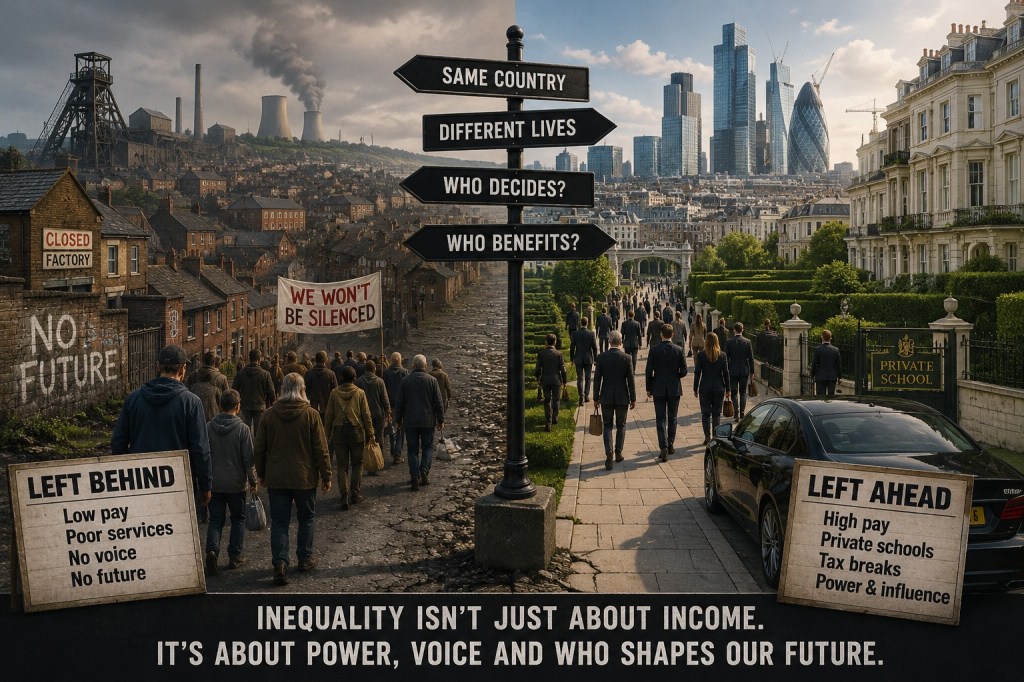
TLDR: The political future depends less on the existence of grievance than on who succeeds in converting it into collective agency, and what kind of ‘we’ they construct?
© 2026 Lance Stephen Goodman. All rights reserved.
Abstract
This paper examines how shared economic, social and ecological pressures acquire political form in contemporary democracies. Its starting proposition is that structural conditions do not generate collective political responses automatically. Grievances must be interpreted, incorporated into collective identities, organised, mobilised and ultimately converted into institutional power. Drawing on Marx’s account of class formation, Polanyi’s analysis of market society, Gramsci’s theory of hegemony, Olson’s analysis of collective action and Scambler’s concept of the fractured society, and integrating these with research on framing, collective identity, political opportunity, organisational resources and collective efficacy, the paper develops a heuristic Collective Agency Conversion Chain:
structural condition → grievance → interpretation → collective identification → organisation → mobilisation → institutional power
The argument does not assume a general decline in collective agency. Evidence instead indicates the weakening of some historically important forms of institutionally embedded collective agency, particularly trade unionism and collective bargaining, alongside a broader recomposition of political cleavages and collective identities (Gethin, Martínez-Toledano and Piketty, 2022; OECD, 2025; Department for Business and Trade, 2026). Radical-right and ethnonationalist movements form one important part of this recomposition. Comparative European evidence suggests that their mobilisation cannot be reduced to economic grievance and depends upon combinations of cultural grievance, political opportunity, media visibility and organisational resources (Castelli Gattinara, Froio and Pirro, 2022).
Perceived collective efficacy is treated as an important conditioning mechanism. People may recognise a grievance and identify with a collectivity while remaining inactive if they doubt that collective action can alter outcomes (van Zomeren, Postmes and Spears, 2008). Recent European evidence linking inequality with lower external political efficacy and political trust provides one possible route from structural inequality towards political fatalism (Bienstman, Hense and Gangl, 2024).
Digital platforms further modify the conversion process by reducing some organisational costs and altering the structure of political communication. Evidence that recommendation systems produce political effects is significant but heterogeneous and platform-specific. These transformations are occurring during measurable deterioration across several Earth-system processes and increasing climate-related risks (IPCC, 2022; Sakschewski et al., 2025).
The paper proposes Collective Agency Conversion Efficiency as a comparative hypothesis concerning the ability of competing political formations to translate grievances into durable institutional power. Three broad outcomes are considered: solidaristic collective agency, exclusionary collective agency and political fatalism. The central empirical question is which conditions determine movement along these different pathways as ecological and socioeconomic pressures intensify.
Introduction
Contemporary democratic societies combine considerable aggregate wealth and scientific capacity with persistent economic inequality, institutional distrust, housing insecurity, pressure upon public services and increasing ecological constraints. Governments retain substantial formal powers to tax, regulate, redistribute, provide services and determine many of the institutional conditions within which markets operate. Possessing those powers does not establish the political conditions under which governments can use them, nor the direction in which they will be used.
That distinction directs attention towards an older sociological problem: how shared social conditions become organised political forces.
Marx identified an early form of this problem. Common economic circumstances could create shared material interests without producing a politically organised class. Political organisation had to be formed through struggle (Marx, 1847/1976). Polanyi (1944/2001) later demonstrated how the extension of market relations could generate pressures for social protection, while offering no guarantee about the political form those responses would take. Olson (1965) showed why the existence of shared interests provides no assurance of collective action. Gramsci (1971) placed political interpretation and the construction of common sense at the centre of struggles for social power.
Contemporary social-movement research gives these processes a more explicit empirical vocabulary. Collective-action frames diagnose problems, attribute responsibility, propose responses and supply reasons for action. Collective identities help explain how people come to understand themselves as participants in common projects. Political opportunities and organisational resources affect whether mobilisation becomes possible and sustainable (Benford and Snow, 2000; Polletta and Jasper, 2001; McAdam, Tarrow and Tilly, 2001).
Social-psychological research adds another mechanism. Van Zomeren, Postmes and Spears’ (2008) meta-analytic synthesis found that perceived injustice, social identity and efficacy each predict collective action. People may share a diagnosis and recognise a common identity while remaining inactive if they believe collective action cannot influence institutions or outcomes.
These literatures suggest that the central problem is one of conversion: how structural conditions become grievances, how grievances acquire shared interpretations, how interpretations contribute to collective identities, and how those identities acquire organisational and institutional force.
This problem has acquired renewed significance because the institutional and electoral structures through which collective interests were organised during much of the twentieth century have changed substantially. Trade-union density and collective-bargaining coverage have declined across many advanced economies (OECD, 2025). Comparative electoral research demonstrates a long-term restructuring of the relationship between education, income and party support (Gethin, Martínez-Toledano and Piketty, 2022). Collective agency has therefore been recomposed as well as weakened in particular institutional forms. Nationalist and radical-right movements show that substantial mobilisation remains possible, while environmental and other social movements provide further evidence against a simple thesis of generalised political atomisation.
Digital platforms have simultaneously altered the communicative environment through which grievances are interpreted and political identities constructed. These developments are occurring while climate change and other Earth-system pressures increasingly require sustained forms of coordination extending across electoral cycles and national boundaries (IPCC, 2022; Sakschewski et al., 2025).
The present paper does not attempt to provide a general account of inequalities organised around race, gender or other ascriptive social divisions. These constitute substantial and developed fields of inquiry in their own right. The analytical scope here is narrower: the institutional, interpretive and organisational mechanisms through which structural pressures are converted into collective political agency. Collective identification is therefore central to the argument, while the paper does not attempt a substantive sociology of particular identity categories.
The paper asks why shared vulnerability may be converted into solidaristic political organisation in some circumstances, exclusionary or authoritarian mobilisation in others, and fatalism or withdrawal elsewhere. The argument is deliberately provisional. Ecological deterioration and the decline of particular forms of organised labour can be measured with relative confidence. The comparative capacity of competing political formations to convert grievances into durable institutional power is harder to establish. That difference in evidential strength is central to the analysis.
Markets, protection and countervailing institutions
Polanyi’s The Great Transformation provides a useful starting point because it challenges the treatment of markets as naturally occurring arrangements that emerge whenever states withdraw. Markets require institutions. Property has to be defined, contracts enforced, currencies maintained and decisions made about which resources, activities and relationships may legitimately be organised through exchange. Market societies are therefore political constructions as well as economic systems (Polanyi, 1944/2001).
Polanyi’s description of labour, land and money as ‘fictitious commodities’ is especially relevant. Labour involves human beings and their capacity to work; land encompasses the natural environment upon which social life depends; money is an institutional creation. Organising these entirely according to market signals has consequences extending beyond individual transactions. Labour markets affect family life, health and community security. Land use affects ecosystems and access to resources. Financial systems affect investment, housing and macroeconomic stability.
Polanyi’s double movement describes the historical tendency for market expansion to generate pressures for social protection. Trade unions, factory legislation, social insurance, public provision and economic regulation represented different institutional responses to the disruptive consequences of marketisation. The post-war European settlement provided an unusually extensive expression of this tendency. Organised labour, collective bargaining, welfare provision, public services, progressive taxation and macroeconomic management constrained important aspects of market power without eliminating markets.
Galbraith’s concept of countervailing power captures one institutional mechanism within this settlement. Concentrated economic power could be checked by other organised centres of power, including trade unions, regulators and governments (Galbraith, 1952). The relevant unit was organisation. Individual workers and consumers generally possessed fewer resources than large corporations. Collective institutions altered the balance.
This matters because political accounts focused upon individual preferences can obscure the institutional distribution of resources. A large corporation enters a policy dispute with capital, legal and technical expertise, established access to government and the capacity to alter investment decisions. An individual employee or consumer normally possesses none of these at comparable scale. Organisation changes the relationship.
From the late 1970s, the institutional balance shifted across many advanced economies through varying combinations of privatisation, financial liberalisation, tax reform, restrictions upon trade-union activity and the extension of market mechanisms into domains previously organised more extensively through public provision or collective regulation. The extent and timing differed markedly between countries. The category ‘neoliberalism’ can conceal that variation if used carelessly. One measurable consequence, however, has been a substantial decline in organised labour.
Across the OECD, average union density fell from approximately 30 per cent in 1985 to 15 per cent in 2023–24. Collective-bargaining coverage fell from 47 per cent to 33.6 per cent. Employer organisation remained considerably more stable, with around 55 per cent of private-sector employees working in firms affiliated to an employer organisation in 2023–24 (OECD, 2025). The asymmetry matters because employers enter bargaining and political processes through organisations that already aggregate resources and interests.
Britain demonstrates the longer trajectory clearly. Trade-union membership reported by unions peaked at 13.2 million in 1979. Labour Force Survey estimates indicate that 6.6 million UK employees were union members in 2025, giving an employee union density of 22.4 per cent. Density had fallen from 32.4 per cent in 1995. The 2025 estimate represented a small increase from 22.0 per cent in 2024, and the official bulletin advises caution in interpreting short-term movements because the Labour Force Survey series is currently classified as official statistics in development (Department for Business and Trade, 2026).
The long-run pattern remains clear, but it should not be represented as an uninterrupted annual decline.
These data establish the weakening of one historically important infrastructure of collective agency. They do not establish a general decline in collective agency itself.
Trade unions historically performed functions extending beyond wage negotiation. Branches, shop stewards, workplace meetings, ballots, political education and industrial disputes created settings in which private experiences could acquire collective interpretations. A dispute about an individual wage could become a question about bargaining power. Redundancy could become a discussion about investment and ownership. Unsafe work could become a collective issue rather than a private misfortune.
The decline of this infrastructure therefore raises a question about what has replaced it. It does not permit the assumption that people have ceased to organise collectively.
From structural position to collective agency
Marx provides an early formulation of the conversion problem. In The Poverty of Philosophy, economic conditions produce a mass of people sharing interests in relation to capital, but political struggle is required before that population constitutes itself as an organised class (Marx, 1847/1976). The later textbook distinction between a ‘class in itself’ and a ‘class for itself’ tidies Marx’s language, but the underlying analytical problem remains valuable.
Shared circumstances do not contain their own political interpretation.
A nurse, warehouse worker, pensioner, self-employed tradesman and delivery driver may all experience high housing costs, deteriorating public services or economic insecurity. They may explain those experiences through entirely different causal accounts. Capitalism, immigration, taxation, globalisation, government incompetence, wealthy elites, environmental regulation and personal failure can all be invoked as explanations for overlapping experiences.
The existence of a shared condition therefore tells us relatively little about the politics that will follow.
Thompson’s historical account of class formation reinforces this point. Class is formed through relationships and historical experience rather than simply assigned through occupational categories or income distributions (Thompson, 1963). Political collectivities are constructed within structural circumstances. They do not simply emerge from them.
For present purposes, collective agency refers to the socially organised capacity of people who recognise some significant common condition or interest to develop shared interpretations of that condition, coordinate resources and action, sustain collective organisation and influence social or political institutions.
The definition is intentionally politically neutral. Trade unions possess collective agency. So can environmental movements, nationalist movements, religious organisations, civil-rights movements and fascist movements. The existence of collective agency tells us nothing by itself about the moral quality of the project being pursued.
This allows a more precise diagnosis of contemporary change. Some forms of collective agency have weakened, particularly those rooted in organised labour and some traditional mass political organisations. Other forms have developed or expanded. The problem concerns recomposition, distribution and political direction.
The Collective Agency Conversion Chain
The processes through which shared conditions acquire political force can be represented heuristically as:
structural condition → grievance → interpretation → collective identification → organisation → mobilisation → institutional power
I refer to this sequence as the Collective Agency Conversion Chain.
Its components are not novel discoveries. The contribution lies in bringing together mechanisms already established across class analysis, collective-action theory, social-movement research and political psychology and using them as a common framework for comparing competing forms of political agency.
Olson (1965) demonstrated why shared interests need not generate collective action. Individuals may benefit from successful collective action regardless of whether they bear the costs of participation, creating familiar free-rider problems. Concentrated interests also possess organisational advantages over large populations receiving diffuse benefits. A small number of firms facing large regulatory costs have a stronger incentive to organise than millions of citizens each receiving a modest dispersed benefit. Corporations also arrive already organised, with budgets, professional staff and institutional memory.
Social-movement research adds processes that a purely material account cannot adequately explain. Benford and Snow (2000) show how collective-action frames identify problems, attribute causes, propose responses and provide motivations for participation. Framing is part of the mechanism through which grievance acquires political meaning.
Polletta and Jasper (2001) identify collective identity as another important component. People mobilise partly through understandings of who ‘we’ are, the boundaries surrounding that category and the relationship between individual identity and collective projects. Collective identity cannot simply be inferred from structurally given interests.
Political-process and contentious-politics approaches further demonstrate that mobilisation depends upon political opportunities, organisational networks and interactions with institutions and opponents (McAdam, Tarrow and Tilly, 2001). Political movements consequently emerge through combinations of grievance, interpretation, identity, resources and opportunity.
The Social Identity Model of Collective Action adds perceived efficacy to this account. Van Zomeren, Postmes and Spears (2008), synthesising 182 effects across three meta-analyses, found that perceived injustice, identity and efficacy each contribute to collective action. Efficacy refers here to the belief that coordinated group action can affect relevant outcomes. It therefore conditions movement through the middle stages of the Conversion Chain.
This does not require another formal stage. Perceived efficacy can affect several transitions simultaneously. It can influence whether grievance is understood as politically actionable, whether collective identification produces commitment, whether organisations recruit successfully and whether mobilisation is sustained.
The Conversion Chain should therefore be treated as recursive and conditional. Organisations generate identities. Political entrepreneurs can construct frames before widespread grievance becomes coherently articulated. Mobilisation can create organisations. Institutional reforms can generate constituencies that later organise to defend them. Successful action can increase perceptions of efficacy, while repeated political failure can reduce them.
The sequence is a heuristic for locating transitions and blockages rather than a deterministic chronology.
This distinction also prevents political visibility from being confused with political capacity. A movement attracting millions of social-media interactions may possess fewer durable organisational resources than a union with a much smaller membership, professional negotiators, legal resources, institutional recognition and the capacity to withdraw labour. Mobilisation, organisation and institutional power therefore require separate measurement.
Political Recomposition
The decline of organised labour might once have supported a relatively straightforward account of declining class politics. Comparative electoral evidence makes the contemporary picture more complicated.
Gethin, Martínez-Toledano and Piketty (2022), examining more than 300 elections across 21 Western democracies between 1948 and 2020, document a substantial long-term transformation in the social composition of left and right electorates. In the 1950s and 1960s, lower-income and lower-educated voters were more strongly associated with social-democratic, socialist and affiliated parties. Over subsequent decades, higher-educated voters increasingly moved towards parties of the left while high-income voters remained more likely to support parties of the right. The authors describe an increasing disconnection between the political effects of income and education and argue that many Western party systems have become more multidimensional. The rise of green and anti-immigration parties contributed to this development, although it explains only part of the longer transformation.
The importance of this finding lies less in the labels ‘Brahmin left’ and ‘merchant right’ than in the evidence that political cleavage cannot now be read straightforwardly from income or occupational position. Gethin, Martínez-Toledano and Piketty explicitly caution that their evidence does not provide a complete causal explanation of the realignment (2022). Their findings establish a long-run empirical pattern rather than a comprehensive theory of why it occurred.
For collective agency, the implication is substantial. The older pathway connecting occupational position, class identification, trade-union organisation and party affiliation has become less reliable. Economic position continues to matter, but it intersects with education, housing tenure, age, geography, cultural values and attitudes towards migration and national identity.
This also weakens any assumption that a coherent political constituency exists waiting to recognise its objective economic interests.
Individuals can possess materially cross-cutting interests. A homeowner may favour rising property values while worrying about their children’s inability to afford housing. A pension holder may benefit from corporate profitability while supporting higher wages. A worker may favour cheaper energy while also supporting decarbonisation. A small-business owner can experience both the autonomy of ownership and considerable economic insecurity.
Political collectivities have to be constructed across these contradictions.
That strengthens the Gramscian component of the argument.
Hegemony and the struggle over interpretation
Gramsci’s concept of hegemony concerns the capacity of particular understandings of social life to become embedded within common sense. Political power depends upon institutions and material resources, but also upon the ability to make particular interpretations appear plausible, normal and legitimate (Gramsci, 1971).
Periods in which established political explanations lose authority create opportunities for competing projects. Gramsci’s concept of an interregnum has frequently been used to describe such periods, although its application to contemporary politics should remain provisional.
An empirical account of an interregnum would require more than widespread dissatisfaction. Relevant indicators might include weakening identification with established parties, declining institutional trust, electoral volatility, the growth of challenger parties, fragmentation of political narratives and the absence of a stable successor settlement.
The important point for the present argument concerns interpretation. Societies can contain widespread agreement that conditions are deteriorating alongside profound disagreement about causes.
Housing shortages can be attributed to inadequate construction, financialisation, planning restrictions, migration, second-home ownership, population distribution or combinations of these. Stagnant wages can be attributed to weak productivity, globalisation, employer power, migration, taxation, automation or trade-union decline. Deteriorating public services can be attributed to inadequate funding, poor productivity, privatisation, demographic change, migration, managerial inefficiency or excessive demand.
These explanations have different empirical merits. Politically, they also construct different collectivities.
The causal story helps determine the ‘we’, the adversary and the plausible response.
Fracture, efficacy and fatalism
Scambler’s concept of the fractured society adds an outcome easily overlooked when political analysis concentrates upon mobilisation. Economic insecurity, inequality and cultural disorientation may produce forms of disconnected fatalism characterised by abandonment, bitterness, impotence and alienation (Scambler, 2018).
The concept becomes more empirically tractable when connected to research on political efficacy.
Political efficacy is conventionally divided into internal efficacy, concerning an individual’s sense of competence in understanding and participating in politics, and external efficacy, concerning the perceived responsiveness of political institutions to citizens. Low external efficacy therefore captures a proposition central to political fatalism: the belief that institutions are unlikely to respond regardless of what ordinary citizens do.
Bienstman, Hense and Gangl (2024), using time-series cross-sectional data from the European Social Survey, examine whether inequality contributes to political distrust through its effects on external efficacy. They find that increases in income inequality are associated with declines in external political efficacy and political trust, while mediation analysis suggests that lower efficacy accounts for part of the relationship between inequality and distrust.
The finding does not establish that inequality mechanically produces political withdrawal. It identifies a plausible pathway. Structural inequality may alter citizens’ perceptions of institutional responsiveness, which can in turn affect trust and the perceived utility of political participation.
Fatalism matters because grievance does not necessarily proceed towards organisation. People can conclude that collective political action is futile. Under those conditions, adaptation becomes increasingly private. Individuals attempt to protect their own income, property, pension, family and immediate security. Political anger can remain intense while confidence in collective solutions declines.
This suggests a possible feedback process:
inequality or insecurity → reduced external efficacy → distrust → weaker collective participation → inadequate institutional response → further distrust
The sequence remains a hypothesis. Its components require independent measurement and causal direction may run both ways.
It nevertheless sharpens the third destination for grievance alongside competing solidaristic and exclusionary projects.
Shared vulnerability may contribute to solidaristic agency where common interpretations, identification and collective efficacy develop.
It may contribute to exclusionary agency where a bounded political ‘we’ is constructed alongside a credible narrative of restoration or control.
It may contribute to fatalism where grievances are recognised but collective efficacy remains low.
Economic resources and political power
Economic inequality matters to this argument principally through the resources and opportunities it distributes.
Bourdieu’s distinction between economic, cultural, social and symbolic capital provides one account of how advantages acquired in one domain can be converted into advantages elsewhere (Bourdieu, 1986). Economic resources can purchase education, professional expertise, security and access to networks. Cultural resources affect navigation through institutions. Social connections provide access. Symbolic resources affect credibility and legitimacy.
Lindblom (1977) adds the structural position of business. Governments operating within predominantly private economies depend upon investment for employment, production and taxation. Policy-makers therefore have incentives to anticipate the responses of investors even in the absence of explicit lobbying.
This produces two distinguishable forms of business power. Instrumental power operates through lobbying, political finance, policy networks and access. Structural power operates through the anticipated economic consequences of investment decisions.
Neither should simply be assumed.
Gilens and Page’s (2014) analysis of 1,779 US policy issues found substantial independent associations between the preferences of economic elites and organised business interests and policy outcomes, while average citizens showed little or no independent influence once preferences were considered simultaneously. The study concerns the United States, operates within distinctive American institutions and has generated methodological debate. It cannot establish an equivalent distribution of influence in Britain or elsewhere.
Its relevance here is methodological. Claims about the conversion of economic resources into political influence can be tested.
Lukes’s three-dimensional conception of power provides a useful clarification of where such influence can operate (Lukes, 1974/2005). Power may be visible in observable decisions. It may operate through control over agendas, determining which questions become politically actionable. It may also operate earlier, through processes affecting preferences, assumptions and perceptions of what is possible.
These dimensions correspond to mechanisms already present in the argument. Gilens and Page concern observable policy influence. Lindblom’s structural power partly concerns agenda formation and anticipated constraints. Gramscian hegemony concerns the interpretive environment within which interests and possibilities are understood.
The third dimension raises difficult questions about the identification of ‘real interests’, and those questions are not resolved here. Lukes is therefore used as a typology of locations at which power can operate rather than as a claim that an analyst can determine people’s interests independently of their expressed preferences.
This distinction matters for the Conversion Chain. Power does not enter only at its final stage. It can affect which structural conditions become recognised as grievances, which explanations receive public visibility, which collective identities appear legitimate and which political alternatives enter institutional debate.
Ecological constraint
The ecological side of the analysis rests upon a comparatively strong empirical foundation.
The planetary-boundaries framework identifies Earth-system processes associated with maintaining relatively stable conditions for human societies. The 2025 Planetary Health Check assessed seven of nine planetary boundaries as transgressed, with ocean acidification becoming the seventh boundary assessed as outside the proposed safe operating space (Sakschewski et al., 2025).
These boundaries should not be described as seven irreversible tipping points. They represent risk thresholds and increasing departure from a proposed safe operating space. The framework itself involves scientific judgements about control variables and boundary placement and should not be treated as a literal countdown to societal collapse.
The IPCC provides a separate and much broader evidence base. Human-induced climate change has already caused widespread adverse impacts and related losses and damages to nature and people. Vulnerability differs substantially within and between regions, and some human and natural systems have already encountered adaptation limits (IPCC, 2022).
The political significance arises because ecological pressures are socially mediated.
Heat, flooding, crop losses, water scarcity, insurance costs, energy prices and migration affect populations differently according to income, housing, infrastructure, welfare provision and state capacity. Ecological pressures therefore enter existing distributions of resources and political conflict.
A plausible mechanism is:
ecological pressure → distributional consequences → grievance → competing interpretations → mobilisation or fatalism
No political outcome follows inevitably from ecological pressure. A food-price shock can encourage demands for redistribution or hostility towards outsiders. Climate-related migration can generate international cooperation or border fortification. Energy insecurity can produce accelerated investment in renewables or demands to slow decarbonisation.
The ecological crisis intensifies the conversion problem without solving it.
Radical-right collective agency
The rise of radical-right and ethnonationalist politics provides a strong reason for rejecting a simple thesis of declining collective agency. These movements demonstrate substantial capacities for political identification and mobilisation.
The empirical literature also cautions against explaining their growth primarily through economic insecurity.
Castelli Gattinara, Froio and Pirro (2022) analysed 4,845 far-right protest events across 11 East and West European countries between 2008 and 2018. Their findings show that classical social-movement explanations can be fruitfully applied to far-right mobilisation. Cultural grievances, particularly concerns surrounding immigration, political opportunities and organisational resources all matter. Media visibility, networks among nativist organisations and access to elected representatives contribute to mobilisation.
The study is particularly useful here because it treats the far right as a mobilisation problem rather than assuming that political support follows mechanically from immigration levels or economic deterioration.
This changes the causal story.
Economic insecurity may contribute to the context within which mobilisation occurs, but grievance is multidimensional. Cultural change, immigration, political distrust, national identity and perceived status loss can enter the conversion process alongside material insecurity.
Radical-right movements may be effective at connecting these grievances through accessible narratives.
National decline provides a diagnosis.
Elite betrayal attributes responsibility.
National identity constructs the collective subject.
Outgroups or institutions can provide adversaries.
Political restoration supplies a programme.
The empirical accuracy of each component requires separate investigation. The sociological mechanism concerns the capacity of the narrative to organise experiences that might otherwise remain disconnected.
National identity has a particular advantage as a basis of collective identification because it can cross economic positions. A pensioner, warehouse worker, small-business owner and professional may possess conflicting material interests while all recognising themselves as British. Political narratives that transform this broad identity into a threatened political community can therefore construct solidarities that do not depend upon shared class position.
This does not make nationalism intrinsically authoritarian or exclusionary. Civic nationalisms can construct relatively inclusive political communities. The analytical issue concerns how the boundaries of the collective ‘we’ are defined, which adversaries are identified and what political consequences follow.
The digital public sphere
Political conversion increasingly occurs within a communications environment very different from that inhabited by Marx, Polanyi or Gramsci.
Habermas’s concept of the public sphere provides a useful institutional starting point. Democratic political life requires communicative spaces through which social experiences become matters of public discussion and through which opinion can influence political institutions (Habermas, 1989).
Digital platforms have greatly expanded opportunities for participation in those processes. They reduce the cost of publication, allow movements to communicate directly with supporters and enable geographically dispersed individuals to discover one another rapidly. They are also predominantly privately governed infrastructures whose ranking and recommendation systems determine a substantial part of what users encounter.
This alters parts of the Conversion Chain.
A conventional pathway might require grievance to become interpretation and identity before organisations coordinate mobilisation. Digital networks can permit more immediate movement from interpretation and identity towards networked mobilisation. Formal organisation can sometimes be bypassed, at least temporarily.
The empirical evidence concerning political effects requires caution.
Huszár et al. (2022), analysing Twitter’s algorithmic amplification across several countries, found greater amplification of mainstream political-right content than political-left content in six of seven countries studied. They did not find evidence that extreme political groups received greater amplification than moderates.
More recent experimental evidence from X provides stronger causal evidence. Gauthier et al. (2026) randomly assigned US X users to algorithmic or chronological feeds over seven weeks. Algorithmic exposure increased engagement and exposure to conservative content and shifted some political attitudes in a conservative direction. Effects were not found across all political outcomes.
Those findings should not be generalised into a universal theory of social-media effects.
Guess et al. (2023), in a large experiment during the 2020 US election, found that replacing Facebook and Instagram algorithmic feeds with reverse-chronological feeds substantially altered users’ behaviour and information exposure but did not significantly change issue polarisation, affective polarisation, political knowledge or other key attitudes during the study period. A related deactivation experiment likewise found several political-attitude and turnout effects close to zero (Allcott et al., 2024).
A recent integrative review of 52 peer-reviewed studies of political communication on Twitter/X reinforces this conditional interpretation. Naranjo-Vinueza et al. (2025) identify interactions among actor strategy, audience behaviour, platform architecture, algorithmic mediation, trust and legitimacy. Their review is limited to Twitter/X and studies published through 2024, so it cannot provide a general theory of platform effects. Its relevance here lies in supporting a relational and platform-specific account of political communication.
The defensible conclusion is narrow. Some recommendation systems can produce politically asymmetric amplification and measurable political effects. The magnitude and direction of those effects vary across platforms, users and political contexts. Claims that ‘the algorithm’ generally radicalises users exceed the available evidence.
This creates an unusual methodological problem.
Social media is simultaneously part of the causal environment and one of the places through which observers attempt to judge political strength.
A feed is not a representative sample.
Highly motivated minorities can generate disproportionate quantities of material. Engagement-based systems can increase the visibility of contentious content. Repetition can create perceptions of prevalence whose relationship with population-level opinion is uncertain.
Yet amplification can also alter political reality.
A plausible sequence is:
existing support → disproportionate visibility → perceived prevalence → normalisation → agenda-setting → increased support
Social media can therefore make a movement appear larger than it is while helping it become larger than it was.
This is one reason why claims that the radical right is ‘winning’ cannot be established from online visibility.
From mobilisation to institutional power
The final stages of the Conversion Chain are easily neglected.
Mobilisation does not guarantee institutional power.
Digital communication can generate rapid identification and episodic mobilisation while producing organisations with little durability, expertise or governing capacity. Institutional influence requires leadership, finance, candidates, professional expertise, organisational memory, coalition-building and the ability to operate within or transform existing institutions.
This distinction applies equally to progressive movements. Large demonstrations may have limited policy effects. Smaller organisations with institutional access may produce significant regulatory or legislative change.
Collective bargaining illustrates the importance of institutionalisation. OECD evidence shows that countries with widespread sectoral or multi-employer agreements can retain high bargaining coverage even where union membership itself is comparatively modest (OECD, 2025).
England’s developing fair-pay agreement for adult social care provides a contemporary example. The Employment Rights Act 2025 created powers for a sector-wide collective-bargaining framework. The government’s July 2026 response states that the Adult Social Care Negotiating Body will be established during 2026–27, negotiations for the 2028–29 financial year are expected to begin around April 2027, and the first agreement is intended to take effect in April 2028 (Department of Health and Social Care, 2026).
The example complicates any linear account in which widespread political consciousness must precede institutional change. Institutions can create experiences of collective determination, and those experiences may subsequently strengthen collective identification, efficacy and organisation.
This is where Erik Olin Wright’s analysis adds an important final component. Wright distinguishes among ruptural, interstitial and symbiotic strategies of social transformation and examines how institutional arrangements can increase the capacity of social actors to exercise power over economic and political conditions (Wright, 2010). For the present argument, the important point concerns institutional reproduction rather than the wider socialist project within which Wright develops it.
Successful collective agency can create institutions that alter the conditions of subsequent collective action.
A cooperative, union recognition agreement, sectoral bargaining institution, community organisation or participatory political structure may produce an immediate outcome while also creating organisational resources, expectations, relationships and experience. Institutions can therefore store and reproduce collective capacity.
Wright’s concept of positive class compromise is also relevant. Under some conditions, strong organised labour may produce arrangements that improve workers’ position while solving coordination or productivity problems for employers (Wright, 2000). Countervailing power need not operate exclusively through zero-sum confrontation.
This extends the recursive character of the Conversion Chain. Institutional power is an outcome, but it can also become an input into subsequent rounds of collective agency.
The chain therefore ends analytically at institutional power without implying that the social process itself ends there.
Collective Agency Conversion Efficiency
The central comparative hypothesis can now be stated more precisely.
Collective Agency Conversion Efficiency refers to the comparative capacity of political formations to translate grievances into shared interpretations, collective identities, organisation, mobilisation and durable institutional power.
The concept is proposed as a research heuristic rather than an established measure.
Its components should not initially be collapsed into a single index.
Possible indicators include organisational membership, activist networks, financial resources, electoral support, media reach, offline mobilisation, organisational persistence, coalition formation, agenda-setting influence, effects upon established parties, institutional representation and demonstrable policy outcomes.
Perceived collective efficacy is related to, but distinct from, Conversion Efficiency. The former concerns actors’ beliefs about whether collective action can succeed. The latter concerns the observable capacity of a political formation to convert grievance into political power. The two may interact. A movement that repeatedly demonstrates effectiveness may increase perceived efficacy among potential supporters; repeated failure may reduce it.
Different movements may perform very differently across the dimensions of conversion.
A digital movement may possess enormous reach and weak organisation.
A union may possess modest public visibility and considerable institutional leverage.
A radical-right party may exercise agenda-setting power while remaining outside government.
An environmental organisation may exert regulatory influence without mass electoral support.
Conversion efficiency therefore concerns movement through the chain rather than success at any single stage.
The contemporary radical-right hypothesis can then be stated in a form capable of empirical failure.
Radical-right and ethnonationalist movements may currently possess relatively high conversion efficiency because they combine salient grievances, accessible causal narratives, broad identity categories, identifiable adversaries, organisational networks and sophisticated digital communications.
Evidence against the hypothesis would include persistent failure to translate visibility into organisation, declining electoral support, weak organisational durability, little agenda-setting effect, limited institutional penetration or superior conversion by competing political movements.
Cross-national comparison is essential. A hypothesis derived largely from Britain or the United States cannot automatically describe Sweden, Germany, Spain or the Netherlands.
The proposition should remain precisely what it is: a testable claim about comparative political capacity.
Three possible conversions
The resulting model identifies three broad political trajectories under conditions of structural pressure.
The first is solidaristic collective agency.
Shared vulnerability is interpreted through accounts emphasising common interests, accompanied by sufficient collective efficacy to sustain participation, and generates organisation directed towards cooperation, redistribution, universal provision or collective regulation.
The second is exclusionary collective agency.
Shared vulnerability is interpreted through narratives defining a threatened political community and attributing significant responsibility to outsiders, minorities or allegedly illegitimate internal groups. Mobilisation becomes more likely where actors combine this collective identity with a credible belief that political action can restore control, status or security.
The third is fatalism.
Grievance fails to become durable collective organisation. Individuals retain anger or dissatisfaction while losing confidence in the possibility that collective action will produce meaningful change.
These categories are analytical simplifications. Real movements can combine solidaristic and exclusionary elements, while individuals can move between mobilisation and withdrawal. They nevertheless provide a clearer dependent variable than a general claim about the rise or decline of collective agency.
The empirical question becomes:
Under what conditions does structural pressure convert predominantly into solidarity, exclusion or fatalism?
That question connects the literatures considered throughout the paper.
Marx directs attention to the transformation of shared circumstances into collective political identity.
Polanyi explains why market disruption can generate pressures for protection.
Olson identifies organisational obstacles.
Social-movement theory explains framing, identity, resources and opportunities.
Social-psychological research identifies perceived injustice, collective identity and efficacy as predictors of collective action.
Gramsci directs attention to competition over political meaning.
Lukes clarifies the different levels at which power can shape decisions, agendas and the interpretive environment.
Scambler identifies the possibility that fracture terminates in fatalism.
Wright shows how successful collective action can become institutionalised in ways that reproduce or expand future collective capacity.
The contribution of the Conversion Chain lies in placing these mechanisms within a common comparative problem.
What would falsify the argument?
The argument should be vulnerable to evidence.
First, if the decline of traditional labour institutions were consistently accompanied by equivalent or stronger forms of durable democratic organisation capable of exercising comparable institutional power, the claim that an important conversion infrastructure has been lost would weaken. The argument would then need to describe institutional substitution rather than loss.
Second, if changes in grievance, political opportunity, organisational resources, framing, collective identification and perceived efficacy showed little relationship with mobilisation or institutional outcomes, the Conversion Chain would have limited explanatory value.
Third, if collective identities proved largely epiphenomenal once individual material interests and institutional opportunities were controlled, the emphasis placed upon interpretation and identity would require revision.
Fourth, if external political efficacy showed little relationship with participation, mobilisation or political trust, the proposed connection between fracture, efficacy and fatalism would weaken.
Fifth, if radical-right movements consistently demonstrated high online visibility but weak electoral performance, poor organisational persistence, little agenda-setting influence and minimal policy effect, the hypothesis of comparatively high radical-right conversion efficiency would fail.
Sixth, if platform recommendation systems showed no systematic effects upon political exposure, attitudes, mobilisation or network formation across well-designed experimental and observational studies, the role assigned to digital mediation would have to be reduced. Existing evidence already cautions against universal claims because effects vary substantially between platforms.
Seventh, the ecological component should remain analytically separate from claims about political response. Evidence that societies experiencing substantial ecological stresses consistently develop stronger cooperative institutions would weaken any expectation that ecological pressure favours exclusionary politics. Conversely, systematic movement towards authoritarian or exclusionary politics following ecological shocks would strengthen that mechanism.
Finally, if institutionalised forms of collective action did not increase subsequent organisational capacity, efficacy or political leverage, the recursive role assigned to institutions would require qualification.
The argument therefore does not require the radical right to win.
It predicts political competition over the conversion of structural pressure.
The outcome remains open.
Conclusion
The starting point of this paper was a problem of political capacity. Contemporary democracies possess extensive formal powers and substantial aggregate resources while confronting persistent inequalities, institutional distrust and ecological pressures requiring sustained collective responses. Explaining this condition requires an account of how social conditions become political forces.
The evidence does not support a simple claim that collective agency has disappeared. Trade-union density and collective-bargaining coverage have declined substantially across many advanced economies, weakening one historically important infrastructure through which economic experiences were interpreted and organised collectively (OECD, 2025; Department for Business and Trade, 2026). At the same time, other forms of mobilisation have expanded. Comparative electoral research demonstrates substantial changes in the social bases of political competition, while radical-right, environmental and other contemporary movements demonstrate that modern societies remain capable of generating collective political identities (Gethin, Martínez-Toledano and Piketty, 2022).
The more useful concept is recomposition.
Structural conditions create possibilities and constraints. Their political meaning has to be produced.
Marx’s problem of class formation remains relevant because common circumstances do not automatically generate collective political subjects. Polanyi demonstrates that disruption can generate pressures for protection. Olson explains why common interests encounter organisational barriers. Social-movement theory identifies framing, identity, political opportunity and organisational resources as mechanisms through which mobilisation occurs. Van Zomeren, Postmes and Spears add collective efficacy, showing that perceived injustice and shared identity are more likely to generate collective action when participants believe coordinated action can make a difference. Gramsci explains why the interpretation of social experience is itself an arena of political struggle. Scambler identifies the possibility that insecurity and fragmentation terminate in disconnected fatalism.
The Collective Agency Conversion Chain brings these mechanisms together:
structural condition → grievance → interpretation → collective identification → organisation → mobilisation → institutional power
Its purpose is heuristic. Each transition can be investigated empirically, and movement through the chain can stop, reverse or be accelerated by existing institutions. Collective efficacy operates across several of these transitions rather than constituting a separate stage. Success can increase efficacy; repeated failure and perceived institutional unresponsiveness can reduce it.
Recent evidence on inequality and political efficacy strengthens this part of the argument. Bienstman, Hense and Gangl (2024) find that increases in income inequality are associated with lower external political efficacy and lower political trust across European democracies, with reduced efficacy mediating part of the relationship between inequality and distrust. This provides one empirically testable pathway through which structural conditions may contribute to political fatalism without assuming that inequality directly causes withdrawal or authoritarian politics.
The contemporary radical right provides an important test case because its mobilisation demonstrates the inadequacy of assuming that weakening traditional class organisations necessarily produces political passivity. European evidence indicates that far-right mobilisation draws upon combinations of grievances, opportunities and organisational resources rather than any single material cause (Castelli Gattinara, Froio and Pirro, 2022).
Digital platforms alter this environment further. They reduce some costs of communication and mobilisation while placing substantial parts of political communication within privately governed algorithmic infrastructures. Experimental evidence demonstrates that some recommendation systems can asymmetrically amplify political content and influence attitudes, while other large experiments report little change in important political attitudes after substantial changes to feed ordering or platform access (Guess et al., 2023; Allcott et al., 2024; Gauthier et al., 2026). Recent review evidence reinforces the conclusion that political effects emerge through interactions among platform architecture, actor strategy, audience behaviour and political context rather than through a uniform platform effect (Naranjo-Vinueza et al., 2025).
Reaching institutional power also does not terminate the process. Wright’s analysis of social empowerment makes clear that institutions created through collective action can themselves become resources for subsequent collective agency (Wright, 2010). Sectoral bargaining illustrates the mechanism. An institutional settlement can change immediate outcomes while also creating representation, organisational resources, expectations and experience. Institutional power can therefore become an input into the next cycle of collective action.
The resulting political competition is taking place under ecological conditions that can be measured more confidently. Climate change is already producing widespread adverse effects, and seven of nine planetary boundaries were assessed as transgressed in 2025 (IPCC, 2022; Sakschewski et al., 2025). These pressures do not contain a predetermined politics. Their social consequences are distributed through existing inequalities and institutions and interpreted through competing political narratives.
This produces three broad possibilities.
Shared vulnerability can be converted into solidaristic collective agency.
It can be converted into exclusionary collective agency.
It can dissipate into fatalism.
Which pathway dominates depends upon interpretation, identity, organisation, opportunity, perceived efficacy and institutional capacity.
Collective Agency Conversion Efficiency turns this into a comparative empirical question. Political formations can be examined according to their ability to move from grievance through interpretation and mobilisation towards durable institutional influence. Claims that the radical right currently possesses an advantage can then be tested against electoral support, organisational durability, agenda-setting, institutional penetration and policy outcomes rather than inferred from the apparent prevalence of political content online.
The ecological dimension gives the problem urgency without determining its outcome. Increasing environmental pressures will create additional demands for coordination, adaptation and distributional decisions. Those demands enter political systems in which older class alignments have weakened, new cleavages have developed and communications infrastructures have changed profoundly.
Collective agency remains abundant. The unresolved question concerns its conversion.
The political struggle ahead will concern who succeeds in explaining shared vulnerability, who is included within the resulting ‘we’, whether people believe collective action can make a difference, what institutions that collectivity constructs, and whether those institutions reproduce the capacity to act.
The race for collective agency is already underway.
References
Allcott, H., Gentzkow, M., Mason, W. et al. (2024) ‘The effects of Facebook and Instagram on the 2020 election: a deactivation experiment’, Proceedings of the National Academy of Sciences, 121(21), e2321584121. doi:10.1073/pnas.2321584121.
Benford, R.D. and Snow, D.A. (2000) ‘Framing processes and social movements: an overview and assessment’, Annual Review of Sociology, 26, pp. 611–639. doi:10.1146/annurev.soc.26.1.611.
Bienstman, S., Hense, S. and Gangl, M. (2024) ‘Explaining the “democratic malaise” in unequal societies: inequality, external efficacy and political trust’, European Journal of Political Research, 63(1), pp. 172–191. doi:10.1111/1475-6765.12611.
Bourdieu, P. (1986) ‘The forms of capital’, in Richardson, J.G. (ed.) Handbook of Theory and Research for the Sociology of Education. New York: Greenwood Press, pp. 241–258.
Castelli Gattinara, P., Froio, C. and Pirro, A.L.P. (2022) ‘Far-right protest mobilisation in Europe: grievances, opportunities and resources’, European Journal of Political Research, 61(4), pp. 1019–1041. doi:10.1111/1475-6765.12484.
Department for Business and Trade (2026) Trade Union Membership, UK, 1995 to 2025: Statistical Bulletin. London: Department for Business and Trade.
Department of Health and Social Care (2026) Fair Pay Agreement Process in Adult Social Care: Government Response. London: Department of Health and Social Care.
Galbraith, J.K. (1952) American Capitalism: The Concept of Countervailing Power. Boston, MA: Houghton Mifflin.
Gauthier, G., Hodler, R., Widmer, P. and Zhuravskaya, E. (2026) ‘The political effects of X’s feed algorithm’, Nature, 652, pp. 416–423. doi:10.1038/s41586-026-10098-2.
Gethin, A., Martínez-Toledano, C. and Piketty, T. (2022) ‘Brahmin left versus merchant right: changing political cleavages in 21 Western democracies, 1948–2020’, Quarterly Journal of Economics, 137(1), pp. 1–48. doi:10.1093/qje/qjab036.
Gilens, M. and Page, B.I. (2014) ‘Testing theories of American politics: elites, interest groups, and average citizens’, Perspectives on Politics, 12(3), pp. 564–581. doi:10.1017/S1537592714001595.
Gramsci, A. (1971) Selections from the Prison Notebooks of Antonio Gramsci. Edited and translated by Q. Hoare and G.N. Smith. London: Lawrence & Wishart.
Guess, A.M., Malhotra, N., Pan, J. et al. (2023) ‘How do social media feed algorithms affect attitudes and behavior in an election campaign?’, Science, 381(6656), pp. 398–404. doi:10.1126/science.abp9364.
Habermas, J. (1989) The Structural Transformation of the Public Sphere: An Inquiry into a Category of Bourgeois Society. Cambridge: Polity Press.
Huszár, F., Ktena, S.I., O’Brien, C., Belli, L., Schlaikjer, A. and Hardt, M. (2022) ‘Algorithmic amplification of politics on Twitter’, Proceedings of the National Academy of Sciences, 119(1), e2025334119. doi:10.1073/pnas.2025334119.
IPCC (2022) Climate Change 2022: Impacts, Adaptation and Vulnerability. Contribution of Working Group II to the Sixth Assessment Report of the Intergovernmental Panel on Climate Change. Edited by H.-O. Pörtner et al. Cambridge: Cambridge University Press. doi:10.1017/9781009325844.
Lindblom, C.E. (1977) Politics and Markets: The World’s Political-Economic Systems. New York: Basic Books.
Lukes, S. (1974/2005) Power: A Radical View. 2nd edn. Basingstoke: Palgrave Macmillan.
Marx, K. (1847/1976) The Poverty of Philosophy. Moscow: Progress Publishers.
McAdam, D., Tarrow, S. and Tilly, C. (2001) Dynamics of Contention. Cambridge: Cambridge University Press.
Naranjo-Vinueza, A., Casillas-Martín, S., Cabezas-González, M. and Nevado-Batalla Moreno, P.T. (2025) ‘From tweets to power: an integrative thematic review of political communication and platform governance on Twitter/X (2009–2024)’, Frontiers in Political Science, 7, 1666104. doi:10.3389/fpos.2025.1666104.
OECD (2025) Membership of Unions and Employers’ Organisations, and Bargaining Coverage: Standing, but Losing Ground. Paris: OECD Publishing. doi:10.1787/fe47107c-en.
Olson, M. (1965) The Logic of Collective Action: Public Goods and the Theory of Groups. Cambridge, MA: Harvard University Press.
Polanyi, K. (1944/2001) The Great Transformation: The Political and Economic Origins of Our Time. Boston, MA: Beacon Press.
Polletta, F. and Jasper, J.M. (2001) ‘Collective identity and social movements’, Annual Review of Sociology, 27, pp. 283–305. doi:10.1146/annurev.soc.27.1.283.
Sakschewski, B., Caesar, L. et al. (2025) Planetary Health Check 2025: A Scientific Assessment of the State of the Planet. Potsdam: Potsdam Institute for Climate Impact Research/Planetary Boundaries Science. doi:10.48485/PIK.2025.017.
Scambler, G. (2018) Sociology, Health and the Fractured Society: A Critical Realist Account. London: Routledge.
Thompson, E.P. (1963) The Making of the English Working Class. London: Victor Gollancz.
van Zomeren, M., Postmes, T. and Spears, R. (2008) ‘Toward an integrative social identity model of collective action: a quantitative research synthesis of three socio-psychological perspectives’, Psychological Bulletin, 134(4), pp. 504–535. doi:10.1037/0033-2909.134.4.504.
Wright, E.O. (2000) ‘Working-class power, capitalist-class interests, and class compromise’, American Journal of Sociology, 105(4), pp. 957–1002.
Wright, E.O. (2010) Envisioning Real Utopias. London: Verso.
Post Script
A few points about the finished version are worth recording. The original paper defined collective agency broadly and explicitly treated it as politically neutral; that remains intact here. Likewise, the Conversion Chain remains explicitly heuristic and recursive rather than being presented as a newly discovered causal law.
The empirical spine is now considerably stronger. OECD reports the long-run fall from roughly 30% to 15% in union density and 47% to 33.6% in bargaining coverage, while also providing the important counterexample that sectoral bargaining can preserve high coverage with relatively low union membership. The 2025 UK statistics confirm 6.6 million employee members, 22.4% density and the warning about the Labour Force Survey data. Gethin, Martínez-Toledano and Piketty provide the 21-country, 300-plus-election evidence for political recomposition. Castelli Gattinara, Froio and Pirro provide the particularly important independent evidence that far-right mobilisation depends upon grievances, opportunities and organisational resources rather than grievance alone.
The two final additions have also earned their place rather than merely adding names. SIMCA supplies meta-analytic evidence for injustice, identity and efficacy as mechanisms in collective action. Bienstman, Hense and Gangl provide the bridge from structural inequality through external efficacy towards political trust. Wright then closes the downstream gap by asking what happens once collective agency becomes institutionalised; Envisioning Real Utopias is explicitly concerned with institutional forms capable of expanding social power. Lukes has deliberately been restricted to a short clarification of where power operates rather than allowed to become another theoretical excursion. His 2005 second edition also revisits the debates and criticisms surrounding the original three-dimensional account.
Note on method and the use of generative AI
This paper was developed through an iterative process of conceptual analysis, literature testing and critical revision assisted by generative AI. The originating research problem, theoretical orientation and principal analytical framework were developed by the author, including the concept of Collective Agency, the Collective Agency Conversion Chain and the attempt to connect changing forms of countervailing power with political mobilisation under ecological constraint. Generative AI was subsequently used as a research and critical-writing tool: to identify potentially relevant literatures, test propositions against competing explanations, locate empirical evidence, expose conceptual weaknesses, check whether apparently original arguments duplicated established work, and assist with drafting and restructuring. Candidate arguments were repeatedly challenged by asking what evidence would contradict them and whether alternative explanations better fitted the available evidence. This process led to substantive revisions, including replacing an initial implication of declining collective agency with the more defensible concept of its political recomposition, qualifying claims about socioeconomic insecurity and radical-right mobilisation, incorporating collective efficacy, distinguishing online visibility from institutional power, and treating claims about algorithmic political effects as platform-specific rather than general. Sources and empirical claims were checked against the published literature rather than treating AI output as evidence. Generative AI therefore contributed materially to the research process and presentation of the argument, but responsibility for the conceptual choices, interpretation of evidence, exclusions, judgements and final argument remains with the author.
I do not claim that AI merely polished my prose. It has contributed significantly: it found literature, challenged propositions, helped us discover that parts of the Conversion Chain already existed separately across several literatures, identified efficacy (something I have used elsewhere) as a missing mechanism, and helped reformulate the argument. Saying so strengthens rather than weakens the methodological defence.
The crucial distinction is between AI-generated authority and AI-assisted inquiry. Nothing should be accepted because the model says it. The model has been used much more like an unusually fast research interlocutor: propose, search, challenge, compare, revise, falsify, verify. The evidential authority remains the underlying research.
And there is a further point worth making if somebody simply calls the result “AI slop”: the intellectual provenance of the paper is unusually recoverable. We can identify which ideas originated in my initial argument, which came from Marx, Polanyi, Gramsci, Olson, Scambler and others, which empirical findings forced revisions, and which concepts emerged from the iterative synthesis. “AI slop” is a criticism of intellectual quality, provenance and reliability, not a serious methodological category. The appropriate test is whether the argument is coherent, its concepts are useful, its sources are genuine and accurately represented, its inferences follow from the evidence, and its claims remain vulnerable to refutation.
On those criteria, the paper should stand or fall as scholarship, not according to whether a language model participated in producing it.
Copyright:
This work, including its original conceptual framework, argument and the Collective Agency Conversion Chain, is the intellectual work of the author. Generative AI was used during the research and writing process as an assistive tool for literature discovery, critical interrogation, source checking, structural revision and drafting. Responsibility for the selection and development of concepts, interpretation of evidence, substantive argument and final text remains with the author.
No part of this work may be reproduced, distributed or published without appropriate attribution and, where required by law, the permission of the copyright holder.


Bravo Zulu dear boy!
I do enjoy a sprinkling of Gramsci! It’s been a while since I’ve read academic papers like this so I needed a break half way through for a cuppa tea and let my brain cool down. Read in conjunction with your blog posting helped… Very good- although I couldn’t help but notice that your proposed “Collective Agency Conversion Chain” can be shortened to “CACC”, (pronounced “cack”)- puerile and childish I know, but still made me chuckle.
We must catch up over a video call again soon, via FaceTime/what’s app or whichever platform we’ve done in the past?
Up yours!
Cheers,
Roger
0212781537
LikeLike